
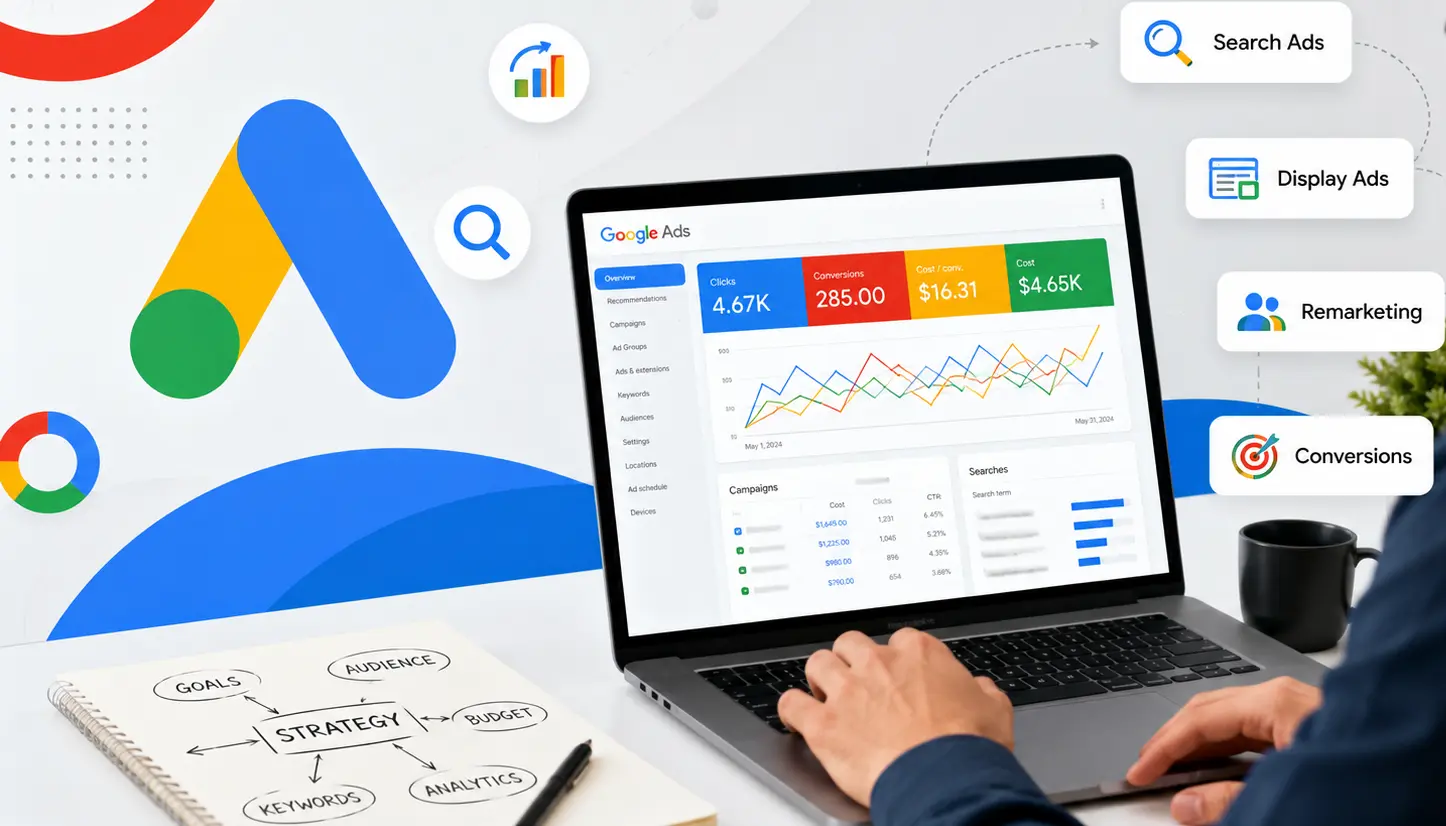
Somewhere in Dubai, an entrepreneur is looking at his Google Ads dashboard, observing the drain of his budget and asking what is wrong in his performance marketing Google strategy. There are clicks, there are spends, but no leads, no calls, and a lot of anxiety.
This is not some rare case. On the contrary, this is the most common situation that happens with advertisers in the UAE using Google Ads, and it has pretty much nothing to do with the platform itself. This problem stems from the lack of proper Google marketing strategy, and here is how to understand and fix it.
Why Your Budget Is Disappearing Before It Has a Chance to Work
The structure of the vast majority of the Google Ads accounts in the UAE is pretty much the same. One campaign, several ad groups, broad match keywords for everything, and all of the traffic directed towards the home page
It may seem logical when creating the account; but in reality, this is the same as having a shop, leaving its door open, and being surprised why the clients do not buy anything. Not everyone coming to the shop wants to make a purchase. Some are just researching, while others may be your competitors; some searched for something that looks like your keyword in Google but has nothing to do with your service.
According to Google, more than 40% of accounts operating on the broad match mode without negative keywords have a significant portion of their budget being spent on irrelevant searches, somewhere between 40 and 70 percent. In the UAE, where the CPC in some of the sectors (real estate, legal services, and healthcare) is around AED 30 and AED 100, such a waste of budget is not some small issue. In many cases, it means the campaign loses money, even if it manages to get enough conversions.
The solution to this problem is quite simple. You need to segment your campaigns by intent, not just by product. For example, someone searching ‘google ads’ is just browsing through the options, while someone searching ‘google ads agency in Dubai quote’ is looking for a service provider. They need different campaigns, different bids, different ad copy, and different landing pages. Giving them the same experience makes them the same in your account, while they are not.
Think of your keywords match types as a filtering process, not just targeting. The exact phrase match lets you choose who gets in, while negative keywords determine who will be turned away at the door. Without both working properly, the auction will not differentiate them; you pay for every knock, whether you like it or not.
The UAE Market Has Rules Most Advertisers Are Not Playing By
The United Arab Emirates has the world’s highest penetration rate of smartphones, which exceeds 98 percent. Over three-quarters of all Google searches in the country are done via mobile devices. However, the majority of landing pages into which the traffic purchased is routed are designed for desktop access, take over four seconds to load on mobile, and require visitors to fill out forms that have clearly been designed with a keyboard and mouse in mind. The traffic comes in. The user experience is a failure. Bounce rates go up. And quality score measure, among other things, of landing page experience, slowly declines, making cost per click increasingly higher each month.
This is perhaps the most expensive invisible issue in Google ads. Quality score is not some theoretical measure displayed on the dashboard. It affects how much you pay to be in the same position in the auction as your competitor. Accounts with a quality score of 8 in the competitive keyword category will pay significantly less for clicks than accounts with a quality score of 5 for the same spot, sometimes 30 to 40 percent less. In the environment with an average cost-per-click of AED 50, this makes a significant difference. One business is purchasing the same visibility at a discount its competitor will never see.
Language is the other variable that almost nobody in UAE accounts takes into consideration. In a multilingual environment, where Arabic, English, Hindi, and Tagalog speakers are all actively looking for the same services, to run exclusively English language campaigns is not just a loss of potential – it is a deliberate ceding of auction share to anyone who is willing to meet these audiences in their own languages. Arabic search queries in such categories as legal services and financial products consistently deliver lower costs per click and higher intent signals due to the reduced competition. The volume is there. The arbitrage is left to sit untouched.
Seasonal dynamics add yet another layer of complexity to all this. Ramadan, Dubai Shopping Festival, and expo seasons change search patterns in ways that make a previously high-performing campaign inefficient. Bid strategies that worked in February may be over or under bidding in March. Those who do not modify their campaign settings, ad scheduling, and creative to reflect these changes are overpaying for traffic while their messaging is out of touch with what their audience is going through. Digital Google marketing specialists always take care of this as a matter of course. Most in-house campaigns never do.
What You Are Actually Measuring and What It Is Costing You
There is a paradox many UAE business owners face but very few say out loud: they are unsure of whether their Google Ads are working but equally unsure of how to check if they are. Each month, the agency presents the report with a lot of impressions, clicks, and click-through rates. The numbers look alive. Business feels stagnant. But nobody in the room knows how to correlate them. This is not a communications problem. It is a measurement architecture problem and it originates at the very beginning of the account creation process.
Conversion tracking is perhaps the most crucial feature of any Google Ads account and yet it is the one that is done worst. Without conversion tracking, the account is literally flying blind. You know how much you paid. You know how many people clicked. You don’t know how many called, how many filled out the form, how many initiated a WhatsApp chat, or how many walked through your door. Campaign optimization without conversion data is like modifying your recipe without tasting it – the whole feedback loop is disconnected.
Vanity metrics replace data when there is none. Impressions feel like reach. High click-through rate feels like success. But a 5 percent click-through rate on a keyword that never converts is a well-packaged failure. For UAE small and medium enterprises, the metric that truly matters is cost-per-qualified lead, not cost-per-click, not impressions, and not even total conversions if they include form submission from those who never intended to buy from you anyway. Narrowing down the definition of success is painful but necessary in order to make budget decisions logical.
Attribution is yet another layer that few accounts ever bother with. The last click model – which Google still uses by default – attributes 100 percent of credit to the final touch point before purchase. This systematically undervalues the upper-funnel keywords that introduced your prospect, overcredits branded searches, and leads to budget decisions that ultimately hollow out the most successful parts of your campaign. A company running Google ads and SEO campaigns without cross-channel attribution view is optimizing each channel against itself and not understanding how they interact with each other.
Creating the Account That Works Through Compound Interest
A large retail client in Dubai redesigned the entire architecture of their Google Ads account structure within three months – splitting brand and non-brand campaigns, implementing campaign tiering by intent, redesigning landing pages for mobile access, and setting up proper conversion tracking for calls, form submissions, and WhatsApp initiations. Their cost per lead declined by 44 percent. Not due to any change in budget but due to the structure finally matching their customers’ behavior and decision-making process. The budget remained the same. The system changed.
Campaigns in the search network are the base for every serious quality score improvement program. All ad groups should consist of tightly connected keywords with the same intent, with ad copy reflecting that intent, and directing to a landing page designed to convert that particular visitor. When all three match – the keyword, the copy, and the landing page – quality score goes up, cost per click goes down, and Google Ads algorithm rewards this account with more placement for less money. This is how the compounding effect works. It doesn’t happen in week one but it is durable in a way that merely throwing more money into a broken system never can.
But all smart bidding strategies such as Target CPA and Target ROAS are intelligent only until the quality of the training data used is poor. The input data in any machine learning model determines how good decisions will be made. The algorithms learn and optimise towards the wrong outcome when supplied with conversion data from a badly configured tracking environment. That is why conversion tracking is important not only for reporting purposes but also because it is an essential part of any automated decision-making process. Poor tracking will do a sophisticated bidding strategy more harm than good.
Many UAE-based businesses fail to capitalise on remarketing. An internet visitor who came to the website through the paid ad, spent some time reading the information on the service page but did not take further action can become an excellent candidate for remarketing. If the remarketing campaign is well structured and uses Google Display and YouTube channels in the right sequence, the resulting cost per acquisition of these visitors will be three to four times lower compared to that of cold traffic. Some part of the trust-building work is done; the only task is to finish it.
Those organisations that will dominate in terms of online search visibility in the next three years will not be the companies with the biggest advertising budget. These will be companies that use the rigour of engineers when building their Google Ads accounts, tracking everything that needs to be tracked, structuring according to the intent and addressing their audience using the language that will resonate with them, treating each dirham as the variable that has to be optimised and not the cost of doing business.
Moving from spending money on Google Ads to investing in a Google online marketing strategy is a significant paradigm shift.
The businesses that decide to switch from a guessing game to engineering their paid search will outperform their competitors and eventually make them irrelevant.