
It has been twenty years since we played what was known as the “game of reaching the top.”
We knew the rules. We chased the right keywords, acquired backlinks, refreshed our dashboard, and celebrated whenever we improved our rank by just one number.
And then the game changed mid-play.
The toll booth nobody wanted
Here’s the uncomfortable part: people never wanted your website.
They wanted what it knew.
The ten blue links were a toll, click, scroll, skim, bounce, repeat, and we paid it because nothing better existed.
Now something better exists. An answer engine reads a thousand pages so a person doesn’t have to, then hands back one confident reply. That’s the real answer engine vs search engine distinction: a search engine gives you a shelf; an answer engine hands you the thing on it.
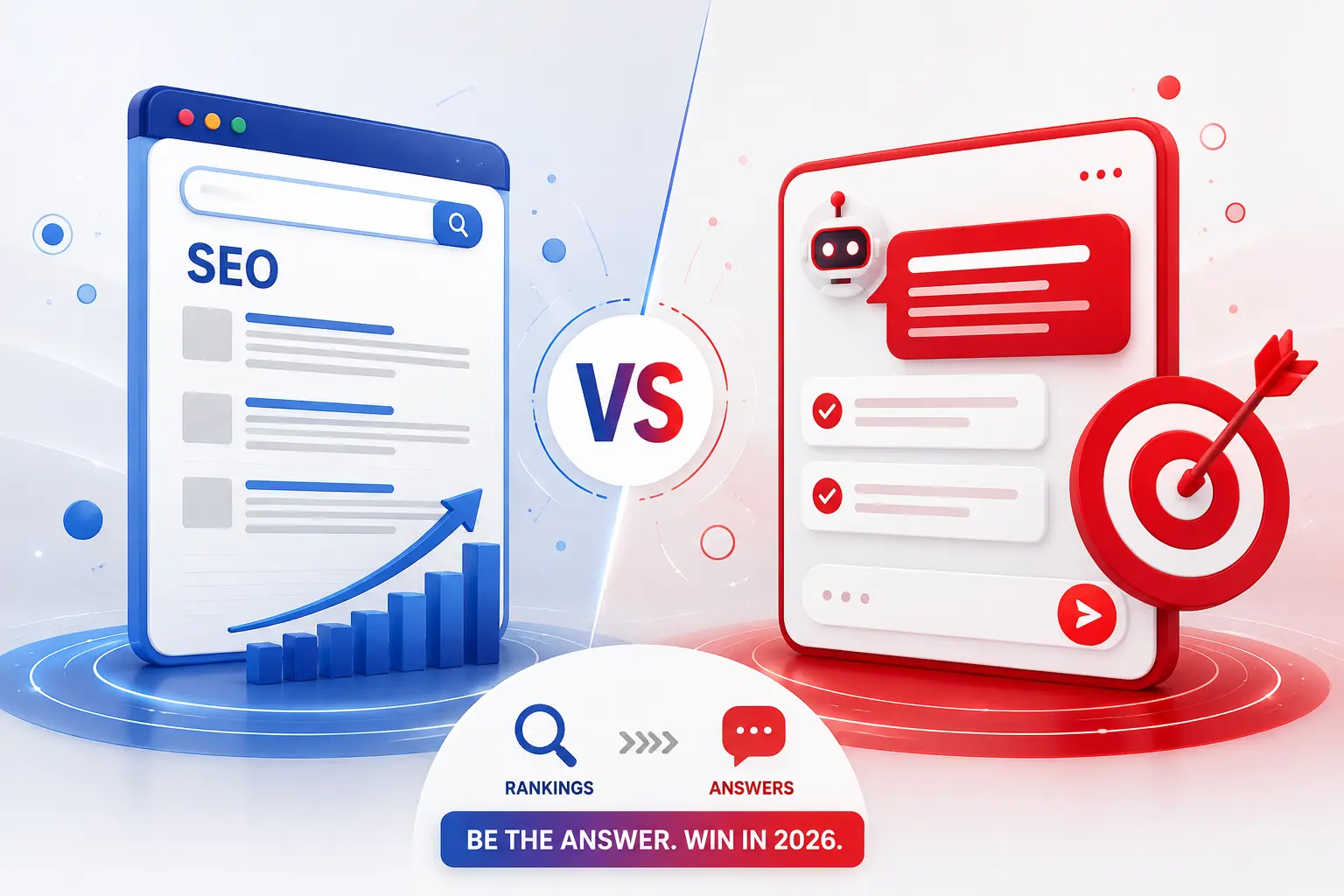
Which brings us to AEO vs SEO. Search engine optimization earned you a spot on the shelf. Answer engine optimization earns you a place inside the answer.
What your reader needs, wants, and fears
Marketing rests on three things, and the AI didn’t change them.
The need is to be found. No visibility, no business. Table stakes.
The desire is to be chosen to be the trusted name, the default, the source people quote without double-checking. To grow without grinding.
The problem is where it splits in two, and most marketers only notice half of it.
The extrinsic problem: the floor is moving
This is the visible, measurable obstacle.
Rankings no longer equal traffic. If there is an AI Overview above the listing, the click-through rate of the number one spot could drop by more than half. In fact, more than two thirds of search queries don’t receive any clicks at all. Being number one doesn’t mean anything anymore.
That’s the headline among the ranking differences AEO SEO forces you to confront: the old scoreboard measured position, the new one measures whether a machine quotes you at all.
The intrinsic problem: the quiet fear
This is the one nobody writes into the project brief.
It’s the dread that everything you mastered is suddenly furniture. The anxiety of doing it all “right” the audits, the schema, the content calendar and watching the traffic line bend down anyway. It’s the fear of being erased from a conversation you used to own.
Extrinsic problems cost you clicks. Intrinsic problems cost you nerves.
AEO is the work of solving both at once.
How answer engines actually pick
To win, you have to understand how the choosing happens.
Most answer engines run on retrieval. They pull relevant passages, synthesize them, and cite a handful of sources, often three, sometimes five. This is generative response ranking, and it rewards different things than the blue-link era did.
A few signals now matter more than they used to:
- Lead with the answer. Machines lift the first clear, self-contained sentence or two. Bury your point under three paragraphs of throat-clearing and you’ve lost the citation window.
- Show your work. Concrete facts, original data, a number nobody else has — these are hard to replace and easy to quote.
- Earn trust. Real author bios, genuine expertise, consistent terminology. The same experience-and-authority cues that shape featured snippet signals now shape who gets cited.
- Stay fresh. Stale pages quietly lose their citations. Refresh the important ones, or watch them fade.
- Add structure. Clear headings, short sections, FAQ and Article schema. Make the page easy to lift from.
Notice what’s missing: tricks. There’s no keyword to stuff. The shortcut is to be genuinely, plainly useful the most durable marketing strategy there has ever been.
The regional wrinkle: this isn’t a Silicon Valley story
The UAE SEO strategy evolution is a useful case in point.
For markets that are rapidly moving, multi-lingual, and mobile first, the expectation is an immediate response in one’s own language. Local companies who have developed rich content in Arabic and English linked with the local geography and relevant question are being cited, while larger and slower companies are being abstracted.
The lesson travels: answer engines reward the specific, the local, and the trustworthy over the merely large.
So what do you actually do?
Stop optimizing only to be found. Start optimizing to be the source that people are found through.
Pick the questions your best customers actually ask. Answer each one directly, near the top, in plain language. Back it with something only you can offer. Mark it up. Keep it current. Then check whether the engines are quoting you and where they’re quoting someone else instead.
SEO put you in the running. AEO makes you the answer.
The brands that win the next decade won’t be the ones who shout the loudest. They’ll be the ones a machine trusts enough to speak for.
That’s not a hack.
That’s just generosity, finally rewarded.
FAQ
What is the difference between SEO and AEO?
While SEO is used to optimize the page in order for it to be ranked as one of the search results, which will still require a human click. However, AEO is the optimization that allows an AI to extract and cite the content directly in their answer. SEO gets you onto the shelf; AEO gets you into the answer.
Why is answer engine optimization becoming more important?
Because the behavior changed underneath us. These days most searches don’t result in clicks, AI Overviews are blocking even the top results from clicks, and more than a hundred million people start their research from within chat assistants. If your optimization strategy is limited to clicks, then you’re competing for an ever-decreasing share of attention.
How can businesses optimize content for answer engines?
Lead every section with a direct, self-contained answer. Support it with original data and visible expertise. Structure data and use proper headings to make it easy for machines to lift your content. Refresh your valuable web pages and monitor citations from ChatGPT, Perplexity, and Google’s AI Overview pages in addition to ranking.