
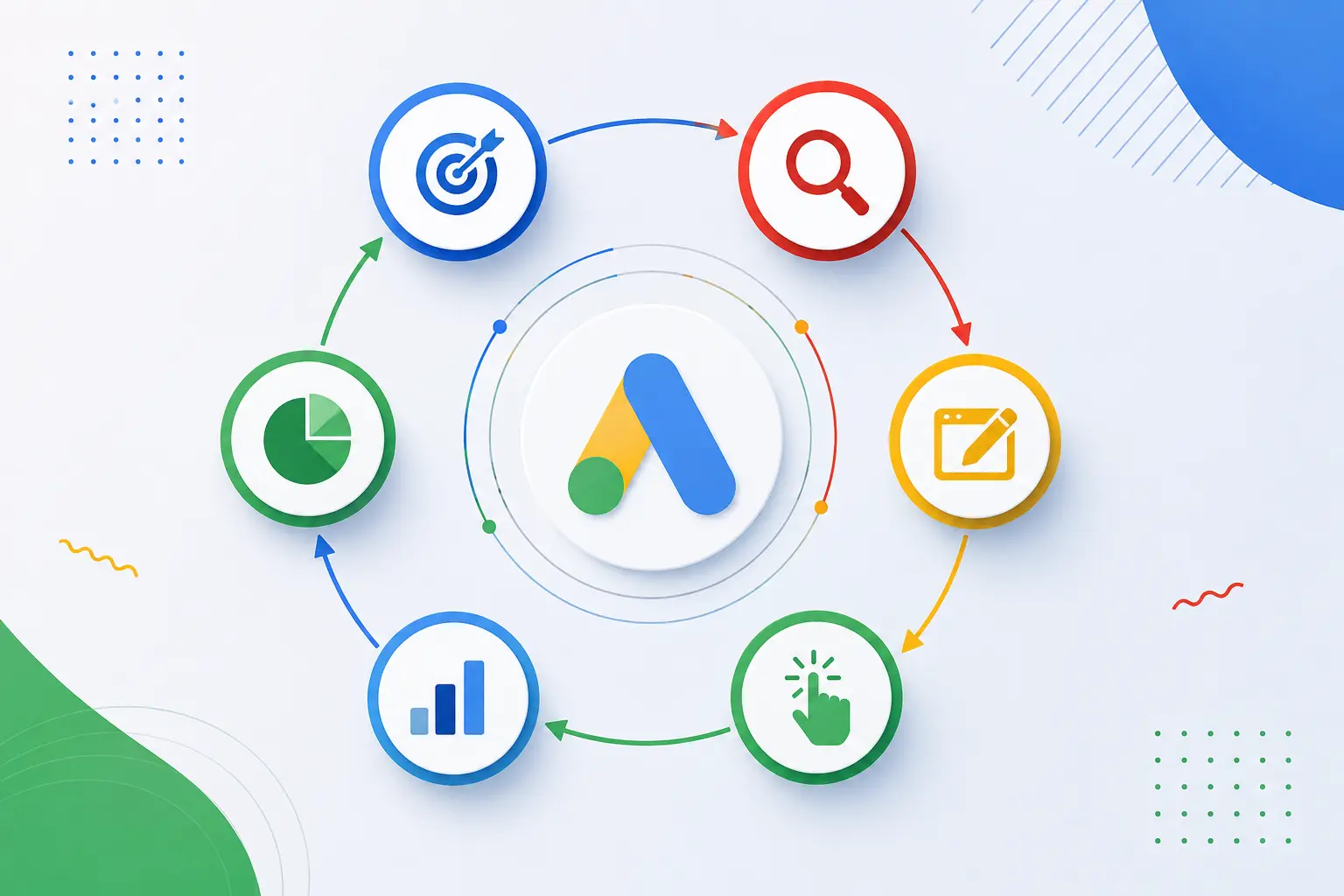
A Real Breakdown of how campaigns work
The surprising thing about Google Ads is that it is arguably the most transparent and accountable form of advertising possible, tracking clicks, impressions, conversions, and every single dirham spent. And yet, it also creates some of the most misinterpreted metrics in the marketing world. Companies spend months optimizing toward seemingly positive numbers while their businesses go into reverse. The problem isn’t in Google lying; it’s that the account was not properly structured to ask the right questions. That is the space that most Google Ads services in the UAE exist in, and that is exactly the beginning of campaign breakdown.
The Auction Nobody Explains To You
With every Google search, an auction takes place within seconds. It’s not just that you are paying for a spot on sponsored Google Ads services. It’s that you are bidding for a spot, and it’s not just your max CPC that matters, but the whole Ad Rank i.e. your max CPC multiplied by your Quality Score. Even if you are spending AED 60 per click, your competitor spending AED 30 and having a Quality Score of 9 will always have a higher Ad Rank than yours. And that difference is by design.
In the UAE, that auction is incredibly expensive compared to most other markets in the world. Average cost per click for real estate, legal, and health care verticals typically ranges from AED 50 to AED 120, and finance keywords could go even higher. Many business owners see these numbers and assume they are paying extra because of the market’s competitive nature. Some are. Others are paying extra due to improperly set up account bidding on itself.
Think of Quality Score as your ads’ credit rating. Higher Quality Score leads to lower interest rates; meaning, less money you need to spend for the same spot on Google. Low quality score means that you need to spend more for less. When an agency sets up your account without giving a damn about Quality Score, it is basically giving you a high-interest credit card and calling it advertising.
Fixing it is relatively simple; you need well-themed ad groups in which keywords, ad copy, and landing pages all relate to the same intent. Running a single campaign with broad matching keywords and linking it to the homepage is not setting up a Google Ads account; it is running an expense account with a login.
Where Your Budget Goes – and Vanishes
Here is a situation that is very common for UAE Google Ads accounts. A company runs a single campaign with ‘office cleaning Dubai’ as target phrase with broad matching. Google interprets that very liberally, which can sometimes be useful but often isn’t. Within a week, you already get a report of spending on queries such as ‘cleaning job vacancy in Dubai’, ‘how to start a cleaning business’, and many queries in Hindi and Tagalog that you never intended. There were no negative keywords set up. There were no intent-based segmentation. The budget was vanishing without anyone noticing.
UAE is a multilingual country with significant searches done in Arabic, English, Hindi and Tagalog. Yet, most campaigns operate in English only. It is not a strategic choice, but an error. Intents expressed in Arabic when searching for the same service could be completely different in terms of commercial urgency, CPC, and behavior. Not addressing those segments not only leaves you a lot of potential customers on the table; but also forces you to spend your budget on the most competitive segments of the market.
Seasonal effects amplify this. During Ramadan, DSF, or periods around other major events, auction dynamics change dramatically. Those who prepare creative and adjust bidding strategies to that catch the intents at better prices. Those accounts that don’t adapt to that become either overpaying or simply turn off at the time of the biggest consumer activity.
Click fraud is the silent leak. For high-demand verticals, such as construction, recruitment and legal services, competitors click and bots make impressions and clicks for nothing. Proper Google paid search services include fraud monitoring, IP exclusion and regular anomaly review. Without that, you are financing noise and reporting it as signal.
What Conversion Tracking Is Actually Telling You or Hiding
The most frequent problem with accounts that underperform in the UAE context is not a lack of good keywords or poor copywriting. It is poor measurement. Incorrect or missing conversion tracking is double-counting conversions or tracking the wrong actions – for example, page views reported as leads and form submission when actually abandoned halfway through. All decisions based on incorrect data make the account perform poorly, no matter how well thought out your bidding strategies are.
Without accurate conversion tracking, Google’s automatic smart bidding algorithms are trying to optimise for something irrelevant. Their goal becomes increasing the number of clicks. It sounds helpful but only in so far as clicks are not customers. A campaign optimised for clicks will generate them. Whether those clicks are from people that will actually buy something is a whole other story.
Attribution problem is a little more complex. According to the rules of the last-click attribution model, all credit goes to the keyword the user clicked last before converting. So branded keywords appear as rock stars while discovery keywords get zero. In reality, the user may have seen a display ad, gone through a generic search two days later, and converted using a branded keyword. Last-click attribution model credits that keyword fully. The discovery keyword that triggered the journey gets zero – and sometimes even gets paused because it appears as wasted money.
Solving this problem requires implementation of tagging with Google Tag Manager, validation of each conversion action, and setting up an attribution model reflecting the purchase path correctly. For most UAE SME businesses offering considered services, it means going from last click to data-driven or position-based attribution. It is not flashy work but this is the work that turns reporting into something useful.
Why Campaign Structure Is the Decision That Overrides Everything Else
Most underperforming accounts have the same architecture issues before any keyword or budget problems become apparent. Everything resides in one campaign. Brand terms compete with non-brand terms. Terms intended for awareness campaigns share a budget with purchase-intent keywords. There is one ad per ad group. Ad copy is generic and points to the website homepage. Tests do not exist because there is nothing to compare them with.
Google Advertising Services has a proper account structure for a Dubai company with sponsored ads, featuring separate brand, non-brand, and competitor campaigns. They each get their own budgets, bidding strategies, and measurement. A properly managed brand campaign should yield conversions cheaply and consistently – if they do not, something else is wrong with the brand experience, not the advertisement. Non-brand campaigns need careful negative keyword management and regular search term report analysis. Competitor campaigns require completely different creative strategies.
Proper landing pages are vital but more important than most accounts consider. Sending a click from the ‘Google Ads agency in Dubai‘ keyword to the homepage is the same as having a store window advertising watches and putting the customer right in the stationery aisle. The intent is very specific. If the experience that follows is generic, the click was wasted regardless of how well it was obtained.
Ad copy testing is where most Google PPC services differentiate themselves – or fail to. Running two or three different versions of responsive search ads at once, tracking click-through and conversion rates separately, and optimising based on these results is a very basic process. Running the same headlines for six months means monitoring rather than managing the account.
Business owners who actually see results through the use of Google Ads are not those who have the most budget allocated. Those who actually see the results are those who stop tolerating reports that they are unable to question and start demanding access to their account, search terms, and conversions. When you know how you are spending money, you are no longer a managed client but a decision-maker yourself. And that is more valuable than any optimization of your campaigns.
Is it whether Google Ads work? It is whether someone from your side knows how to make them work.