
Search changed. Not gradually, overnight for a lot of businesses.
Google’s AI Overviews started appearing at the top of results pages, and suddenly the old SEO playbook felt less reliable. Rankings that used to drive steady traffic? Some of them still hold. But the clicks aren’t following the same pattern anymore.
Here’s what’s actually happening and what you should do about it.
The Overview Problem Nobody’s Talking About Honestly
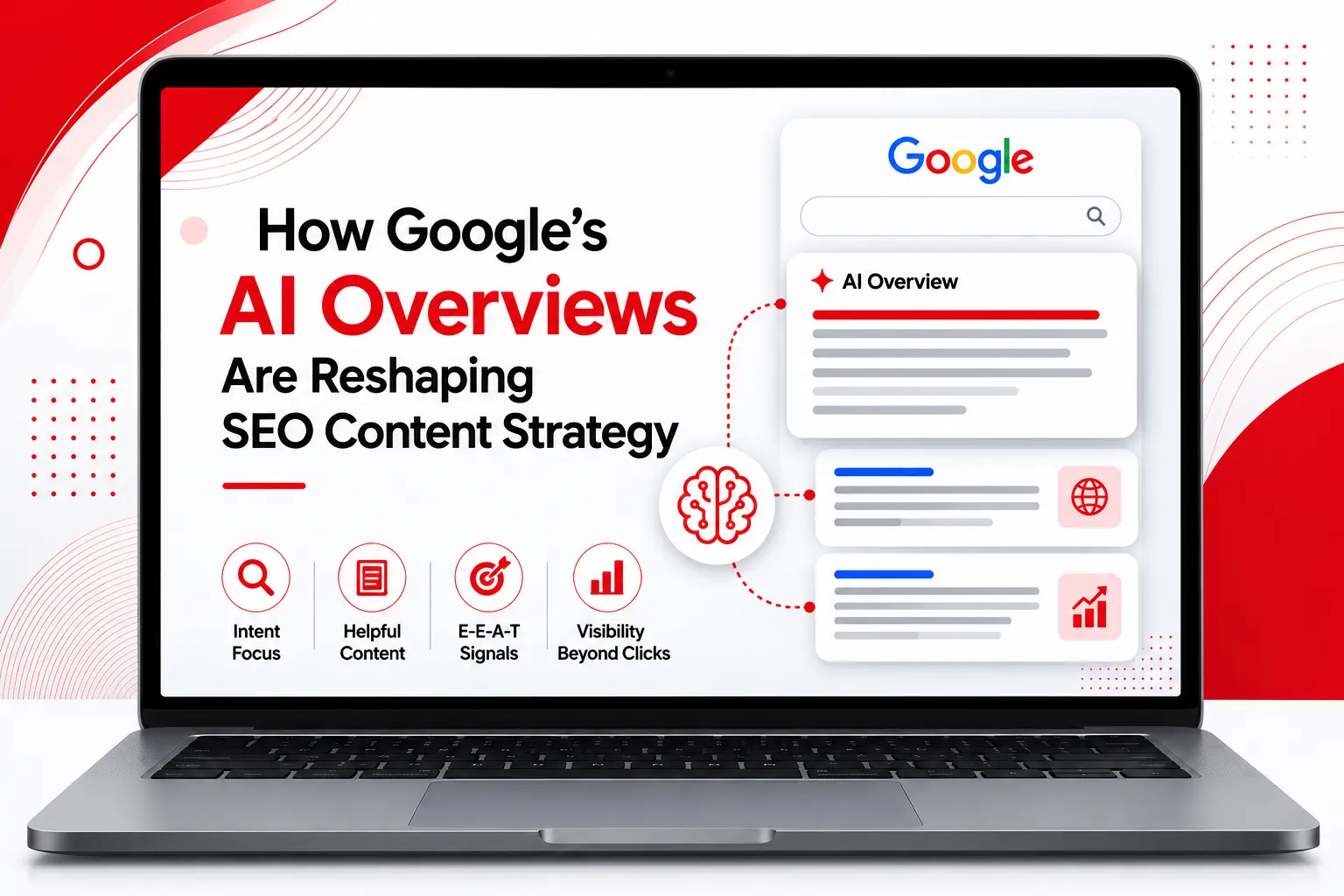
AI Overviews pull answers directly from web pages and serve them to users without requiring a click. For informational queries how-to questions, definitions, comparisons Google answers the question before the user ever reaches your site.
This isn’t a penalty. Your page can rank in position one and still get fewer visits than before. That’s the shift.
For businesses that invested in content marketing, this hurts. It’s not that the content is bad. It’s that the game changed.
What Still Works (And Why)
AI Overviews never cite sources that are chosen at random. Google draws information from sites which are considered reliable, structured, and helpful in some way. Thus, if you are mentioned in such an overview, then you’ve been given positive visibility.
It becomes less about “ranking for this keyword” and more about being a trusted source on this topic.
That means a few things practically:
Content needs to be specific. Broad, generic articles get ignored. If you’re writing about web development services, you need real depth not 600 words of padded generalities but actual insight into what clients experience, what problems get solved, what decisions matter.
Structure matters more than it used to. Clear headings. Concise answers near the top of each section. Google’s systems scan for extractable answers, and if yours aren’t cleanly formatted, you get skipped.
E-E-A-T has teeth now. Experience, expertise, authoritativeness, trustworthiness these aren’t buzzwords. They’re the criteria AI systems use to filter sources. First-person experience, named authors, real case data all of it signals legitimacy.
The Local and Regional Angle
A domain in which the use of AI Overviews hasn’t been fully realized thus far: location-based searches.
In searches for digital marketing agency Oman or Oman web designing companies, Google continues to show its traditional map pack results, along with local search and organic results, even though the Overview is more subtle because it is transactional rather than informational in nature.
That’s a window. Businesses offering website development Oman services should be doubling down on local SEO right now – location-specific pages, client testimonials with detail, service pages that answer the actual questions buyers ask before hiring someone.
The window won’t stay open forever. But for now, local search is one of the cleaner paths to traffic that doesn’t get absorbed by an Overview.
What to Actually Change
Stop optimizing for keywords in isolation. Start optimizing for questions. What does someone need to understand before they hire you? What objection are they trying to resolve? Write content that answers those questions with specificity, not with SEO filler.
Audit your existing content. Identify pieces that rank for informational terms where Overview traffic is eating your clicks. Either update them to go deeper than any Overview would, or shift focus to bottom-funnel content where the buyer is closer to a decision.
Build topic authority. One strong page doesn’t cut it anymore. Google wants to see that you’ve covered a subject consistently, across multiple angles. That’s what earns the kind of site trust that gets you cited inside Overviews rather than replaced by them.
The Mindset Shift
It used to be all about achieving visibility through SEO, but now it’s about earning citation, and there’s a big difference between the two because one doesn’t necessarily lead to the other.
The companies that are successful today were not the ones that disregarded or panicked over AI Overviews. They’re the ones who figured out how to become a source worth quoting.
That’s a much harder bar to clear. It’s also a much more defensible position once you get there.