
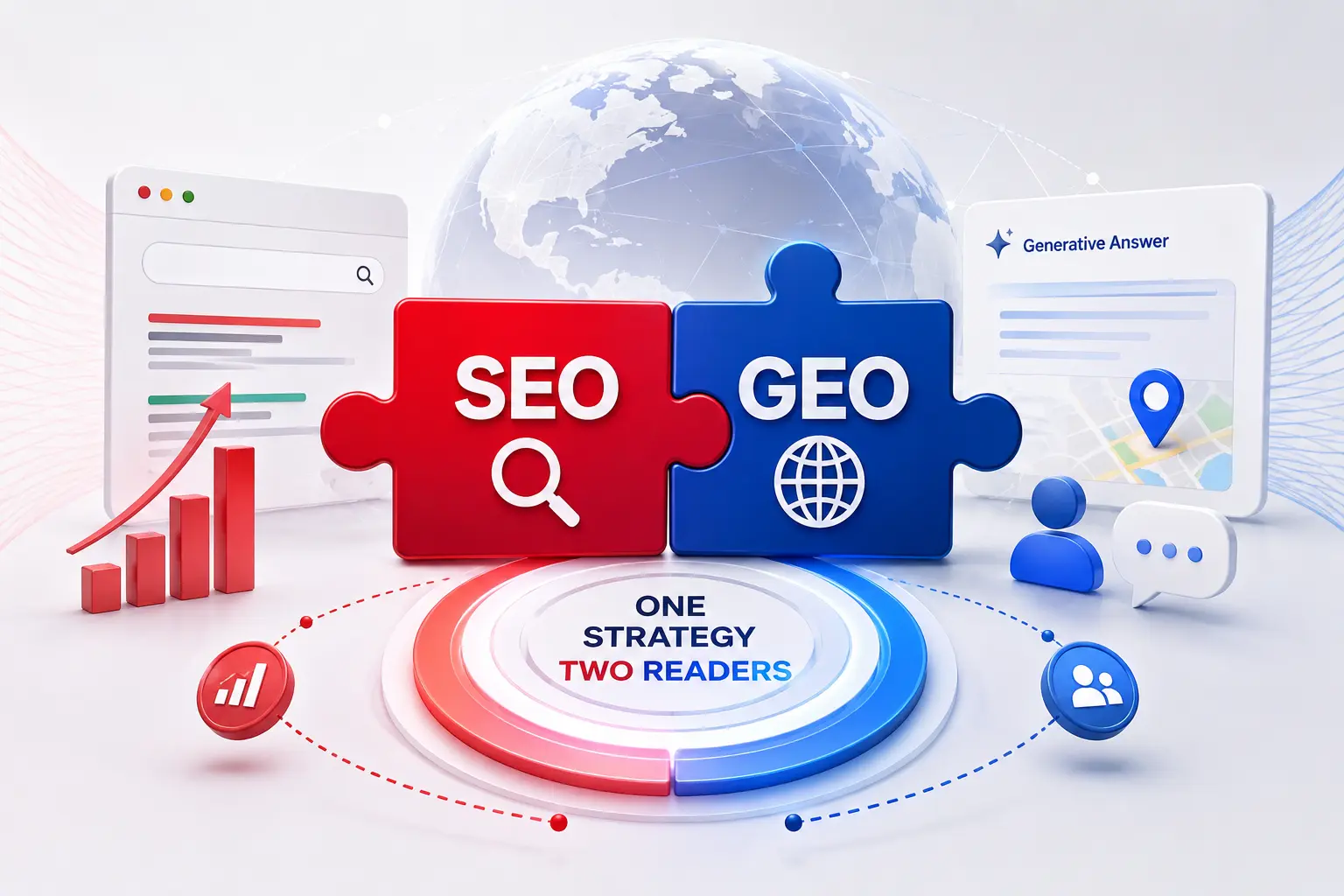
Right now, somewhere, two marketers are arguing about an acronym.
GEO. AEO. LLMO. SEO-but-for-robots.
They’re debating the label on the box while their competitors quietly walk off with the shelf.
Here’s the thing nobody in that argument wants to admit: this was never two disciplines.
Search has always evolved. So have you.
When mobile arrived, we didn’t invent “mobile SEO” and hire a separate team for it. Mobile was just search, growing up.
When voice arrived, same story.
Generative AI is the next chapter, not a different book. The job has always been the same: be the most useful, most trustworthy answer to the question someone is actually asking.
What changed isn’t the job. It’s the reader.
You used to write for one reader. Now you write for two.
Reader number one is the human, arriving through a ranked list of links. That’s classic SEO, titles, structure, authority, the front door of Google’s index.
Reader number two is the machine, reading your page to decide whether to quote you in an answer the human will never click away from. That’s GEO.
Two readers. One page. Same goal.
This is why AI search + traditional SEO isn’t a choice you make. It’s a single discipline wearing a new coat.
Integration beats addition
Most people treat GEO as something you bolt on after the SEO is finished. A second project. A separate sprint.
That’s backwards.
The AI engines pull most of what they cite from the same search indexes you’ve spent years optimizing for. Roughly four in ten AI citations come straight out of Google’s top ten results. Rank well, and you already have a head start in the answer box.
But and this is the part that should keep you honest ranking is the head start, not the finish line. A page can sit at position three on raw backlink muscle and still get skipped by the machine, because the writing is foggy and the key facts are buried six paragraphs deep.
So when you integrate GEO with SEO, you’re not adding a layer. You’re making the authority you already built legible to a new kind of reader.
That’s the whole point of GEO SEO integration: same foundation, two audiences served in one motion.
What the machine reads that the human forgives
Humans skim. Machines parse. The machine notices things a human reader would never punish you for.
Three of them matter most.
Speak in entities, not pronouns. A human knows “it” means the tool you named two sentences ago. A machine isn’t so sure. Write “Asana is a project management tool,” not “it’s a popular one.” Name the people, the products, the studies, the sources. The clearer the naming, the more confidently the machine attributes the fact to you.
Answer the question, not just the keyword. People don’t type two words into a chat box. They ask whole questions “what’s the best CRM for a small remote team?” These conversational search signals are the new raw material. Map your content to the way people actually ask, not just the terms they once typed.
Remember your reputation lives off your website now. Traditional SEO was mostly about assets you owned. The machine reads the whole web – Reddit threads, reviews, a forum post, a news mention you forgot existed. A single stale review can shape how an AI describes you. Watching your third-party mentions is no longer optional; it’s part of the job.
Plan one index, not two
Here’s the mindset shift that makes all of this manageable.
Stop keeping two scorecards. Do your AI search index planning all as one exercise: document the questions being asked by your most valued customers, select those that you actually deserve to be the answer to, and create the pages that will rank both on Google and for AI.
Always start each section with an answer. Keep the heading hierarchy clean. Add the schema. Cite real research by name. Refresh the page before it goes stale the machine quietly drops sources that stop keeping up.
Do that, and you’re not optimizing twice. You’re optimizing once, for both readers.
A note on where this is heading
Look at SEO future trends UAE for a preview of the rest of the world.
In a world which is quick, multi-lingual, mobile first, the customer already wants an answer in his/her language in his/her terms, immediately. The companies that succeed in such markets do not have the largest presence but the most precise one. They created pages associated with specific locations, queries and expertise in both Arabic and English.
The lesson is portable. Wherever you sit, the future belongs to the trustworthy and the specific, not the loud.
So here’s the move
Stop arguing about the acronym. Start writing for both readers.
SEO earns you the authority. GEO makes that authority legible to the machine now standing between you and your customer. Neither one works as well alone.
The brands that win the next decade won’t pick a side in a debate that was always a false choice.
They’ll just be useful, clearly, specifically, generously to everyone reading. Including the readers made of math.
That was always the assignment.
The machines just made it harder to fake.
FAQ
Can GEO and traditional SEO work together?
They don’t just work together, they’re the same discipline. These engines get their references from the same search indexes that are optimized by the SEO process, making it the bedrock on which GEO is built. When these SEO strategies are integrated, you can have just one page that ranks in Google and gets referenced by AI at the same time.
What signals do AI search engines use in addition to SEO ranking factors?
Aside from typical SEO ranking factors and backlinks, AI-based search engines rely on entities and how often your brand appears consistently across the Internet, including even mentions that aren’t linked. Additionally, there are such factors as clear factual claims, well-structured data which could be parsed, relevance to conversation, freshness of your content and your reputation on third-party sites.
Why is GEO becoming an essential part of modern SEO strategies?
Because a growing share of customers now begin their research inside AI assistants, and ranking alone no longer guarantees you show up there. A page can rank well on Google and still be invisible in ChatGPT or Perplexity. GEO closes that gap, turning the authority you’ve already built into visibility inside the answers where buying decisions increasingly get made.