
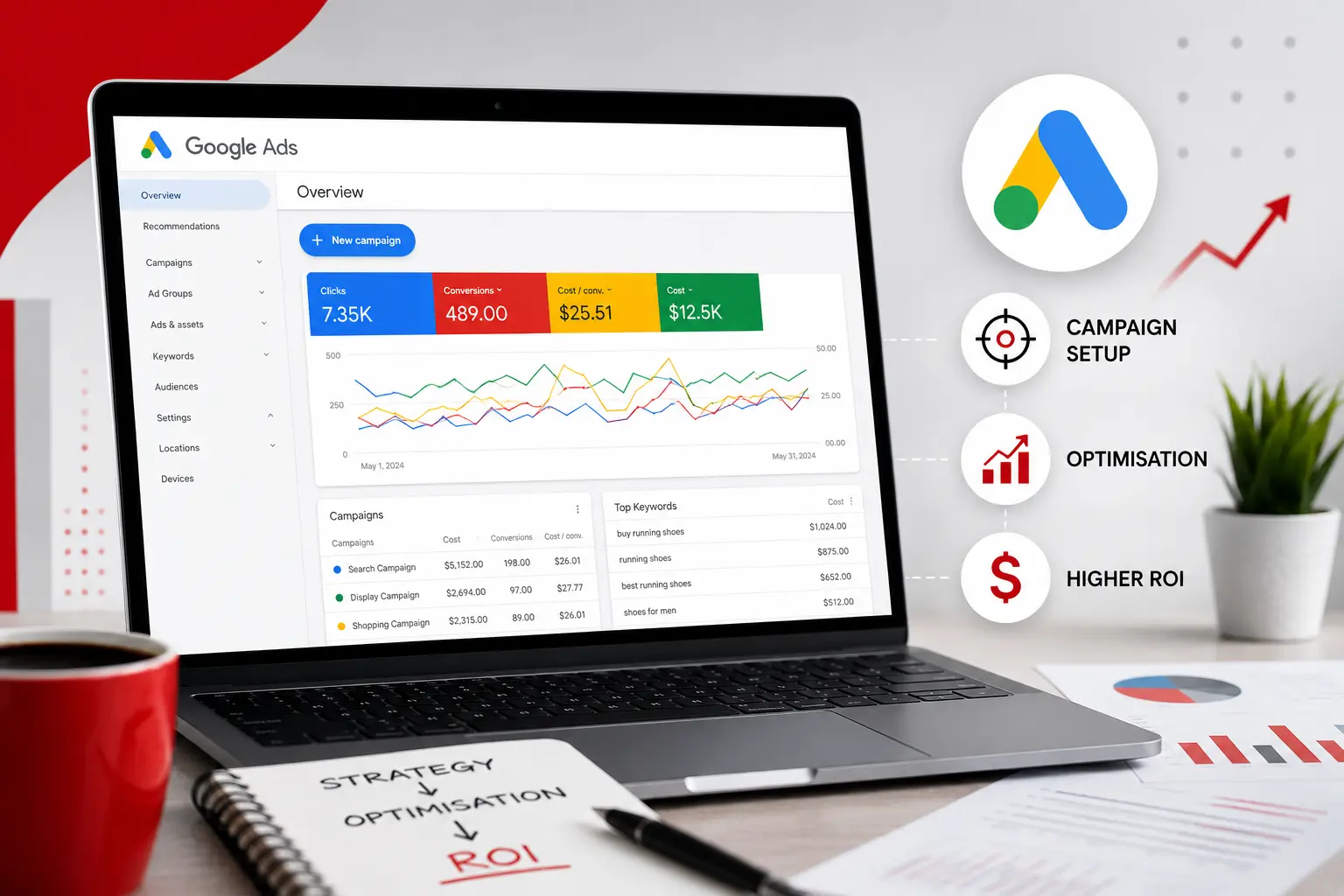
The client’s brief said to increase leads. The agency said, “leave it to us.” 3 months later, the report showed 14,000 impressions, 2.3 per cent clickthrough rate and cost per click that has somehow increased every single month.
No one noticed it. No one explained it. And you, looking at a screen filled with metrics that seem to be made to dazzle rather than inform, begin to suspect if the problem lies with the platform or its managers.
It usually lies in the latter. Sometimes, even in the former, as it often lies within the brief that was never provided. Understanding the actual mechanics of Google Ads services, not only theoretically, but in a practical context of launching the campaign in the UAE market, is the key difference between a company that succeeds due to its paid search efforts and a company funding someone else’s learning curve.
Why Most UAE Campaigns are Set up for Plateauing, Not Scaling
Imagine hiring a sales team but equipping every representative with the exact same script, territory and commission structure and without any way of knowing which one is actually closing deals. This is not a sales strategy. This is organised chaos with a salary attached. Google ads agency Dubai will tell you that this is precisely what most inherited accounts are like, featuring one campaign, dozens of keywords, no segmentation and inability to track what works.
This applies especially to the UAE market, where competition within the auction is fierce enough to punish such poorly managed campaigns in addition to themselves. Your Quality Score is 4 and theirs is 8? They will have a lower cost per click on the same keyword. This is not the game of budgets anymore. This is the game of account management quality, and the gap is established long before dirhams are spent.
Campaign setup is not a one-time thing. It is the base on which all future decisions will be made. Proper separation of brand and non-brand traffic, segmentation of keywords according to true intentions behind searches and building ad groups so tight that the headline seems to directly address the query are not some advanced techniques. They are just basic architecture. But they need someone to actually care about their correct implementation at the very beginning of the campaign launch process.
Failure in Conversion Tracking That Nobody Sees Until It Is Already Too Late
One of the questions asked in every account audit concerns conversion tracking. The response is: “It is being tracked in the contact page”. Not the page after submitting the form, not even the phone call confirmation. The contact page; that is, every visit to this URL is seen as a conversion, even when the user didn’t fill the form. Great statistics, yet no movement is being made.
This is a common case scenario. Failure in the conversion tracking is one of the most popular problems in Google advertising accounts in the UAE, and it distorts all decisions that come later. The smart bidding algorithm works based on what seems to work the best, and if the metrics that show what works are false, it optimizes everything according to the wrong criteria; very effectively. The result is that you have a machine that became excellent at performing the wrong thing.
For Google paid advertising to be a real performance channel, there are three questions that need to be answered. What keywords generate leads, and not clicks? What is the true cost per lead, and not clicks? Which campaigns generate revenue, and not just traffic? When the conversion tracking is not done properly, when it is not connected to any actions; filling up the form, making a phone call over 60 seconds, buying anything, then the answers for the three questions above cannot be honest.
Finally, we have the attribution problem, which the vast majority of the accounts cannot solve. In the case of the last click attribution, which is still the default one in many systems, all the campaigns that work on brand awareness and considerations are failures. All of them are defunded. And suddenly, the business wonders why the performance has fallen apart after getting rid of the underperforming campaigns.
The Language Gap That Is Quietly Costing UAE Advertisers
Here is something most agencies operating in this market will not raise unless you ask. The UAE has smartphone penetration above 98 percent and a population where Arabic, Hindi and Tagalog are live search languages alongside English. Most Google AdWords accounts in this market run English only. Not because the data supports it. Because it is simpler to set up and nobody pushes back.
Arabic language search in sectors like healthcare, education and home services represents a segment with genuine demand and, in many cases, meaningfully lower CPCs than the equivalent English terms because fewer advertisers compete there. That is not a marginal efficiency. In a market where a single click in a competitive vertical can cost AED 80 or more, running campaigns that reach high-intent Arabic-speaking audiences at a lower cost is a structural advantage. It requires proper keyword research, native copy, and landing pages that match the ad’s language. Most agencies skip it. The ones that do not consistently outperform on cost per lead.
Seasonality is the other variable that generic campaign management consistently underweights. Ramadan is not a calendar note, it is a wholesale shift in audience behaviour.
Evening search volumes spike. Certain categories accelerate sharply. Others slow down. Bidding strategies calibrated for February will overspend or underperform in March if nobody has built seasonal adjustments in advance. DSF, back-to-school, and Expo style demand surges all carry the same implication: the auction you are bidding in today is not the auction you were bidding in six weeks ago.
How ROI Really Looks When the Account is Running Well
The companies in UAE that experience high ROI from their paid search all have one thing in common. They focus on the right metrics and ignore those that do not matter. Impressions do not deliver business. Clicks do not deliver business. Low Cost Per Qualified Lead below the average deal value sustained throughout the quarter – that is what brings business.
Google ads Dubai campaign that is set up correctly and monitored properly will show you after a few weeks what the cost per lead is by campaign, keyword cluster and audience segmentation. This information will change your decisions. You will not be asking anymore if Google Ads is delivering and will ask what part of it delivers the most results that deserve your money. Instead of defending the decision you will be moving forward.
Click fraud is definitely a problem in competitive verticals in UAE where bot traffic and clicks from competitors might eat your budget without leaving any lead in return and excluding lists, IP-filtering and third-party verification are must-haves in such markets. Search term audit is another way to find out how the budget is silently being spent on unrelated searches driven by broad match keywords.
From Spend to Strategy
There is a way to run your paid search campaign which includes putting money in a black box and hoping that the report will look good in the next month. There are plenty of businesses in the market following such a strategy and their agencies have no motivation to change it.
Alternatively, you can run an account that is readable, challenging and expandable with full transparency of the campaigns’ purpose, budget destinations and manager who can explain the numbers on the slides with no need for distractions.
Stop being just a budget. Become a client of a trusted Google ads agency in Dubai with a clear understanding of your investment.