
The agency report came in on Thursday. Twelve pages. Colourful charts. Click-through rates are trending up. And then somewhere in the appendix, hidden behind a column named ‘Impressions Served,’ was the number that revealed the whole story: The campaign had matched to 340 search terms in that month, and 190 of those search terms had nothing to do with the business. An agency charging AED 70 per click for a property consultancy on people searching ‘how to become a real estate agent.’ That is not poor targeting. That is no targeting. And it is a lot more common in the UAE Google digital marketing than the people managing the accounts care to acknowledge.
The question most UAE business owners are secretly asking themselves is not about whether Google works; they have seen it work for others. Rather, it is how a platform that works so well for one person could be failing so spectacularly for another. The answer lies not in the budget but in the structure beneath it. Digital Google marketing done well is an engine with many moving parts working together. Done poorly, it is an overpriced slot machine.
Structure Is Not Setup – It Is the Strategy Itself
The most dangerous misconception around UAE paid search is that getting the account up and running is the hard part. It is not. Any Google Ads agency in Dubai can set up a Google Ads account within a few hours. What takes skill, and which most accounts lack, is the careful segregation of the intent layers before one spends even a single dirham.
There are two kinds of people searching for your brand online: Those who already know you exist and are looking for a reason to contact you. People looking for something else are still trying to decide whether you make the cut at all. Running both sets of people through the same campaign, bidding strategy, and copy is like having your receptionist and your top salesman deliver the same pitch. And one of them will inevitably be misfired.
Segregation of intent allows for better understanding of the results. When campaigns are broken down into layers by intent, service lines, and audience type, performance patterns become clear. You can see exactly what kind of product generates leads, what area is eating away at your budget, and which group of keywords brings you the wrong kinds of clients. Without that segregation, the account becomes an unidentifiable blur. Something happens there. But you have no way to see what.
The importance of negative keywords in this process cannot be understated. In the market, where a single click on legal services costs AED 80 or more, an absence of the negative keyword list is not a small error. It is a big leak. The search term report – the most accurate record of what a real person has typed before clicking your ad – is the most honest document in the entire Google advertising account. Most businesses have never seen one. And those that did; were usually quite surprised.
The Multilingual Gap Most Google Ads Dubai Campaigns Never Close
It should be noted that the following observation may concern any agency placing ads in this market: the UAE has a very diverse language environment in which Arabic, English, Hindi, and Tagalog all have commercial value, yet the vast majority of Google Ads Dubai campaigns use English only. The point is not only about missing some potential clients; it can be seen as another hidden factor influencing the quality score.
If ad copy, keywords and landing page use different languages while addressing the same person, it lowers the relevance score. This makes the cost per click grow; besides, without taking into consideration the losses due to the lack of clicks of Arabic speakers, who did not find anything to relate to in the English-only ad. A small business working in healthcare and legal services, which has an Arabic-speaking customer base, is effectively supporting its competitors, which took the time to develop proper segmentation by language.
The process is quite simple. Setting up different campaigns targeting Arabic intent keywords, using Arabic ad copy, and Arabic landing pages increases the relevance of the ad, which will be reflected in higher quality scores. As a result, the cost per click decreases. For the UAE auction, for example, the same keyword may cost AED 55 and AED 30 for similar campaign depending on the relevancy. For the period of a meaningful expenditure, the difference will not be marginal but significant.
Furthermore, the seasonal dynamics increases the effect even more. Ramadan affects the consumer behavior in such a manner that most ads Google Ads strategies simply do not consider it. The search volumes, peak times, and even the tone of copy differ during this period. Dubai Shopping Festival causes competitive surges where accounts having a pre-prepared schedule and increased mobile bid adjustments win against those treating it like an ordinary fortnight. Auction timing is not luck; it is planning.
When You Cannot See What Is Working, You Are Not Running a Campaign -You Are Running a Bet
The main uncomfortable truth revealed at the Google Ads audit for UAE business is that many owners have been optimizing for the clicks that were never going to be the customer. It has not happened because of incorrect product; it was due to the broken conversion tracking, misattributed or simply non-existent. If the agency is celebrating a 4 percent click-through rate, but nobody can tell you the cost per lead, you are watching not a reporting but theatre.
Conversion tracking is not a technical matter. It is the entire feedback loop showing to the algorithm what you are really interested in. Without it, smart bidding models, like Target CPA or Maximizing Conversions, cannot optimize to anything. They will take your budget and try to estimate the situation. Sometimes, it is possible; often it is not. But you have no way to understand exactly what you are doing.
Attribution is the next stage ignored by most agencies. The last-click attribution (default setting) gives 100 percent of credits to the last touchpoint before the conversion. That means that your branded keyword search term (when the person types in the search bar after being convinced by three other interactions) becomes the hero. At the same time, your top-funnel campaigns (which introduced the business for the first time) become useless. The strategy is being rebuilt according to the lie; upper-funnel budget is cut right when it works.
But switching to a more honest model of attribution, whether it is data-driven, position-based or even linear, redistributes credits according to the real customer journey. For most advertisers in the UAE, it can reveal a whole new understanding of what campaigns should be scaled and what need restructuring. Any budget conversation should start with an attribution audit.
SEO and Google Ads Are Not Competing Line Items – They Are One Integrated System
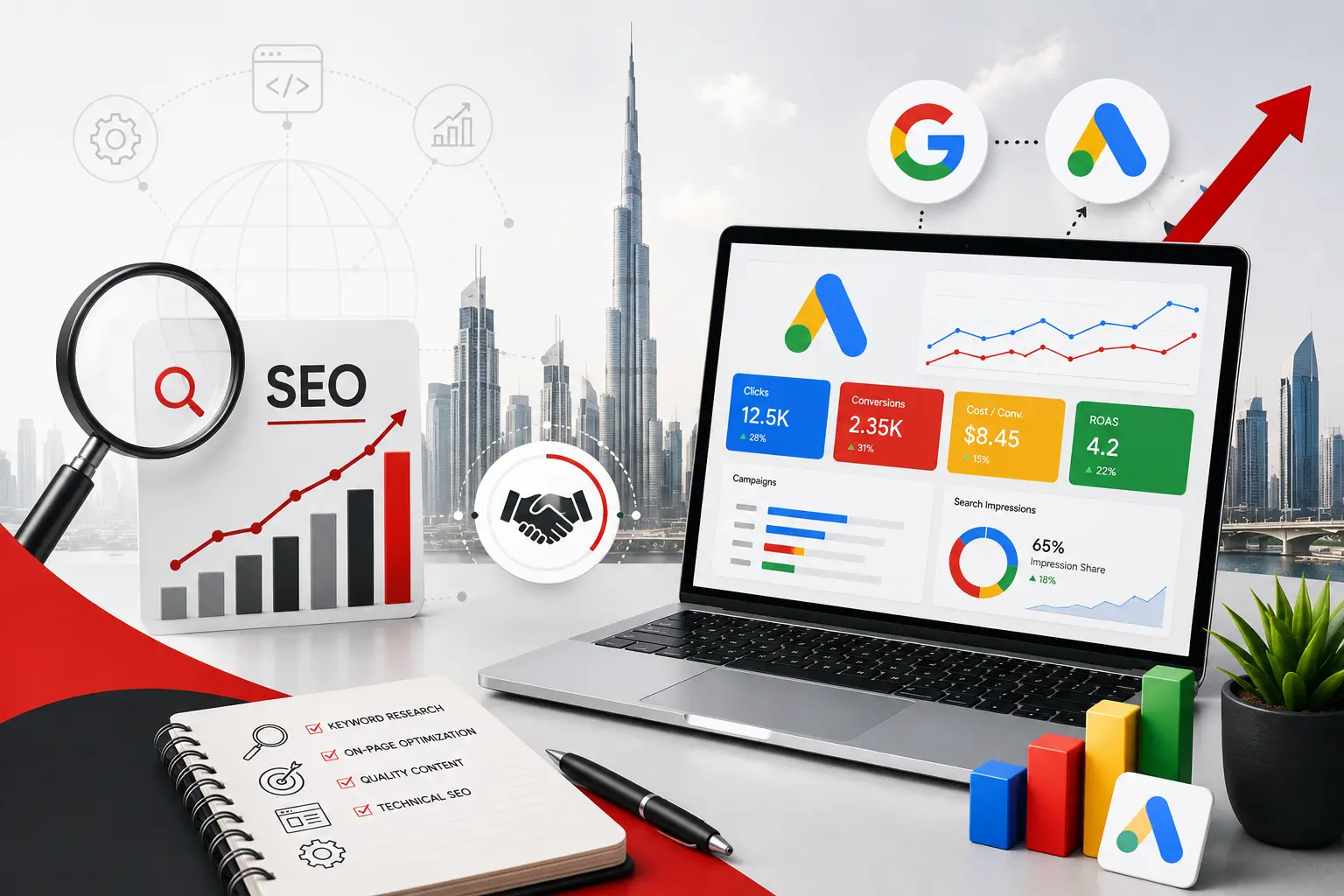
The most intelligent UAE companies are now no longer making decisions on SEO and Google Ads separately. Instead, they think about them in conjunction as an integrated machine. And it works out that way in the numbers. Search phrases that work well in paid campaigns are precisely those that should be targeted by organic content not assumptions, not gut feelings, but validated through real customer data.
Organic search lays the groundwork, and paid search builds on that base. An individual who finds your company via organic search and later is shown your remarketing ad is fundamentally a different type of prospect than a cold prospect who encounters your ad at first impression. Remarketing in the UAE, done right with segmented audience lists, can cut your cost per lead down dramatically; as you are now paying to re-engage individuals who showed previous interest rather than trying to build their interest from scratch.
Click fraud is a very real phenomenon that is largely ignored in competitive UAE verticals. Click volumes are being artificially inflated by competing companies and bots in the real estate and legal sectors; wasting budget with no real customer engagement generated. Without outside click volume monitoring and actively managing your exclusion IP lists, you are basically throwing away your budget dollars.
It is the compounded impact of integrated Google digital marketing that differentiates companies which experience growth from companies that remain stuck in place. SEO creates long-term value for your company. Paid search creates short-term velocity. When combined, they create dominance in the search results page that neither channel can generate by itself. There is no comparison between the credibility of a business that appears in both the organic and paid results of a Google search page and the credibility of a business that appears in only one.
There exists the case of a UAE business owner who is tired of crossing his fingers in hopes of some good news in the agency report. He understands exactly what the search phrase report is showing him. He understands how to scale and what campaigns need restructuring; not because he was told this, but because the machine he set up shows him everything clearly. Such a business owner is no longer dependent on anything else. He is in control. And in a market where each click cost that much, being in control means more than luxury. Being in control is the only business model that compounds itself.
These are the brands that will dominate search in the UAE over the next three years. Not because they have the largest budgets. But because they took the strategy seriously enough to build their infrastructure around it.