
Business owners doing Google Ads give agency a budget, they tell what’s coming down the pipeline, and three weeks later, they have an entire report of impressions and clicks that never translate into revenue. The stress is very specific: not just that the money is being wasted, but uncertainty around whether or not the money should even be there in the first place.
Advertising Google Ads can either be the most transparent form of marketing you’ve ever done or the most costly source of uncertainty. The choice, usually, lies in the account’s Quality Score – a figure mentioned by all agencies in their deck and never scrutinized by any client. What does it really mean, and how can you benefit from knowing it?
What Quality Score Really Represents (And Why Your Agency Should Be Concerned)
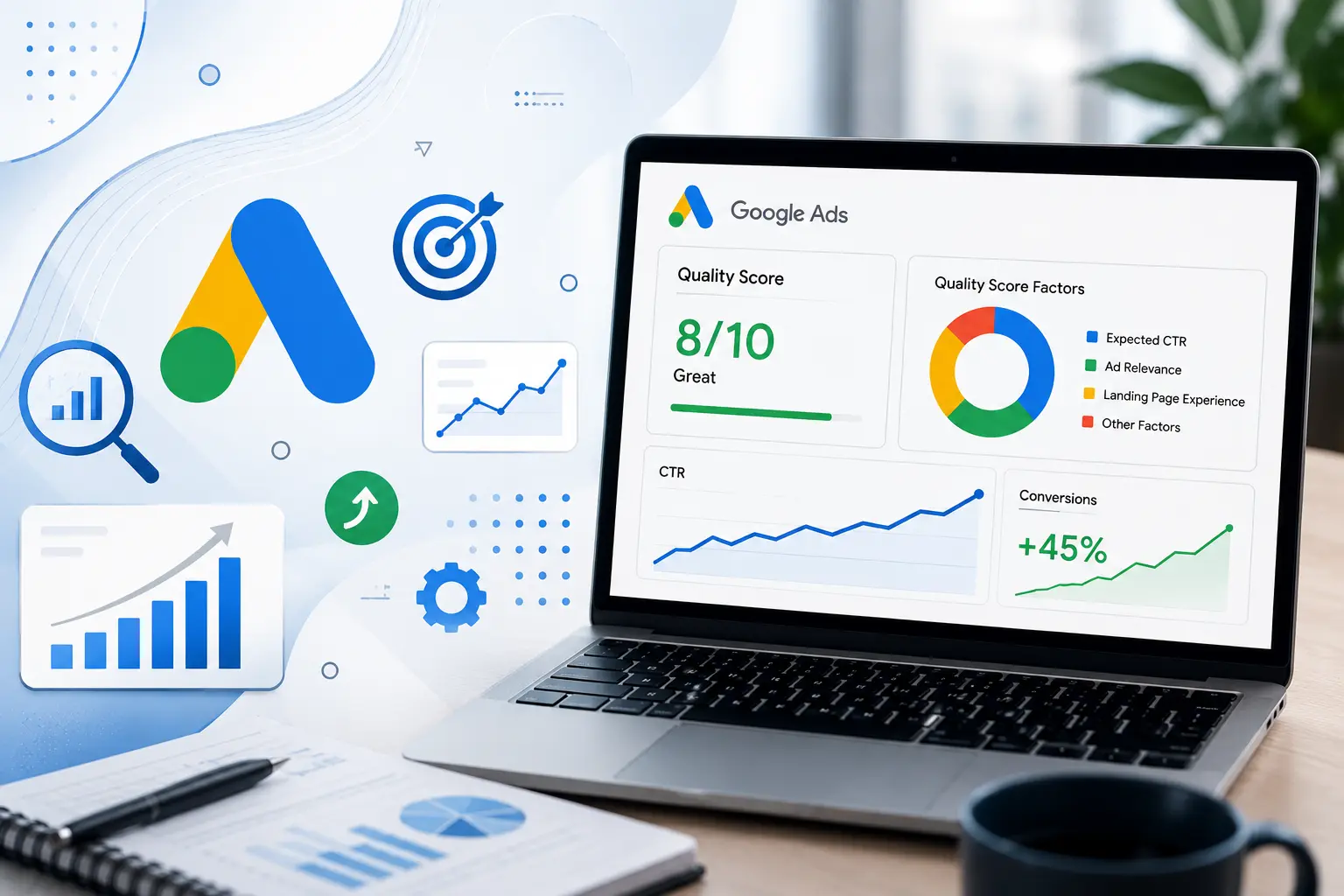
For each of the keywords in your Google Ads account, Google calculates a Quality Score ranging from one to ten. These scores are determined based on three criteria: expected click-through rate, ad relevance, and landing page experience. It may seem like an internal measure, but it matters a lot: the cost of the same keyword is likely to be 50 percent higher when its Quality Score is four compared to when it’s eight, based on the Google bid adjustment system. If we talk about AED 20,000 monthly budget, it might mean that you’re only getting half of what you paid for.
Quality Score improvement can be seen as a credit score of sorts: the higher it is, the more trusted advertiser you are, someone who satisfies searchers with relevant ads and earns Google’s favor in return. The lower it is, the noisier and less trustworthy you appear to be.
The secret dread behind this whole process of running Google Ads search campaigns is the feeling that your budget is being wasted not because of hard-to-beat market, but because of bad management. Many times, the clients’ concerns are right: the inflated cost-per-click numbers provided by your agency due to low Quality Scores are not only inefficient, but costly as well.
The Eleven Techniques, Organised by Where They Hit the Score
- Align your keyword with the search intent. Keywords such as “digital marketing” bring users ranging from students to procurement units in enterprises. Specific keywords like “digital marketing agency Dubai for SMEs” brings the buyer. Narrow search intent ensures higher expected click-through rate, which is the most important factor in Quality Score calculation.
- Create ads based on keyword and not categories. In case one searches for “affordable Google Ads management Dubai,” your headline must match it, not be “We Do Digital.” Ad relevance is measured through a comparison of ad copy to the query. The closer the matching, the better the scores.
- Create Single Keyword Ad Group (SKAG). This is a strategy that ensures ad relevance. By creating SKAG, all ads created will be highly relevant. It requires more work, but will reward you with lower cost per click within thirty to sixty days of high number of impressions.
- Create negative keywords on the first week, not third month. Any click that does not add value to your business is waste of money. Such clicks indicate that your ad is attracting traffic that is not qualified for conversion. A search campaign with no negative keywords list is a bucket with holes. Weekly analysis of search term reports to exclude non-converting items.
- Use keyword insertion sparingly. Dynamic keyword insertion can enable exact keyword to appear in your headline. Its proper use ensures highly relevant ad while improper use may lead to grammatically incorrect ads that reduce your expected CTR. Make sure you have a smart default headline in case of keyword insertions.
- Create three unique ad variations per ad group. Though Google’s responsive search ad system uses up to fifteen headlines and four description combinations, providing it with the same message three times makes it impossible to learn anything from it. Make sure that each headline provides different messages such as benefit, proof point or urgency.
- Match your landing page to the ad, not the homepage. This is the number one mistake made by SME accounts, leading to Quality Score erosion. The ad says “Google Ads management for Dubai restaurants.” The landing page brings up a page with the services overview for the agency. Google detects that there is no match. The visitor does not proceed to a further page. The score falls. Redirect the ad to the correct landing page.
- Prioritize speed optimization before scaling. Landing page experience is scored, among other factors, based on how well a page performs technically. According to studies, a page that loads within less than two seconds consistently performs better in terms of Quality Score and CTR compared to a site loading in four seconds or more. Run GTmetrix and Google’s PageSpeed Insights prior to scaling any campaign.
- Use ad extensions as a relevancy multiplier. Structured snippets, sitelink extensions, and callouts do more than add extra real estate to your ad copy. These add additional relevancy information to Google, thus helping it understand better what the ad is about and improving CTR prediction. Any search campaign should have four sitelinks and two callouts from the start.
- Check search impression share before assessing CTR. When your ad displays for only 30% of impressions eligible for display due to low Quality Score, CTR statistics will mislead you. You could be getting high CTR while losing the auction overall because you cannot compete due to low scores. Fix the problem first.
- Run a Quality Score Audit Quarterly. Your scores can vary with competitor actions, changes in landing pages and changes in search behavior. Account that got excellent Quality Scores in January could be degrading silently by April. Schedule regular Quality Score audit as a mandatory deliverable in your agency contract.
The Landing Page Problem Nobody Talks About in the Pitch Meeting
This is where the money goes missing, and it is rarely included in the standard agency report. A poorly performing landing page that does not provide fast loading time, does not address the search query, and does not offer any action to proceed further is going to destroy your Quality Score from the bottom up, regardless of how good your ad copy or keyword targeting was.
There is weighting applied to the three parts of the Quality Score. Landing page experience is not a secondary factor. Google always emphasizes that low quality, irrelevant, non-unique, or deceptive pages get the biggest penalties to the Score. One audit by WordStream among thousands of accounts showed that the advertisers whose pages scored badly in terms of the Quality Score paid CPCs more than 400% higher than those of the advertisers in the top tier of Quality Score performers. This is no small optimization opportunity. It is an actual structural issue.
A landing page is not just a brochure. It is a continuation of a dialogue started by the search query. Every word on the page should address the question of your potential customer, “Can you really help me with that particular task?” The answer of “yes” increases the conversion rate and decreases the bounce rate and improves your Quality Score.
What You Stop Being When This Finally Makes Sense
Knowing how the Quality Score works will make you not the client who nods and does not understand whether the numbers are good or not during the monthly review meetings. Instead, you will be the business owner who is asking the critical question: “What is the average Quality Score for our top twenty keywords, and what do we do in case of any scores below six?”
Asking this question one time completely transforms the dynamics of agency relationships, showing that you understand where the leverage lies, and you understand Google AdWords advertising enough to differentiate between the efforts and results. The budget discussions will be based on structure, not emotions.
The worst position to take in digital advertising is not to know anything about it. The second-worst is when you know enough to approve the spend but not to ask the questions about the score.