
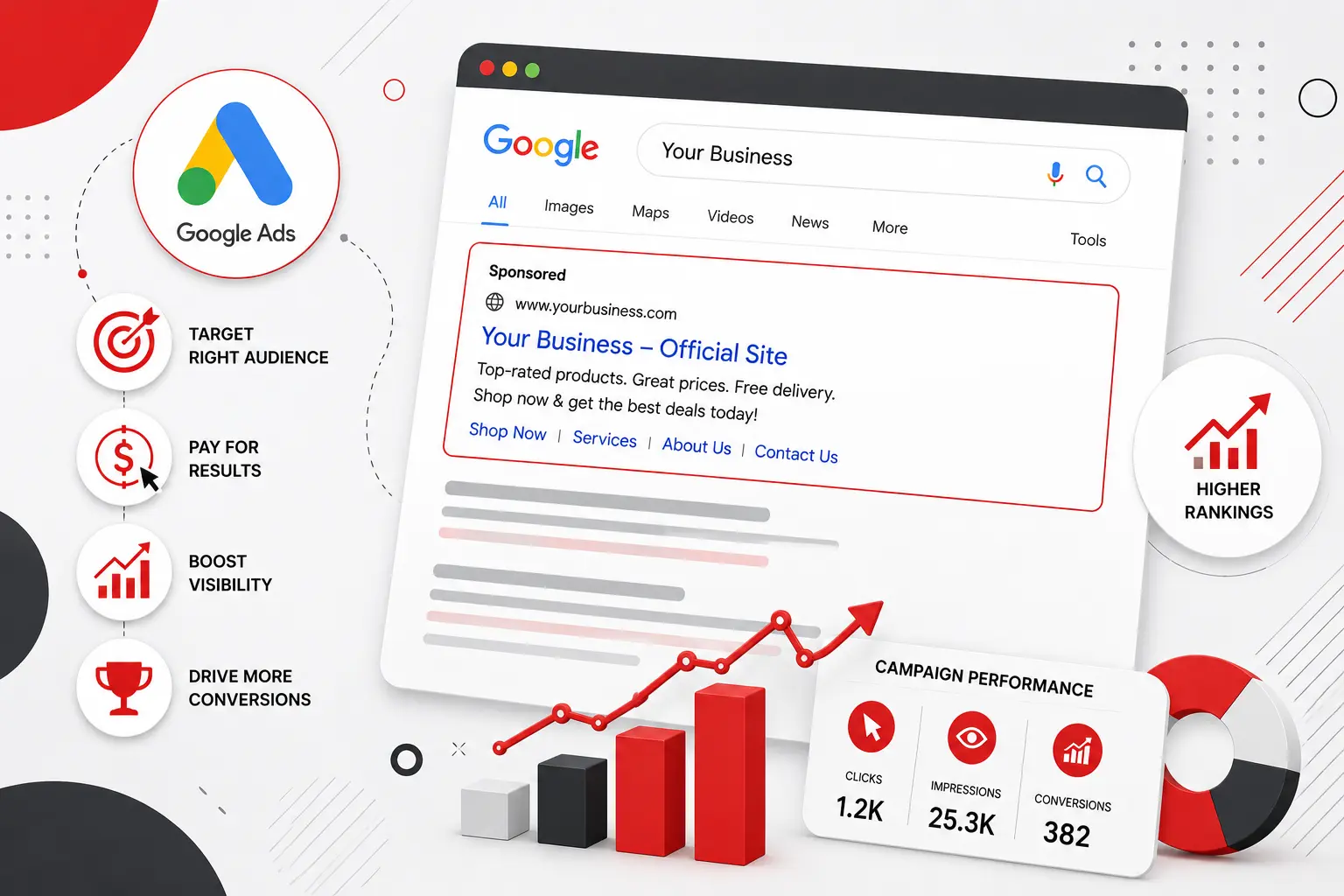
Welcome to the onboarding of a Google Ad account. Good news is that it is LIVE. The budgets are allocated. The business owner refreshes the page, types in their own service, and sees a shiver go up their spine as he/she sees their business name at the very top of Google.
Week 1 looks good. Four weeks into it, the shivers have ceased, and an uneasy suspicion has begun to set in. Business owner is getting clicks and spending money but the phone is no different than before they started.
This scene is repeated countless times in the UAE because it is precisely at this point that Google paid search goes from being an opportunity to becoming a trap. The difference between companies that succeed and fail in that trap is understanding why and how to fix it.
The Auction You Are Entering Is Not The One You Think You Are In
Google’s sponsored search results operate as a dynamic, ongoing auction, taking place millions upon millions of times per day. However, unlike a traditional auction, this auction rewards more than just the highest bid.
Your Google Ad will be weighed against its quality score, a rating comprised of the relevance of the ad itself, its click-through rates, and the experience of the user once they click on your site. Two businesses could be bidding AED 40 on the same keyword and yet pay different amounts, with their ad appearing in vastly different locations purely based on the quality of their site.
This reality makes Google advertising especially challenging in the UAE. Average cost per click in competitive categories such as legal, real estate, healthcare and financial services range between AED 50 and AED 100. Furthermore, in a market like the UAE, click fraud is more likely to occur than any other markets in the world. It can silently eat away at 10-20% of your entire budget with no leads gained at all. To enter this market without having a structured account is foolish, not brave.
Many UAE business owners carry a secret frustration within them and feel restricted from participating in an auction that they are already paying to join. Competition from competitors who are operating a properly structured account already possess all the benefits and advantages, like quality score, conversion history and algorithmic credibility. Newer accounts lack such strategic advantages. Think of it like the subscription pricing on a toll road. You can use the road, but without knowing about the subscriber rate you pay the regular rate forever. No one ever told you.
Entering the auction is not about beating your competitors out of the top spot. It is about out-engineering them. With a solid structure, relevant ads, well-matched landing pages and conversion tracking, your quality score will gradually become better and bring down cost per click in the UAE.
Why the Ad That Looks Right Is Usually Built Wrong
Walk into most UAE businesses running PPC search ads and ask to see the account. The setup you will likely see is one campaign, holding all services the business offers, ad groups with 20 to 40 keywords loosely tied together, one ad written and never changed afterwards, and destination URL pointing to the homepage. Sounds like a Google Ads account. Well, it behaves like one. But it certainly doesn’t perform like one, since the architecture is based on the product the business offers rather than on how the customer searches.
Relevance is the biggest underestimated factor in PPC advertising. A user in Dubai searching for ‘corporate lawyer UAE consultation’ knows what he needs. When the ad that shows up tells about the legal services in broad terms, and the page he arrives at has list of all services the firm provides, the experience resembles situation when the customer reaches for something on the shelf and is given a whole catalog instead. Relevance signal is lost in every stage. User leaves, bounce is registered, quality score drops, cost per click increases. It is totally avoidable, and starts with the creation of specific ads for specific searches, not general ads for general keywords.
Responsive Search Ads, introduced by Google and made the default format, now allow up to 15 headlines and 4 descriptions, rotated and tested automatically. The most common use case here is filling these fields with slight variations of the same generic phrases – ‘Trusted Experts’, ‘Call Us Today’, ‘Best Service in Dubai’. There is nothing to test here. Give the algorithm something to test like the headline that opens with customer’s problem, or with an outcome. Even differentiator headlines that highlight the situation or add some sense of urgency work successfully in generating ideal leads.
Now the machine has something to learn from. The difference in click-through-rate between the thoughtful responsive ad and laziness-filled one can be two or even three times. In competitive UAE auction it can mean everything.
The Mobile Gap That Is Quietly Killing UAE Conversions
Google’s own statistics show that the delay in mobile page loading of even one second results in reduction of conversions up to 20%. In the UAE, the majority of Google Ad clicks happen on mobile. 98% mobile penetration has made mobiles a primary conversion channel, still majorly ignored by most businesses. Ad is competitive. Copy is relevant. Landing page loads in 6.4 seconds on 4G and asks customer to fill the form with nine fields. Click was paid for. Conversion had no chance.
This is the gap between the reality of business and its perception of the PPC advertising performance. Landing page for paid search is not a webpage. It is a conversion tool. Its only task is to convert the person coming with a certain intention and move him to a single action. One headline, relevant to the search. Clear value proposition. Call to action, better if it is clickable on a phone. Anything else is distraction, and it costs a lot when it comes to AED 60 per click on the average.
Multilingual aspect only widens this gap. In the UAE, a large part of searches is in the Arabic language, and a big percentage is in Hindi and Tagalog languages, especially in sectors such as home services, healthcare and retail.
Yet the most common format in the country’s paid search campaigns is English-only campaign. That is a free gift to anyone who will make the effort. The cost per click for Arabic campaigns targeting the local intent keywords in sectors such as legal and financial is consistently lower than cost per click in English campaigns, not because of weaker intent, but simply due to thinner auctions. The opportunity is right there, untouched every day.
What Measuring the Wrong Things Is Actually Costing You
There is a particular type of agency report that makes for great visuals and reveals very little. It comes in on a monthly basis, is several pages long, brimming with thousands of impressions, an outstanding click-through-rate according to the agency, and a neat spend total that matches the budget. What this report lacks is a single line tying that spend to a qualified lead, a booked appointment, a WhatsApp call or even a sale. This is not necessarily bad faith. More often, it is the architecture of measurement that fails to answer questions of real substance.
Partnership with Google ads agency in Dubai that delivers real results is grounded on a different premise. The conversion tracking is set up before the first campaign starts and covers everything: phone calls, form submissions, WhatsApp clicks, and anything that amounts to a business action. Every campaign is assessed in terms of cost per lead, not cost per click. Budget allocation decisions are based on which keywords generate revenue, not traffic. It seems like an obvious statement. Still, it is not the case today in the UAE market.
At the heart of it lies the attribution problem. Last click attribution by default means that each conversion receives 100% of credit from the last ad click before the user converts.
In reality, the potential client who falls into consideration purchase category, a law firm, a medical clinic, a property developer can interact with 4-5 search touch points throughout several days until he finally reaches out. Upper funnel keywords that introduce the brand receive 0%. Branded searches that happen at the time of decision get 100%. Then, budgets flow to the bottom of the funnel, and campaigns that actually drive awareness get turned off because of poor performance. Data support this decision. Revenue does not.
Seasonal dynamics of the UAE market introduce the final layer of complexity that few accounts are set up to handle. Ramadan alters behaviour patterns, search volume dynamics, and auction competitiveness, requiring the bids to be adjusted beforehand, creative updates aligned with the holiday mood, and a modified ad schedule adjusted to match the hours when the intent is actually high. The Dubai Shopping Festival launches compressed periods of fierce competition and unprepared accounts end up paying far too much. It is no random event. It is a certainty of the calendar. To treat it as a surprise is a choice that has consequences.
Those who know how to set up paid Google search advertising the right way stop being advertisers and become something else they become the answer that pops up at precisely the right time for the customer, in precisely the language that customer speaks, on the precise device that customer uses, on a page designed to eliminate all doubts.
This is not a campaign. This is a system. And systems compound.
Once you stop thinking about paid search as a spend and start thinking about it as an engineered asset, you stop competing on the budget and start competing on intelligence and in the UAE market intelligence wins.