
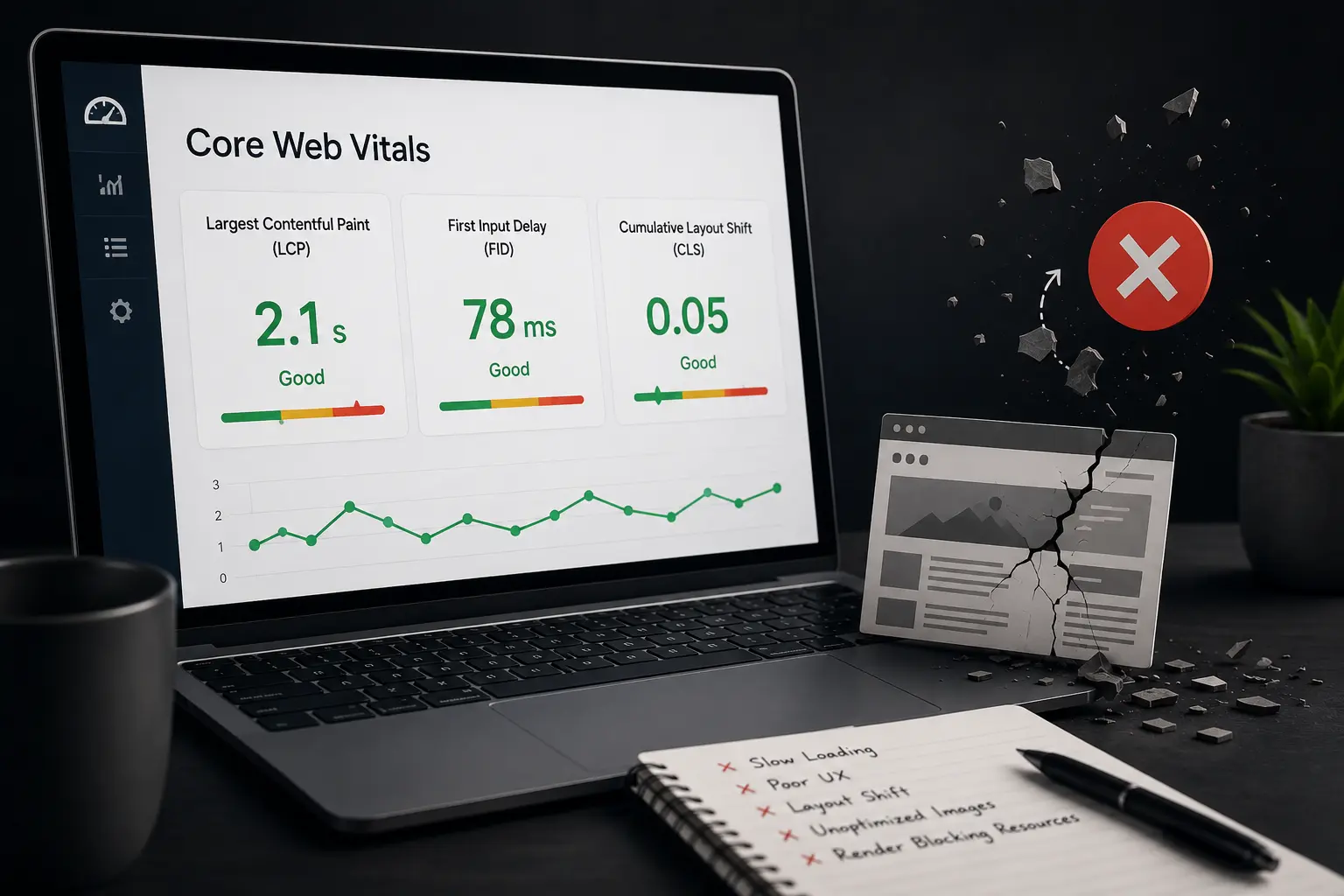
I was reviewing a client’s site last month. Clean design. Fast hosting. Recent redesign. Their team was happy with it. Then I ran a Core Web Vitals check. LCP was over 4 seconds. CLS was all over the place. INP? Not great either.
Nobody had caught it. Not during the build. Not after launch. The site just… sat there, quietly failing metrics that Google actively uses to rank pages.
This happens more than you’d think. And it’s not always about budget or effort. Sometimes it’s about what teams prioritize during a build and what they don’t even know to check.
The Metrics Most Businesses Don’t Actually Monitor
Core Web Vitals include three elements: speed at which your primary content loads (LCP), page stability during load time (CLS), and speed at which it reacts to users’ interaction (INP). These metrics have been used by Google as ranking signals since 2021. Many firms have not made the changes yet.
The problem isn’t awareness. Most people have heard of page speed. The gap is between knowing it matters and actually knowing where you stand. A lot of websites look fine in a browser but fail badly in field data real users on real devices, not a lab test on a fast connection.
Where the Failures Usually Come From
Unoptimized images are the biggest culprit, still. Hero images that are 2MB and served without lazy loading. No WebP format. No size attributes on the img tag, which means the browser doesn’t know how much space to reserve and that’s exactly what causes layout shift.
Third-party scripts are the other major issue. Chat widgets, ad tags, analytics platforms, cookie banners each one adds to the load chain. On mobile, that compounds fast. A site that loads in 2 seconds on a laptop can take 5+ on a mid-range Android phone with a 4G connection.
Fonts are also worth looking at. When a site loads a web font that’s not preloaded, you get a flash of invisible text or a sudden style shift. Users see it. Google measures it.
Why This Is a Bigger Deal in Oman Right Now
Mobile internet usage across the GCC is high. Oman is no different. A large share of site visits happen on phones, often on networks that aren’t always stable. If your site isn’t built to perform under those conditions, you’re already working against yourself.
I’ve seen this pattern repeatedly when auditing sites built by teams who didn’t account for local infrastructure. A website development company Oman that understands the actual device and network context here will approach performance differently than one applying a generic template.
It’s not just about build quality either. Content, hosting location, CDN setup — these all affect how a site performs in Muscat versus how it performs in London. Same files, different experience.
What Good Performance Work Actually Looks Like
The Real Picture of What Good Performance Work Entails
It happens from the get-go.Post-launch, performance involves monitoring. CrUX data is collected over time. It must be monitored on a monthly basis, rather than simply conducting an audit and leaving it at that. Rankings may change without your knowing it. And you’ll want to be prepared to address them before they impact your traffic.
For businesses running SEO or paid campaigns, performance issues directly affect cost and results. A slow landing page hurts Quality Score in Google Ads. Poor Core Web Vitals reduce organic visibility. These aren’t separate problems they compound. Any web design company in Oman handling both build and growth work should be treating performance as a shared priority, not a separate task handed off to developers.
The Gap Between a Good-Looking Site and a Performing One
Design and performance aren’t opposites, but they do require deliberate coordination. A site can be visually polished and technically broken at the same time. That gap is where most businesses lose ground without realizing it.
If you’re working with digital marketing services in Oman and also managing a website, it’s worth asking whether the performance side is getting the same attention as the creative side. Run a CrUX check. Look at PageSpeed Insights field data, not just lab scores. See what real users are experiencing.
The fix isn’t always complicated. But finding the problem requires actually looking for it.