
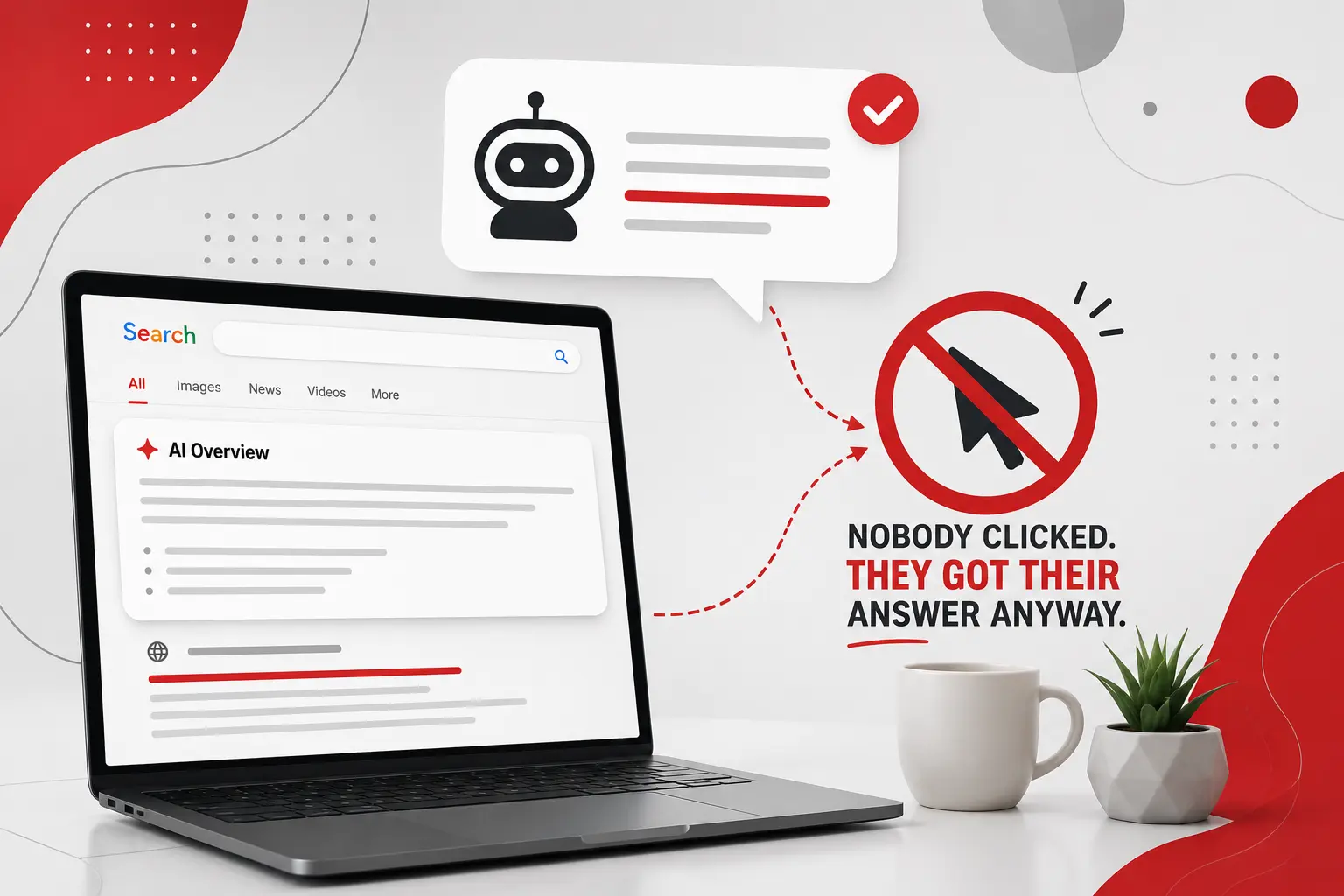
Something quiet happened to the way people use Google. They stopped leaving.
You type a question, the answer sits right there at the top, and that’s it. No blue link. No visit. No traffic for the site that did the actual work of writing that answer. People call this a zero-click search, and it has been chewing through the organic traffic a lot of businesses spent years building.
Here’s the part that stings. The information is still yours. Google just borrowed it and skipped the introduction.
Watch how you search now. “What time does the bank close.” “How tall is Burj Khalifa.” “Best day to post on Instagram.” The answer shows up before you finish reading the page. You never clicked a thing. Now multiply that by millions of small questions a day. That’s where your visitors went.
It is important for any marketer who works in digital marketing in Saud Arabia because of the fast development of its Internet market: people make searches in Arabic and English, do them on their smartphones during dinner and want the answer right now. If your strategy was based on achieving first place in Google and then getting traffic through it, the situation has changed drastically.
So what do you do when the click disappears?
You stop chasing the click. You chase the moment.
If Google is going to show your answer anyway, be the one it shows. Write the clearest answer to the question your customers actually ask. Make it short. Make it honest. Make it better than the half-guess sitting in that gray box. When someone reads your name inside that answer, you got paid in trust, even without the visit. That counts for more than a bounce.
Then give them a reason the box can never satisfy.
A box can tell you a price. It can’t show you the work. The good website design companies in Saudi already figured this out. They build pages that answer the quick question fast, then quietly hold open a door to the bigger one. The thing you can’t squeeze into two lines. The reason a person stops scrolling and reaches for the phone.
Think about the last time a snippet truly satisfied you. Probably a fact. A date, a number, a yes or no. Now think about the last time you actually bought something that mattered. You didn’t buy it from a snippet. You bought it because something earned a second look from you.
That gap is the whole opportunity.
Talk to any sharp digital marketing agency Saudi brands rely on and you’ll hear a version of the same advice. Stop measuring success by traffic alone. Traffic was always a stand-in for the real thing, which is attention that turns into action. A thousand visits that bounce are worth less than thirty people who showed up already half convinced.
Some practical moves, none of them magic:
Answer the boring questions on purpose. The ones too small to feel worth a page. Those are the ones feeding the answer boxes, and they build quiet authority while your competitors ignore them.
Own the questions a box can’t close. Comparisons. Trade-offs. “Is this right for me.” The messy human stuff that needs a real page and a real point of view.
Make your brand worth searching by name. When people skip the question and just type your name, the algorithm stops being your landlord. That’s the long game, and it’s the only one worth playing.
Build for the second visit, not the first click. Give a reason to come back. A reason to remember you. A reason to tell someone else.
None of this is a trick to beat Google. It’s older than Google. Be useful, be clear, be the name people trust enough to look up on purpose.
The search box isn’t your enemy. Pretending it’s still 2015 is.
The click was never the point. It was just the easiest thing to count. The work now is earning attention you can’t measure in a dashboard, the kind that walks in the door already knowing your name.
Start there. The traffic was always a side effect anyway.