
Most websites are a junk drawer.
A post here. A landing page there. A blog nobody’s touched since the rebrand. Each piece written by someone who meant well, dropped into a pile, and forgotten.
We keep adding to the pile and calling it a content strategy.
It isn’t. It’s hoarding.
The thing holding it all up
Content architecture is the invisible structure underneath your content, the scaffolding you never see in the finished site but feel the second it’s missing.
It’s how the pages relate. What sits above what. Which page is the authority and which ones support it. The logic a visitor never notices, because it’s working and notices instantly when it isn’t.
You’ve done this work without naming it. Every time you arranged a page for emphasis, built a menu, or decided what should link to what, you were an architect. Most teams just never make it deliberate.
That’s the whole difference between a site that ranks and one that doesn’t. Not more content. Better-organized content.
A library, not a pile
Picture a thousand books dumped in the middle of a room.
Now picture those same thousand books in a library shelved, labeled, cross-referenced, with a clear path from the front door to exactly the thing you came for.
Same books. Wildly different values.
The difference is architecture. And SEO content structure is just the library science of the web: organizing your pages so both a human and a search engine can walk in, understand what you’re an authority on, and find the exact answer without getting lost.
Google has always been, at heart, a librarian. It doesn’t reward the biggest pile. It rewards the best-organized shelf.
The blueprint: pillars and clusters
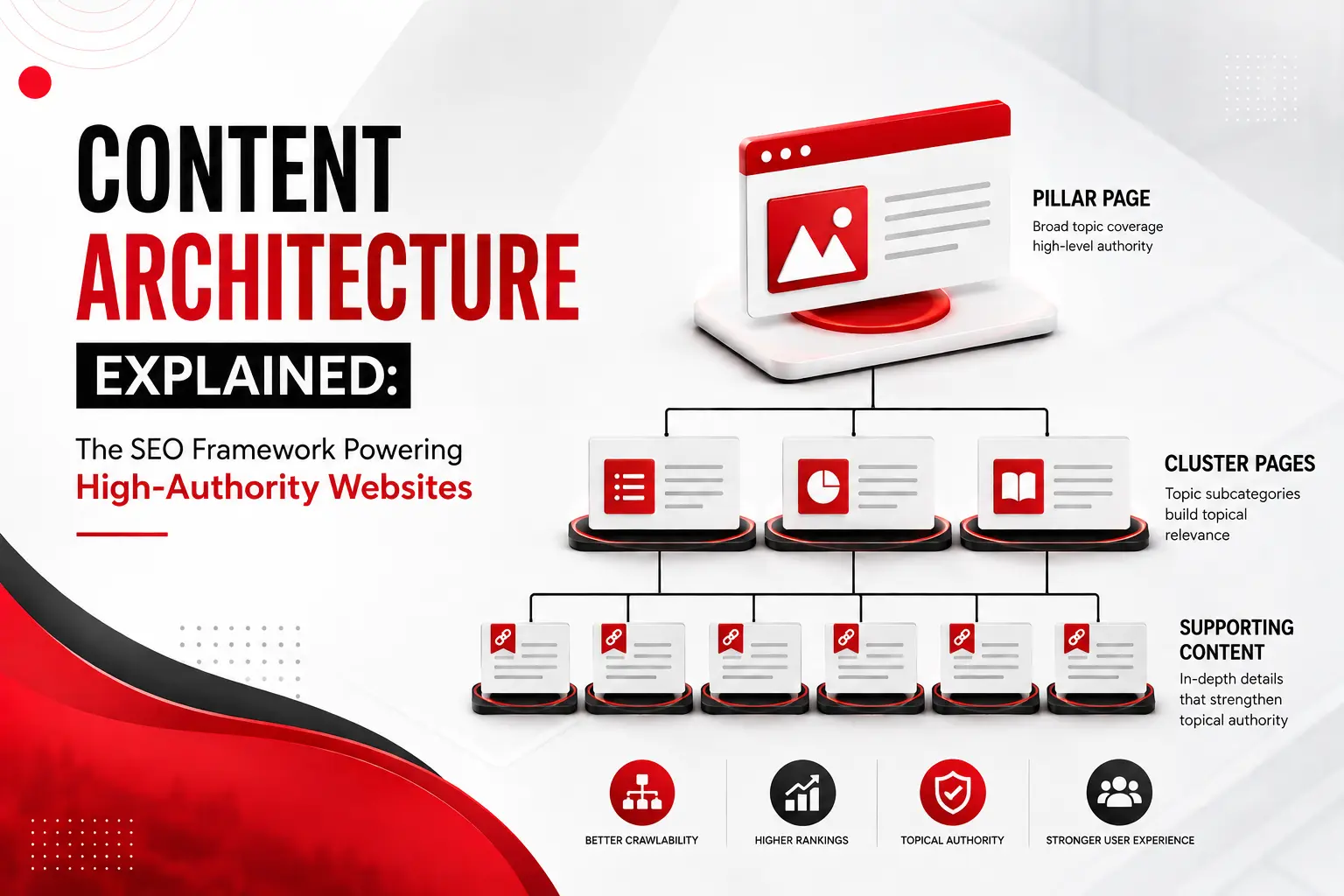
Here’s the structure that does the work. Three parts.
The pillar: your main hall
A pillar page framework starts with one broad, comprehensive page on a topic you intend to own. Not a thin overview of the definitive room. The place that says, plainly, this is what we know more about than anyone.
If you sell project management software, your pillar is “project management” itself. Big. Foundational. The front hall everything else opens off of.
The pillar doesn’t try to say everything. It says the important things, then points down the hallways to the rooms where the details live.
The clusters: the rooms
Around the pillar, you build a topic clusters strategy, a set of focused pages, each answering one specific question inside the larger topic.
“How to run a sprint retrospective.” “Gantt chart vs. Kanban.” “Project management for remote teams.” Each one its own room, deeply furnished, answering one thing completely.
A single great post is a lucky shot. A cluster is a claim. Ten interlocking pages on one subject tell the librarian something a lone article never can: these people live here. This is their territory.
That’s how topical authority gets built not by going wide across a hundred subjects, but by going deep on a few.
The hallways: internal links
Then you connect them. This is internal linking architecture, and it’s the part most teams skip.
The pillar links down to each cluster page. Each cluster page links back up to the pillar and sideways to its siblings. The links aren’t decoration, they’re hallways. They guide the visitor as to what page to visit next and also tell the search engine how these rooms connect with each other.
A link acts as both a vote and a map for you. The link helps you transfer authority from your best performing pages to those which require authority. It also provides a map of your entire web site.
A brilliant page with no links pointing to it is a room with no door. Nobody finds it. Not the human, not the machine.
Why this is how authority actually gets built
Authority isn’t a single viral post. It never was.
It’s the accumulated signal of a site that clearly, deeply, and coherently covers a subject. The pillar declares the territory. The clusters prove the depth. The links bind it into something a search engine can read as a whole, rather than a scattering of parts.
This is also why it travels well into the age of AI answers. The machines that now summarize the web reward exactly what good architecture provides: clear topical focus, clean structure, and obvious relationships between ideas. Build the library well, and you’re legible to every reader, human, crawler, and language model alike.
Build it so it scales
The quiet payoff of architecture is scalable content planning.
When you have a blueprint, every new piece has a home before it’s written. You’re not asking “what should we post this week?” a question that produces junk drawers. You’re asking “which room needs another shelf?” a question that produces a library.
Gaps become obvious. Redundancy becomes obvious. A new writer can see exactly where their piece fits and what it should link to. The structure does the thinking, so the team can do the writing.
That’s the difference between content that compounds and content that just accumulates.
So here’s the move
Stop adding to the pile.
Pick the one topic you genuinely deserve to own. Build the pillar. Surround it with the cluster pages that answer the real questions inside it. Wire them together with links that actually mean something. Then do it again for the next topic. And the next.
You’re not writing more. You’re building something a structure that gets stronger every time you add to it, instead of messier.
The websites that win aren’t the ones with the most pages.
They’re the ones where every page knows exactly where it lives.
That was always the secret.
The architecture was just invisible enough that most people forgot to build it.
FAQ
What is content architecture in SEO?
Content architecture is the underlying structure that organizes your pages into a logical, navigable system: what’s a pillar, what’s a supporting cluster, and how everything links together. In relation to SEO, it is the structure which enables both readers and the search engines to understand the expertise you have on the topic and reach the correct conclusion in time. It may be invisible in the final website, but it differentiates a collection of books from a bunch of unrelated articles.
Why are topic clusters important for SEO?
Because depth signals authority. A single article on a subject is easy to dismiss; a cluster of interlinked pages covering every angle of that subject tells search engines you genuinely own the topic. Clusters also match how people actually search broad questions and narrow ones alike so you capture the full range of intent around a subject instead of one keyword. The result is stronger topical authority and more consistent visibility.
How does internal linking improve search visibility?
Internal links do two jobs at once. They guide visitors from page to page, improving the experience and keeping them on your site. And they pass authority between pages while mapping the relationships among them, which helps search engines crawl your site and understand its structure. A well-linked page is easier to find, easier to rank, and clearly connected to the topics it belongs to while an unlinked page is effectively a room with no door.