
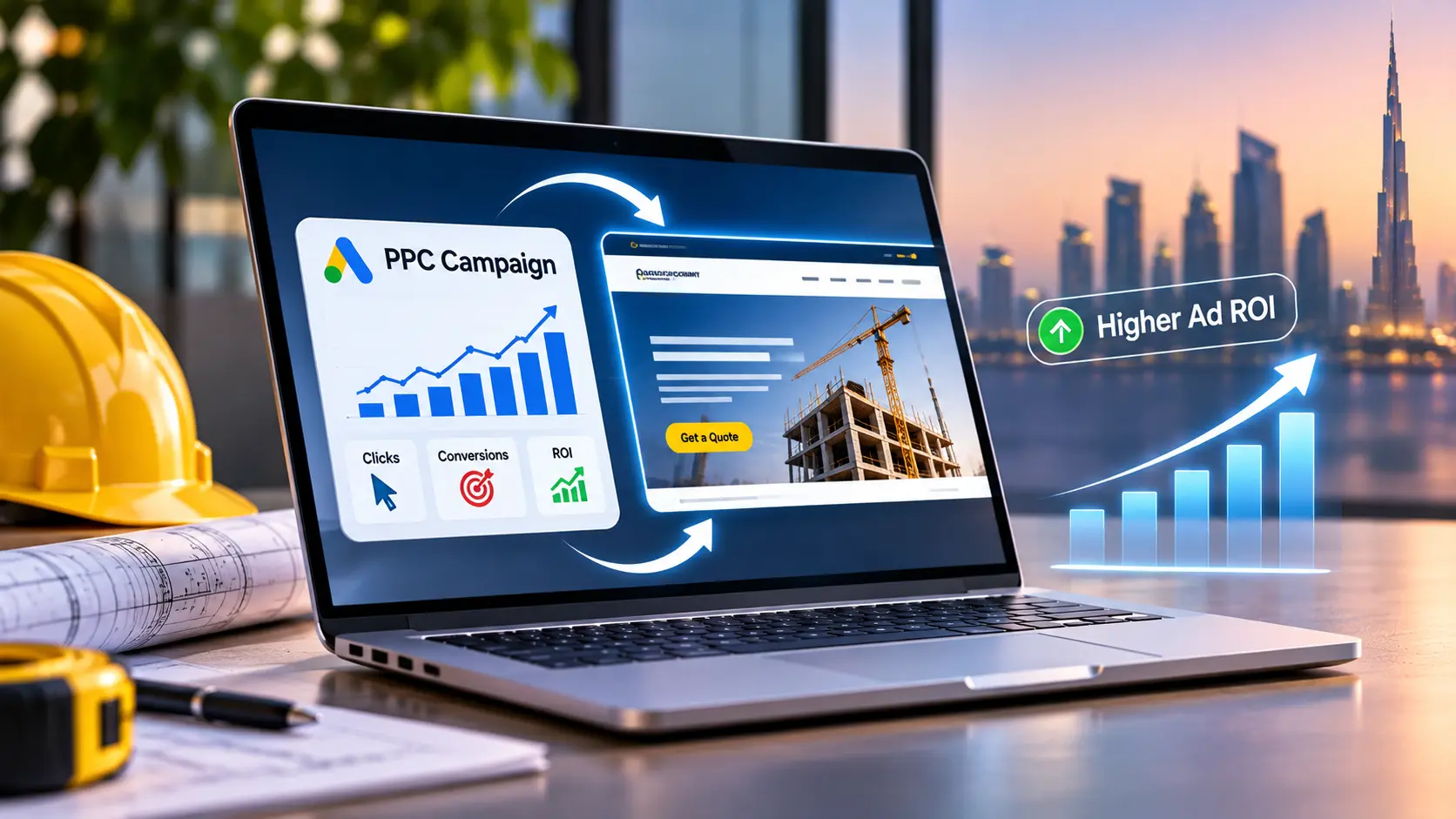
Here’s the cruelest piece of math in marketing. You pay Google for the click. You do not get a refund when a contractor looking for a fit-out company lands on your page, squints, and leaves three seconds later.
The click costs money. The bounce is free to Google. It costs only you. And in Dubai’s construction sector, where a single keyword like “villa contractor Dubai” or “commercial fit-out company” can cost real money per click, every visitor who arrives and immediately leaves is a lead you paid full price for and got nothing from.
And most contractors, when that happens, go and rewrite the ad.
The invitation and the site
Think of a construction PPC campaign as inviting a client to visit a job site.
The ad is the invitation. The keywords, the copy, the project photos, that’s the work of getting a developer, a facility manager, or a homeowner to say yes and click through. It’s important. It’s also only half the job.
Because then they arrive. And what happens next, whether they can see your completed projects, whether they can find your DM/CED licensing, whether they can request a quote without a fight, that’s the website. You can write the most compelling ad in the world; if the site looks unfinished, slow, or vague about what you actually build, your visitor leaves before you ever get the call.
PPC optimization in construction has always been treated as an advertising problem. It’s really a credibility problem. You spent money to get a decision-maker through the door. What they find once they’re there decides whether that spend was worth anything.
Where the money actually dies
When leads dry up, watch where contractors and developers look first. The keywords. The bids. The ad copy. The project photos in the campaign. They tune the invitation, over and over.
They almost never look at the one place the lead actually gets won or lost: the page the visitor lands on.
That’s the blind spot of the whole discipline. You can target “warehouse construction Dubai” perfectly and run the sharpest ad in the market, but if it leads to a slow site, a vague services page, or a contact form with twelve fields, all of that spend was wasted on nothing. The ad’s job ends at the click. Everything that determines ROI happens after it, on a page most construction marketers barely think about.
Google charges you twice (and rewards you twice)
Here’s the part that turns landing page design from “nice to have” into “directly tied to ad ROI” for a construction business.
Google not only analyzes your ad but also analyses the experience that follows after clicking your ad, which is known as the landing page, and this experience influences your quality score. A good landing page experience leads to a good quality score, which leads to less cost per click and better positioning compared to other competing contractors. The same monthly ad budget buys more clicks, in better positions, simply because your page is good.
So landing page UX pays off twice for a construction advertiser. Once when more site visitors turn into RFQs. And again when Google charges less for every click, because it can see you’re sending people somewhere worth going. A weak landing page is a double tax: it converts fewer leads and makes each click more expensive. Fix it, and both move in your favor at once.
Keep the promise the ad made
The single biggest thing a construction landing page does is keep or break a promise.
The click was a sign of trust. A developer clicked because your ad convinced them you build exactly what they need, a warehouse, a villa extension, a commercial fit-out. You have about three seconds to prove them right or lose them. If the ad says “Commercial Fit-Out Specialists in Dubai,” the landing page needs to show commercial fit-out work, not your general homepage, not a generic “all services” page, not a pop-up asking them to subscribe to a newsletter first.
This is message matching, and it’s the foundation of conversion-oriented website design for construction PPC traffic. Every gap between what the ad promised and what the page delivers is a small deception, and you’ve paid for every one of them.
What a high-converting construction landing page actually does
Good PPC landing page design for a contractor or developer isn’t mysterious. It does a few things relentlessly well:
It loads instantly. Half of visitors expect a page in two seconds or less, and construction sites, often loaded with high-resolution project photography, are frequent offenders. Every second of load time is quotation requests leaking out.
It works on a thumb. A large share of construction leads in Dubai now start on mobile, a facilities manager searching mid-site-visit, a homeowner browsing in the evening. If the page is awkward on a phone, the campaign is awkward on a phone, which is to say broken.
It’s clear, not clever. One obvious service, one obvious next step, “Request a Quote,” “Book a Site Survey”, no clutter of every service the company has ever offered competing for attention.
Its forms are short. Ask for the project type, location, and contact details, and nothing more. Every extra field is a reason a busy developer abandons the form. The quote request is the finish line; don’t keep moving it farther away.
It earns trust fast. Completed project photos, DM or trade licensing, client logos, and real testimonials, small signals that say “this contractor has actually built things like this before.”
CRO is cheaper than bidding
Here’s the strategic punchline, and the reason it matters more in 2026, not less, in a market as competitive as Dubai construction.
When you want more leads, there are two moves. You can bid higher, pay more per click, racing competitors for the same “contractor near me” keywords, squeezing your margins. Or you can convert more of the clicks you’re already paying for.
The first is an arms race. The second is CRO for construction PPC campaigns, and it’s almost always the better trade. Doubling your landing page’s conversion rate is the same as halving your cost per lead, without spending an extra dirham on media. A serious paid traffic strategy for a construction company spends at least as much attention on the landing page as on the bid, because that’s where the cheap wins live.
So here’s the move
Click your own ad. On your phone. Time it. Then act like the client you just paid to attract.
Did the page keep the ad’s promise in three seconds? Did it load before you got bored? Could you request a quote without hunting for a phone number or wrestling a form? If not, you’ve found the leak, and it’s been draining your ad budget every time someone clicked. The winners of 2026 in Dubai’s construction market won’t be the companies bidding the highest.
They’ll be the ones that stopped throwing money at the invitation and finished building the house. You’ve already paid to bring the client to your site. At least be ready when they arrive.
FAQ
Why are landing pages critical to PPC campaign success for construction companies in Dubai?
The conversion occurs from the landing page, not from the ad. You will be paying for each click even if the user does not ask for a quote or simply leaves the website. This is why if your landing page is not good enough, you are going to pay the full cost for the developers, contractors, and home owners who left the website without contacting you.
How does landing page experience affect Google Ads performance for construction keywords?
An inadequate landing page affects the advertisements negatively due to the Quality Score. This incorporates such considerations as the relevancy of the page with respect to the keyword, load speed, and mobile usability. In an expensive cost-per-click category such as Dubai construction, a bad experience with the landing page implies high cost per click.
What elements make a high-converting construction PPC landing page?
Fast loading speed (two seconds or less), design that is optimized for use on a mobile device using one hand during site visit, and consistency between the message of the ad and the information available on the page, the commercial fit-out ad pages should direct traffic to commercial fit-out projects rather than a home page. In addition to these elements, there should be a clear value proposition, one call to action such as “Request a Quote,” a short form with just basic information, and credibility markers like licenses, past jobs, and customer testimonials.