
For as long as there’s been online shopping, the job was to get on the shelf.
Rank on the results page. Win the product carousel. Show up among the forty options so a shopper, scrolling and squinting, might pick you. We optimized it to be findable. One of many.
The shelf is disappearing.
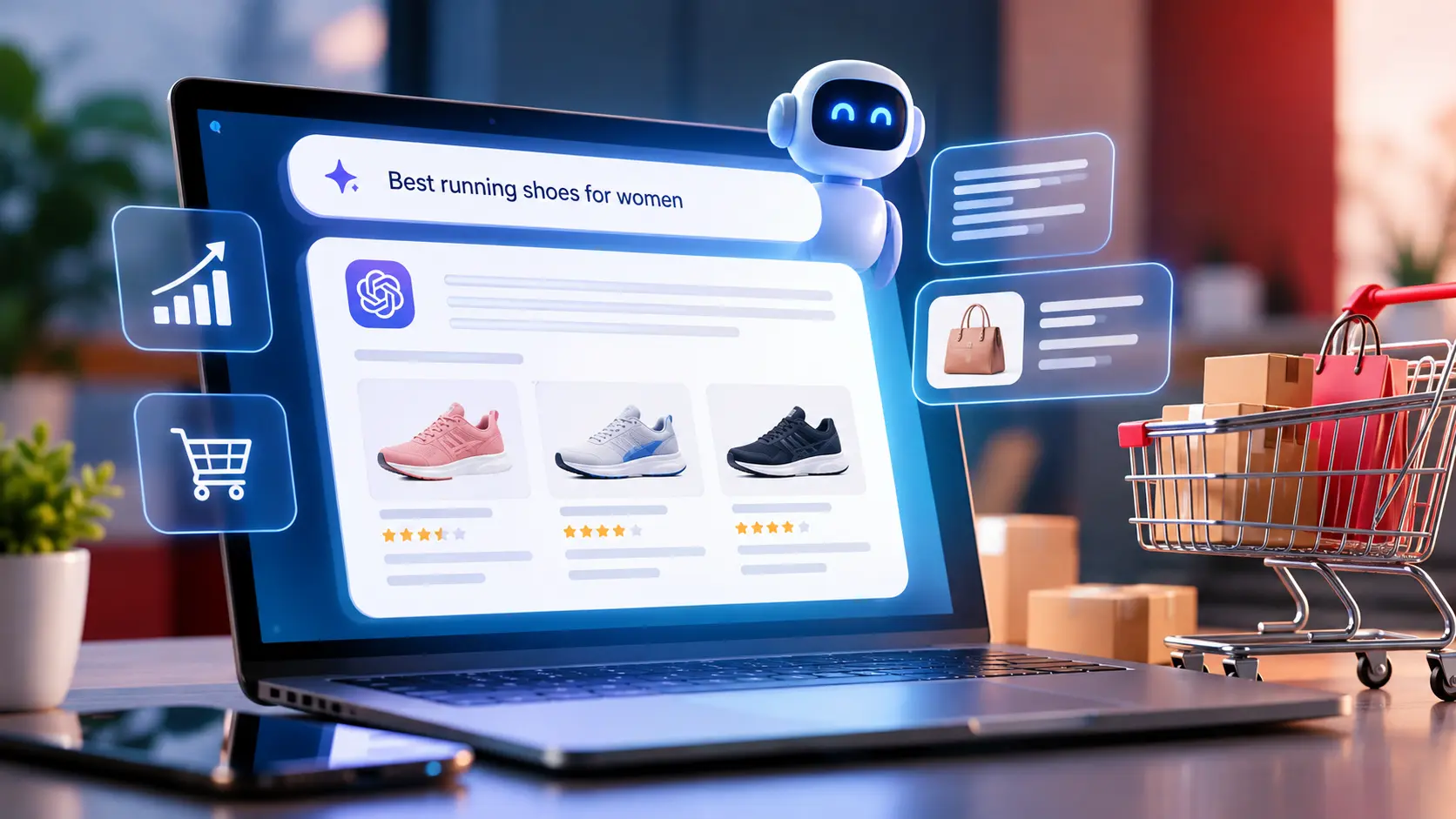
Now a shopper opens ChatGPT and types, “what’s the best protein powder that’s easy on the stomach?” and instead of forty options, they get three. Named. Recommended. With a little card, a price, a link.
You’re not competing for the shelf anymore. You’re competing to be one of the three.
From visibility to the shortlist
This is the shift that makes AI search for ecommerce a different game, not a tougher version of the old one.
Old ecommerce SEO was a numbers game: be present, be crawlable, be one of the many, and let the shopper do the sorting. The funnel was wide at the top and the customer walked down it themselves – searching, comparing, second-guessing, choosing.
AI search collapses that funnel. The machine does the comparison. It reads the reviews, weighs the options, and hands the shopper a shortlist of two or three before a human eye sees anything. Product discovery with AI isn’t a longer list. It’s a shorter one, and it’s already been decided.
Which means the entire game moved upstream. The contest isn’t “can they find me.” It’s “will the machine name me.”
Meet the salesperson who read every review on earth
Here’s the most useful way to picture what you’re now selling to.
Now consider an assistant who has read all the reviews, all the comparisons, all the Reddit discussions, all the spec sheets ever written about anything. A customer approaches, and he says, “I’m looking for running shoes for flat feet under $100.” The assistant doesn’t just pull out a wall of shoe boxes. He says, “Buy these two.”
That assistant is the generative engine. And your product page is no longer a copy for a human to skim. It’s the brief you hand the salesperson so it knows when to recommend you. If the brief is vague, you don’t get named. If it’s clear, specific, and matched to a real need, you do.
That’s the whole of AI search ecommerce SEO in one image: stop writing to be browsed, start writing to be recommended.
Why this converts better than your best ad
This is the part where you need to take notice: being named by the AI is not only visibility; it is largely a paid proposition.
The reason why the consumer is wary when they use the old school search engine method is because each one of their search results is a stranger who wants to sell them something. With the recommendation from an AI assistant, the consumer shows up predisposed to purchase.
So yes done right, AI SERP ecommerce signals can lift conversion, not just traffic, because the visitor who comes from an AI recommendation is the warmest lead you’ll ever get. They didn’t find you. They were vouched for to you. Fewer clicks, maybe but each one pre-sold.
Write the page for the salesperson, not the skimmer
This changes how you write a product page, completely.
A human skimming forgives a vague description. A machine deciding whether to recommend you does not. It needs two things spelled out plainly: who is this for, and why does it matter.
“Lightweight wireless earbuds” tells the machine nothing it can match to a query. “These earbuds stay put during workouts and last a full marathon on one charge” tells exactly which shopper to hand them to. “Ergonomic mesh chair” is invisible. “Supports your back through an eight-hour workday” gets recommended. Spell out the use case, the person, the benefit, in plain language, not spec-sheet shorthand. The clearer the match, the more often you’re the answer.
The signals that get you recommended
Beyond the words on the page, a handful of moves decide whether the machine can find and trust your products. The real ecommerce search ranking work in the AI era:
- Let the crawler in. If your robots.txt blocks the AI shopping crawlers, you don’t exist in their answers. Check this first; it’s the silent killer.
- Structure your product data. Product schema is how a machine reads your catalog cleanly. This isn’t optional anymore.
- Bring real reviews and Q&A. Models lean heavily on first-party reviews and answered questions to understand who a product is for.
- Publish the comparison content. “Best X under $Y,” “A vs B,” “alternatives to Z” with tables and a clear verdict. These are exactly the prompts shoppers ask, and the pages AIs pull from.
- Build a footprint off your site. A mention in a trusted roundup or a genuine Reddit thread often matters more than another page on your own domain.
- Keep it fresh. Stale prices and dead links get you dropped. Update the important pages on a schedule.
A preview from the front: the UAE
Looking at ecommerce visibility in UAE reveals the areas where this is progressing rapidly.
This is the case where AI-enabled buying is on the way in a mobile-first, multilingual environment, which is predominantly mobile-based for its online commerce. The companies that will succeed here have structured their product information properly, garnered authentic reviews, and written detailed descriptions in Arabic and English to enable the machine learning algorithms to match the products to the relevant user in their language.
So here’s the move
Go ask ChatGPT what the best product in your category is. Watch what it says.
If it names a competitor and not you, you’ve just seen the new shelf and your absence from it. Now go fix the brief: let the crawler in, structure the data, spell out who each product is for, and earn the reviews that vouch for you.
The old job was to be findable on a shelf of forty.
The new job is to be the answer when someone asks what to buy.
Be the recommendation. That’s where the sale now lives.
FAQ
How is AI search changing ecommerce product discovery?
It’s collapsing the funnel. Instead of browsing a long results page or an Amazon grid, shoppers now ask tools like ChatGPT and Google’s AI Overviews what to buy and get two or three specific, named recommendations. The machine does the comparing and shortlisting before the shopper sees anything. That moves the contest upstream: you’re no longer competing to be findable among many options, you’re competing to be one of the few products the AI recommends by name.
What content helps ecommerce websites appear in AI-generated answers?
Content that can be understood by the machine and matches the needs of a buyer. This entails proper product schema (product price, availability, product characteristics, and reviews); natural-language-written product description explaining for whom and why the product is important; first-party reviews and question-and-answer pages similar to FAQs; and comparison pages like “best X under Y dollars” pages complete with tables and conclusions. More importantly, give your AI shopping crawlers access to your website, especially for high-value pages.
Can AI search increase ecommerce conversion rates?
Sure, and often times even more so than traffic. Someone who is visiting because he/she was recommended by AI to do so has been screened as a good fit for you – the machine has considered all the alternatives and decided that your product is worthy of recommendation, meaning that the potential customer has come to you predisposed towards liking what you have to offer. You won’t receive many hits compared to a general search, but those hits will be high quality leads.