
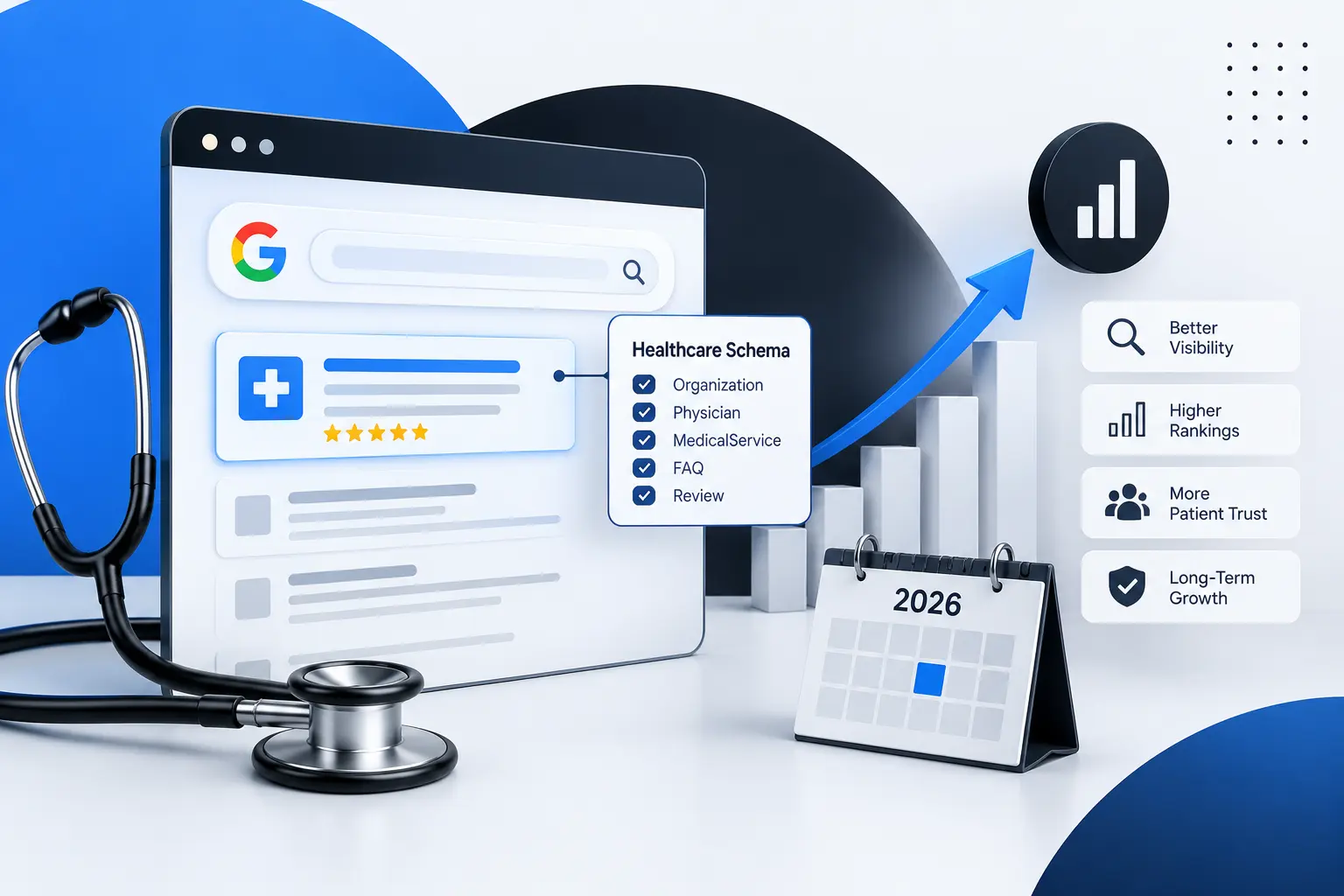
You added MedicalOrganization and Physician markup to your Dubai clinic’s website last Tuesday. It’s Friday, your rankings on google.ae look identical, and the phone hasn’t rung any louder. Was the developer time wasted? Is the code wrong? Did a competitor just outspend you?
Nothing has gone wrong. “How long does healthcare schema take to rank in the UAE” is one of the most common questions clinics and hospitals ask their SEO teams, and the honest answer has two halves. The code can be recognised within hours. The impact behaves nothing like a lever you pull to lift positions. Schema changes how Google, and now UAE users searching through AI answer engines, understand and present your pages.
First, a reality check: schema is not a direct ranking factor
Clear this myth before spending another dirham on structured data. Google has repeated for years that structured data is not, on its own, a ranking signal. Add perfect markup to a physiotherapy page sitting on page four for “physiotherapy Dubai Marina” and it will not jump to the top three because of the code.
What schema does is more valuable for an organization operating within the healthcare sector in 2026. Structured data is a tagging language in JSON-LD that tells search engines precisely what is on the page: this is a clinic, this is a doctor, this is the specialty, this is the license, this is the location in Abu Dhabi.
That machine-readable clarity unlocks three things:
- Rich and enhanced listings – map placement, business details, breadcrumbs, and other visual extras that make your result larger and easier to trust.
- Eligibility for SERP features – the local pack for “near me” searches, knowledge panel information, and site links that dominate branded queries.
- Better machine understanding – which matters more than ever now that AI-powered search and answer engines synthesise responses from well-labelled content. Clearly structured medical pages are far easier for these systems to read, quote, and attribute correctly.
So the real question is not “when will schema raise my rankings?” It is “when will schema start improving my visibility, my local presence, and my click-through rate?” That has a measurable answer.
The realistic timeline: what to expect and when
Stage 1: Recognition (hours to two weeks)
Schema will come into play immediately after Google crawls the page again and indexes it based on the new schema. There is no separate “schema review queue.” It rides along with normal crawling, so the timeline depends almost entirely on how often Google visits your site.
- Established, authoritative sites – a large hospital group in Dubai or Abu Dhabi that publishes often and gets crawled frequently can see new markup recognised within hours to a couple of days.
- Newer or smaller clinics – a single-branch practice with fewer pages and less crawl activity usually waits one to two weeks.
Speed it up by requesting indexing for the updated URL in Google Search Console, and by linking the page well internally from your service and location pages.
Stage 2: Rich result eligibility (days to several weeks)
After Google completes processing your markup, then you will be qualified for enhancements. The qualification is not an assurance. It will be at the discretion of Google whether to apply the enhancements based on the quality of the page, the authority of the website, and the relevance of the enhancements to the searchers’ needs.
Here comes the difference that the healthcare industry has over the other industries. For local and organisation markup, UAE clinics commonly see enhancements appear anywhere from about one week to eight weeks after implementation.
Stage 3: Measurable performance impact (one to three months)
Business results build up as enhanced listings stabilise across your indexed pages. Higher click-through rates, more appearances in the local pack, and stronger engagement accumulate rather than switch on. Most healthcare sites that track schema properly in Search Console see a clear CTR shift within one to three months.
That improved engagement compounds. The better your listing is ranked, the more clicks you will get, which will result in bookings and branded search queries.
The honest summary for 2026: code recognition in days, enhancements in weeks, business impact in months. Anyone promising a ranking jump 48 hours after adding schema is selling something.
What makes the UAE market different
Two forces shape how healthcare schema performs in the Emirates, and ignoring either one slows your results.
Bilingual search. A majority of the health queries in the UAE are conducted in English, however, there are still many Arabic health queries, which are growing. If you target both, then you will require a website that is translated in both languages, hreflang tags and relevant language markup from Google.
Regulated medical advertising. Health services in the UAE are governed by the DHA in Dubai, the Department of Health in Abu Dhabi, and MOHAP for the northern emirates. Advertising and public claims about treatments, results, and pricing are regulated. Your structured data is a public claim like any other, so every specialty, credential, and offer you mark up must match what your licence and approvals actually permit. Over-claiming in schema is both an SEO risk and a compliance risk.
Local intent dominates. “Dentist near me,” “Best Dermatologist in JLT,” “IVF clinic Abu Dhabi” – healthcare search demand in the UAE is local to the max, and medical tourism brings in a continuous flow of searches from overseas. A properly marked LocalBusiness or MedicalClinic schema in conjunction with an accurate Google My Business listing frequently provides the quick wins.
Structured data impact: what the evidence actually shows
If schema does not directly move rankings, why does every serious healthcare marketing team implement it? Because the impact appears in metrics that matter just as much.
Click-through rate. Case studies across industries consistently find that enhanced listings with richer detail attract meaningfully more clicks than plain blue links at the same position. A clinic ranking third with a strong local listing often out-earns a plain result sitting second. You are not ranking higher; you are winning more of the traffic already available at your position.
SERP real estate. Enhanced and local results are physically larger. On a mobile screen, where most UAE searches happen, a map pack entry with hours, reviews, and directions can dominate the visible area and push competitors below the fold.
Entity and trust clarity. Organization and Physician schema connects your brand to its licences, locations, social profiles, and named doctors, helping Google build an accurate picture of who you are. For medical content, which Google treats as “Your Money or Your Life,” that expertise and trust signalling is not optional garnish. It is the foundation the whole page is judged on.
AI search visibility. This is the 2026-specific shift. In UAE as you use AI-powered question-answer engines and assistants for your health-related searches and referrals, your specialties, doctors, and credentials are easily identifiable due to structured data in these applications, which increase your chances of being cited as a resource rather than paraphrased. Schema has stealthily transitioned from being a rich results strategy to becoming core machine-readable medical credibility infrastructure.
The prerequisite nobody skips: schema amplifies pages that already deserve visibility. Thin content, an unverified profile, or a site with weak trust will not be rescued by markup. Structured data is a multiplier, and anything multiplied by zero is still zero.
Healthcare rich results: the cautionary tale worth knowing
You cannot discuss schema timelines in healthcare without addressing an uncomfortable truth: Google deliberately restricts the flashy enhancements in medical search.
The FAQ story is the clearest example. FAQ schema once dominated rich-result optimisation. Add Q&A markup and Google displayed an expandable list right under your listing. Then Google pulled it back in 2023, reserving the visual treatment almost entirely for well-known, authoritative government and health sources. Health is one of the few categories where FAQ enhancements can still surface, but only for genuinely trusted institutions, not a newly launched clinic site.
Three lessons still apply in 2026:
- Do not expect star ratings and dropdowns on treatment pages. Google is cautious about self-serving review stars and dramatic enhancements on health topics. If an agency promises FAQ dropdowns or review stars on your medical pages, ask them to show you a current live example in UAE results.
- Well-structured content still earns visibility. Clear question-and-answer formatting and clean MedicalWebPage markup help you match conversational queries, feed “People Also Ask,” and give AI systems clean, quotable answers. The content pattern survives even when the visual rich result does not.
- Never stake everything on one enhancement. Google gives and Google takes away. Mark up every area relevant to your practice – organisation, location, doctors, breadcrumbs, and content – so no single deprecation wipes out your gains.
Which healthcare schema types matter most
Focus on the types that carry live support and fit how UAE patients search. A practical priority order for most clinics and hospitals looks like this:
- MedicalOrganization / MedicalClinic / Hospital – the core identity of the practice, its specialties, and its departments.
- LocalBusiness fields and location data – address, geo-coordinates, opening hours, and branch details that feed the local pack for each emirate you operate in.
- Physician – named doctors with their specialties and qualifications, which strengthens expertise signals and supports individual doctor searches.
- MedicalWebPage and Article – for condition, treatment, and health-education content, marked with author and reviewer where possible.
- Organization and BreadcrumbList – site-wide identity and navigation that apply across every page.
- FAQPage – still useful for conversational and AI search even though the dropdown rarely shows for non-authoritative sites.
JSON-LD best practices for UAE healthcare sites
Google’s recommended format is JSON-LD, a script block placed in your page’s HTML that describes the content without touching the visible design. Follow these practices so your markup gets recognised quickly and keeps working.
Match the markup to the visible content. Every claim in your structured data must be verifiable on the page and permitted by your licence. Marking up specialties you are not approved for, or prices that do not appear, is a fast route to a manual action and a regulatory problem.
Handle both languages properly. Serve Arabic and English versions with correct hreflang, and keep the markup consistent across both. Do not mark up an Arabic page with English-only entity names if the visible content differs.
Include required and recommended properties. Minimal markup gets minimal results. An entry from MedicalClinic with name, location address, geo-coordinates, telephone number, working hours, and specialty information is much more valuable than simply a name alone.
Validation of templates before and after deployment. Validate all templates via Google’s Rich Results Test tool and the Schema.org validator, and then ensure they are recognized in Search Console under Enhancements reports.
Keep it in sync. Doctors move, branches open, hours change during Ramadan. Stale markup that contradicts the page erodes trust. Automate markup generation from your CMS wherever possible.
One clean graph beats scattered fragments. Connect your entities – link a MedicalWebPage to its Physician author and its MedicalOrganization publisher using @id references – so Google sees one coherent picture instead of disconnected snippets.
A minimal example of clean JSON-LD for a UAE clinic:
<script type=”application/ld+json”>
{
“@context”: “https://schema.org”,
“@type”: “MedicalClinic”,
“name”: “Your Clinic Name”,
“medicalSpecialty”: “Dermatology”,
“address”: {
“@type”: “PostalAddress”,
“streetAddress”: “Jumeirah Lake Towers”,
“addressLocality”: “Dubai”,
“addressCountry”: “AE”
},
“telephone”: “+971-4-000-0000”,
“physician”: {
“@type”: “Physician”,
“name”: “Dr. Your Doctor”,
“medicalSpecialty”: “Dermatology”
}
}
</script>
How to track schema impact like a professional
Deploying markup without measurement is guessing. This monitoring routine turns schema into accountable work.
- Confirm recognition in Search Console’s URL Inspection tool, which shows whether structured data was detected on the last crawl.
- Watch the Enhancements reports for valid items, warnings, and errors across your marked-up pages.
- Segment performance by search appearance to compare CTR for enhanced listings versus standard ones. This is where the payoff becomes visible.
- Monitor the positions of keywords and local packs by using Semrush, Ahrefs or Moz, and filtering by UAE results, to know when improvements will show up.
- Label your data by implementation date so that you can correctly credit any traffic changes.
Frequently asked questions
How quickly can healthcare schema affect search visibility in the UAE?
Google applies the markup the moment it recrawls the page, within a few hours for frequently crawled or authoritative sites and up to one or two weeks for newer or smaller clinics. Local and organisation enhancements, where Google chooses to show them, appear over the following days to several weeks, and a noticeable CTR change usually follows within one to three months.
Does healthcare schema directly increase rankings?
No. Structured data is not and never has been an actual ranking signal. It allows search engines to understand your clinic, doctors, and your content; it gives you access to features that boost your visibility and clicks from your current position. Those extra clicks and clearer signals can support better rankings over time, but only through better presentation and comprehension, not a direct boost.
Which healthcare schema types give the greatest benefit?
The most effective type is whichever fits your practice and carries live enhancement support: MedicalOrganization, MedicalClinic, or Hospital for the practice itself, LocalBusiness fields for each branch, Physician for named doctors, MedicalWebPage and Article for content, and Organization with BreadcrumbList site-wide. FAQPage no longer reliably shows a dropdown for typical clinics but still helps conversational and AI search.
Do Arabic and English pages need separate schema?
Yes, effectively. Serve both language versions with correct hreflang and keep the structured data consistent with the visible content on each version, so Google shows the right page to Arabic and English searchers.
The bottom line: plant now, harvest on schedule
Healthcare schema is less like flipping a switch and more like cultivating a well-labelled garden. Recognition happens within days, enhancements within weeks, and the compounding rewards – higher click-through rates, stronger entity authority, and presence in AI-powered results – take months. The UAE clinics thriving in 2026 are not the ones still wondering why schema did not lift their rankings. They are the ones who implemented it cleanly last year and whose listing simply looks more credible than anyone else’s.
If your clinic still returns plain blue links while competitors show maps, doctors, and trusted detail, time is working against you. Our team can audit your structured data, implement JSON-LD correctly across your templates in both Arabic and English, and set up the tracking to prove the impact. Get in touch for a free schema and technical SEO audit, and give search engines every reason to showcase your practice.