
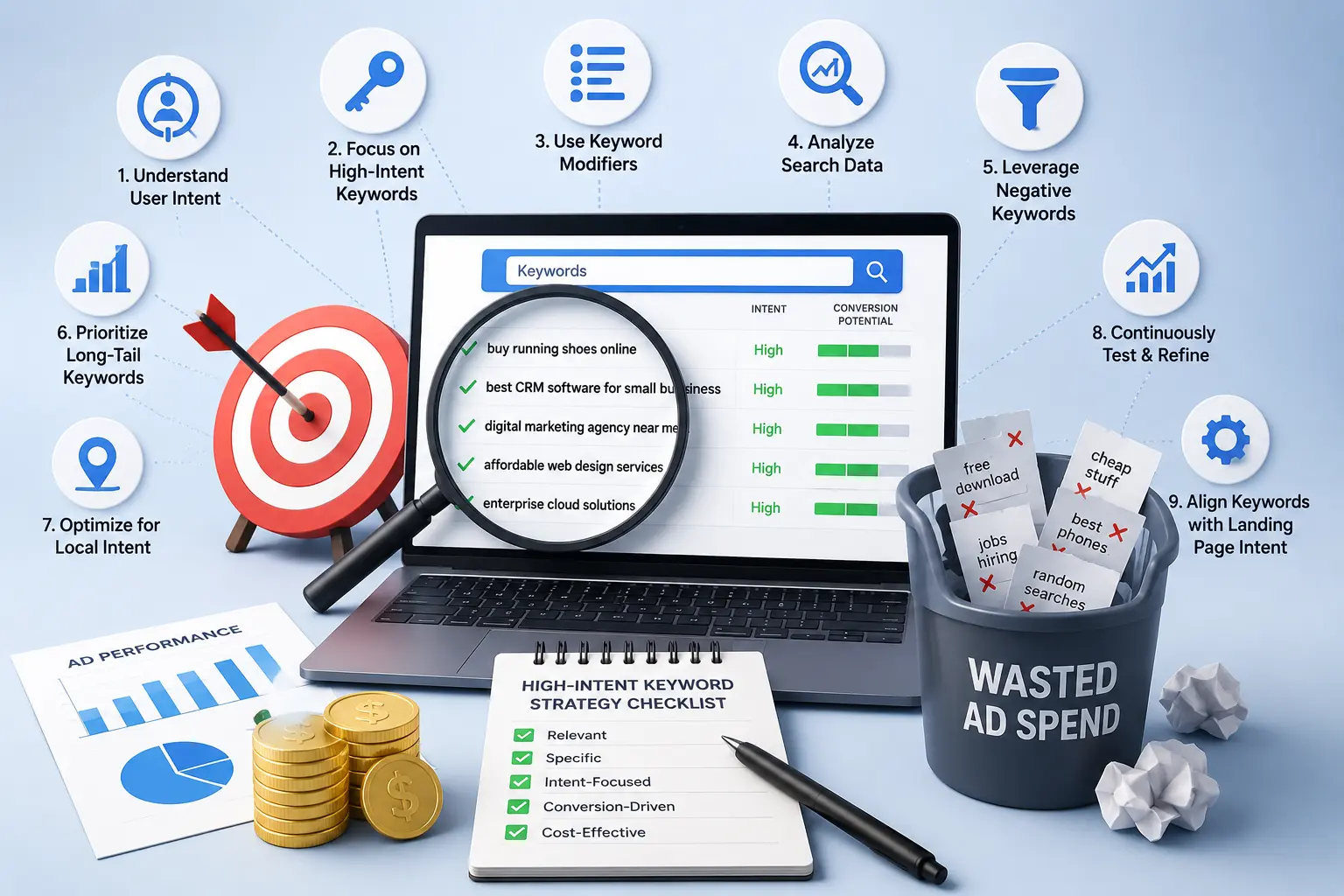
Ad campaign budgets quickly deplete when the focus of pay-per-click search campaigns falls deficient in user search intent. This is especially evident in competitive markets such as the UAE where the goal of driving mass search traffic to a landing page is futile when those clicks fail to result in a sale or lead. Many marketing teams waste a lot of money when they use overly broad search terms to find clientele when in fact those terms are meant to capture research-stage users as opposed to job-search consumers who are looking for a top digital marketing agency in Dubai.
Some performance marketers utilize Google Adwords to an advantage when they align their search term targeting with features that capture high intent users that are demonstrating clear commercial purchasing intent. As with any investment, the focus of your search strategy should be on achieving a target return on investment, and the only way to do that is by moving away from targeting impression volume and focusing on targeting intent.
9 High-Intent Keyword Tactics for Max PPC Efficiency
Focusing search strategies on users that have high intent increases search efficiency. Fine tuning a Google advertising business account means optimizing for high-value traffic and eliminating low-intent traffic.
- Target Commercial Modifier Variations: Focus search campaigns on keywords containing explicit purchasing modifiers such as “buy,” “pricing,” “cost,” “agency,” or “hire.” Users searching with these modifiers are actively evaluating solutions and sit significantly closer to a conversion event than those searching for general educational terms.
- Implement Cross-Match Negative Keywords: Create exhaustive negative keyword lists to prevent broad or phrase match keywords from matching with low search intent queries (e.g., “free,” “jobs,” “definition,” or “courses”). Use negative keyword lists to prevent spending money on advertising to users with no interest in your product.
- Leverage High-Intent Competitor Terms: Advertise for search queries that contain the names of your direct competitors in conjunction with the word “alternatives” or “vs.” By doing so, you place your ad in front of users who are directly comparing competitors.
- Isolate Exact Match High-Performers: Create ad groups with high intent search terms with your exact match keywords to have greater control over your ad text and reduce your cost per click (CPC) with higher quality scores.
- Deploy Location-Specific Commercial Terms: Use local intent modifiers with transactional search queries to target users with a high likelihood to convert within your service area.
- Align Ad Copy with Explicit Search Intent: Write ad text that solves the problem or pain you identified with your query. Increase relevant ad click throughs and decrease bounce / exit rates of users who clicked your ad by customizing ad text with your business’ features / services and your competitive pricing.
- Target Long-Tail Transactional Queries: Use longtail keywords search volume to identify your competitors. These longtail search queries help you capture the market that specifically searches for your service or product.
- Filter Traffic by Audience Intent Signals: Combine your first-party customer data, retargeting lists for search ads (RLSA), and high-intent audience segments at the keyword level. Give higher bid tiers to users that have interacted with your Web Design Service page before and allocate a higher budget in that tier.
- Optimize Landing Pages for Exact Query Matches: Structure keyword advertising strategies for high intent keywords alongside the high converting and tailor-made landing page experiences. Matching keyword strategies to a value proposition with clear pricing, readily available on the site, and quickly fillable conversion forms results in immediate improvements to performance.
Intent Level vs. Campaign Optimization Strategy
Understanding the various levels of reading intent of different keyword categories can help performance marketers prioritize their budget across the conversion funnel.
| Keyword Category | User Intent Level | Primary Campaign Objective | Budget Allocation Strategy |
| Informational Terms | Low (Research Stage) | Brand awareness and educational content downloads | Low budget priority or capture via organic search |
| Commercial Consideration | Medium (Evaluation Stage) | Product comparison and solution discovery | Moderate budget using broad match with negative controls |
| Transactional / High-Intent | High (Immediate Purchase) | Lead generation, demo requests, and direct sales | Maximum budget priority using exact match and bidding automation |
Final Thoughts
Efficient ad spend is achieved through constant optimization of ad experiences for user search query intent. By eliminating irrelevant search terms and increasing the efficiency of conversions, performance teams can use sponsored google ads to shift ad spend from being break-even to being profitable.
Controlling your keyword funnel for high search query intent ensures higher Quality Scores, low conversion cost CPCs and increases overall ad spend ROI.