
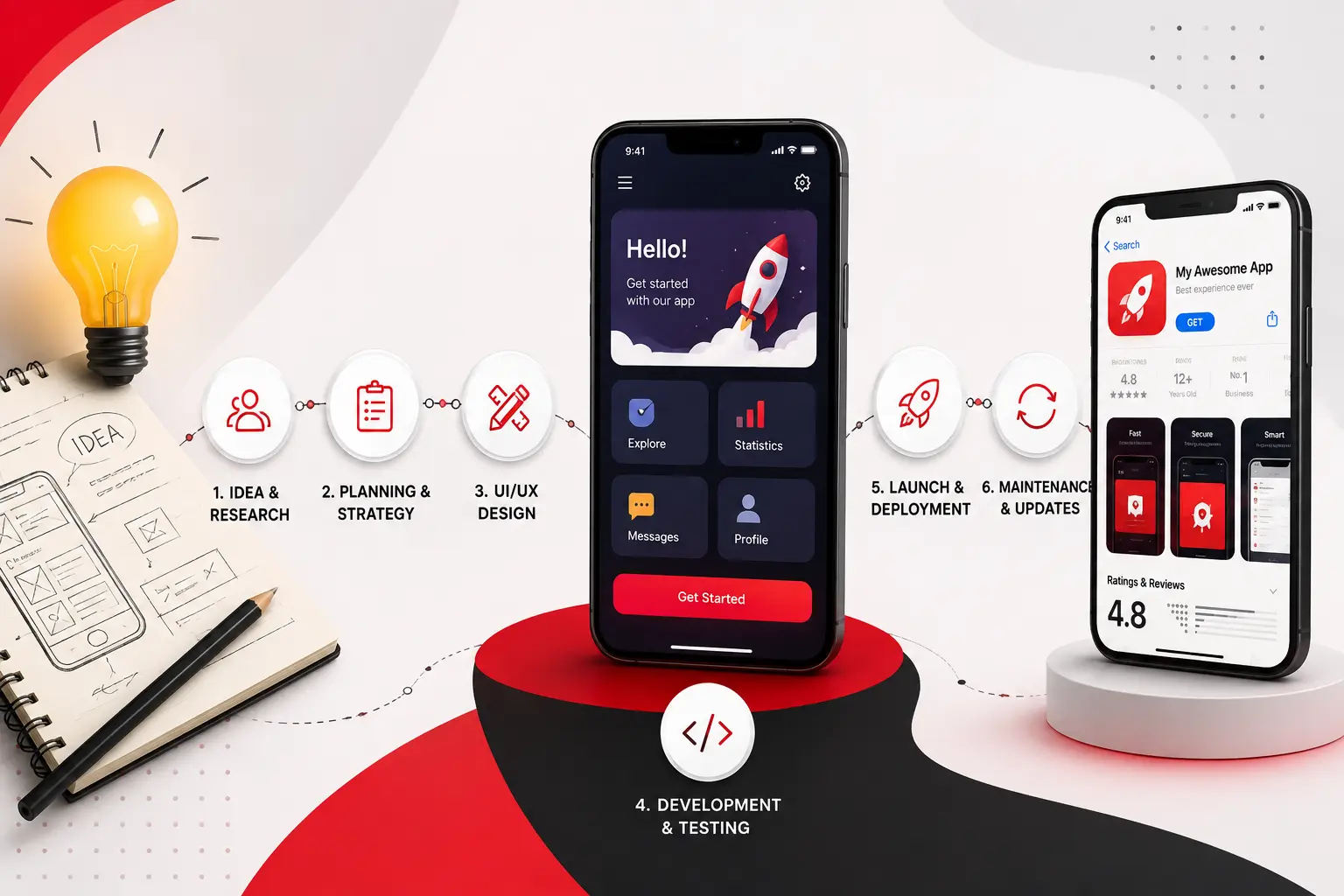
Building a digital product requires more than just some general coding. Now, users are more concerned with overall performance and user experience. Expectations are particularly high given the number of applications (litigation dockets for lawyers?) on the Apple App Store and the Google Play Store. A well-defined and documented process for the various stages of the mobile app developmentlifecycle helps product strategists, UI/UX designers, and developers work towards the same ultimate goals of the business and helps mitigate fiscal and operational barriers.
Having a predictable and consistent process in building mobile applications helps businesses build a product that has a great ROI.
The 6 Core App Development Stages
There are many benefits to product development that have a great deal of planning with a structured approach.
1. Ideation & Discovery Phase
Writing code is not the first step of a successful product. Every app ideation process begins with validating the concept and shopping the idea to a target audience. This stage also involves constructing user personas, examining competitors, and developing unique value propositions, as well as evaluating the best possible technology to implement the mobile application.
2. UI/UX Design & Prototyping
Product designers create both the visual and operational elements of a product during this stage. They create comprehensive user journeys and map them with low-fidelity wireframes, build cohesive brand style guides, and ensure the prototype is clickable and interactive to test the potential usability of the product prior to developing the product.
3. Technical Architecture & Frontend/Backend Development
Engineering teams build the digital foundation of the application. This includes building and setting up secure user authentication frameworks, configuring APIs, and structuring and setting up secure cloud-based databases, as well as building the approved designs for the front end of the application.
4. Quality Assurance & Performance Testing
Comprehensive testing is performed to ensure the software performs as intended on a variety of platforms. Automated and manual test suites check for functional bugs, edge case bugs and issues, and security and performance issues.
5. App Store Deployment & Release Management
The preparation of an application that meets the guidelines of the target app stores is the focus of this phase. This phase includes the configuration of metadata, the development of a promotional app, screenshots, the alignment of signed binaries, and maneuvering through the review process of approval.
6. Post-Launch Maintenance & Continuous Iteration
A mobile product is never fully complete. Operational health relies on monitoring crash reports, user analytics, addressing new OS versions, understanding the impact of new OS versions on the mobile application, and implementing real user feedback driven feature changes in a continuous iteration of product development.
Comparing Strategic Execution Models Across Development Stages
Choosing the optimal approach at key execution points is essential for the speed and optimized budget of product development as well as the subsequent performance of the application.
| Stage Focus | Initial Planning Phase (Discovery) | Active Development Phase (Build) | Pre-Launch Phase (Validation) |
| Primary Objective | Market validation, feature prioritization, and requirement scoping | Sprint execution, API integration, and user interface engineering | System bug resolution, performance benchmarking, and store submission |
| Core Deliverables | Product Requirement Document (PRD), feature roadmap, click-prototype | Functional codebase, cloud database schemas, integrated APIs | QA test execution reports, release candidate build, store listings |
| Critical Risk Factor | Scope creep, unvalidated user assumptions, poor tech stack selection | Technical debt, unoptimized database queries, feature delays | Store submission rejection, security oversights, critical platform crashes |
| Key Stakeholders | Product Managers, Business Analysts, Lead UI/UX Designers | Full-Stack Developers, Mobile Engineers, Solutions Architects | QA Engineers, DevOps Specialists, Compliance Officers |
Executing the Lifecycle: From Concept to Public Release
Methodically executing every step in the process is fundamental to business objective fulfillment through the creation of high-performing digital products.
- Validate Concept via Structured Discovery
Fleshing out product requirements and establishing core user value.
Refine your product idea by analyzing market demand, defining target user segments, and outlining a Minimum Viable Product (MVP). Clear functional scope definitions prevent budget overruns during active engineering sprints.
- Engineer High-Fidelity UI/UX Workflows
Crafting seamless user experiences and intuitive interface layouts.
Create user flows and apply layouts to each scenario using modern UI and UX design tools. Focus on simplicity of navigation and design with a responsive UI and design that adapts to both phone and tablet sizes.
- Construct Frontend and Backend Codebases
Building stable, secure, and scalable mobile architectures.
Execute development using agile sprint methodologies. Establish robust database relations, securely integrate third-party APIs, and build modular, maintainable frontend code using established design patterns.
- Execute Comprehensive Quality Assurance Sprints
Eliminating software anomalies before launching to the market.
Implement a multi-layered QA testing mobile apps framework. Extreme functional testing, load balance validation, cross-device usability checks, and complete security checks should be performed on the application before consideration for launch candidates.
- Deploy Application via Strategic App Store Protocols
Optimizing App Store documentations and public release processes.
Lastly, App Store and Google Play Store listings must be improved. Devise an app deployment strategy that includes beta testing releases (TestFlight or Google Internal Beta) prior to a full public launch.
Navigating App Store Submission Rules and Maintenance
Submitting software to app stores is one of the more convoluted and time consuming processes in the software industry.
App Store Review Guidelines and Post-Launch Growth
Both Apple and Google have high standards when it comes to quality and privacy of their users, and security of their software. Some of the more common reasons that apps get rejected are: developer profiles with missing or recklessly filled out information, bugs that cause the app to crash, broken links, and vague or missing information towards user privacy and data.
In addition, apps that don’t consistently get updated and improved, stop getting used by their intended audience. This is why you have to update your app, consistently improve and change the user paths/paths analytics shows the users take the most, and improve your ranking in the app store with strategies such as App Store Optimization.
Early emphasis on UX UI design mobile apps pays off in a sense that there is lower churn rates, better overall app usage, and consistent app downloads.
Frequently Asked Questions
What are the stages of mobile app development?
The important stages are research on users and the discovery of how users will interact with the app, planning and designing the user interface and user experience, coding, publishing the app on a store, and continually updating the app to improve its user experience over time.
Why is QA testing important before launching an app?
Things like major bugs, poor software security, slow loading times, and other performance related and usability related issues are detected when QA testing is done. Failure to perform testing means that there will be negative feedback, app abandonment, security related issues, and rejection from app review teams.
How long does the mobile app development process usually take?
This depends on the application’s complexity. A basic Minimum Viable Product (MVP) app takes 3 to 4 months. A custom mid-complexity application requires 4 to 7 months to develop. For an enterprise-level application with complex integrations, we are looking at a discovery to launch a time frame of 8 to 12+ months.