
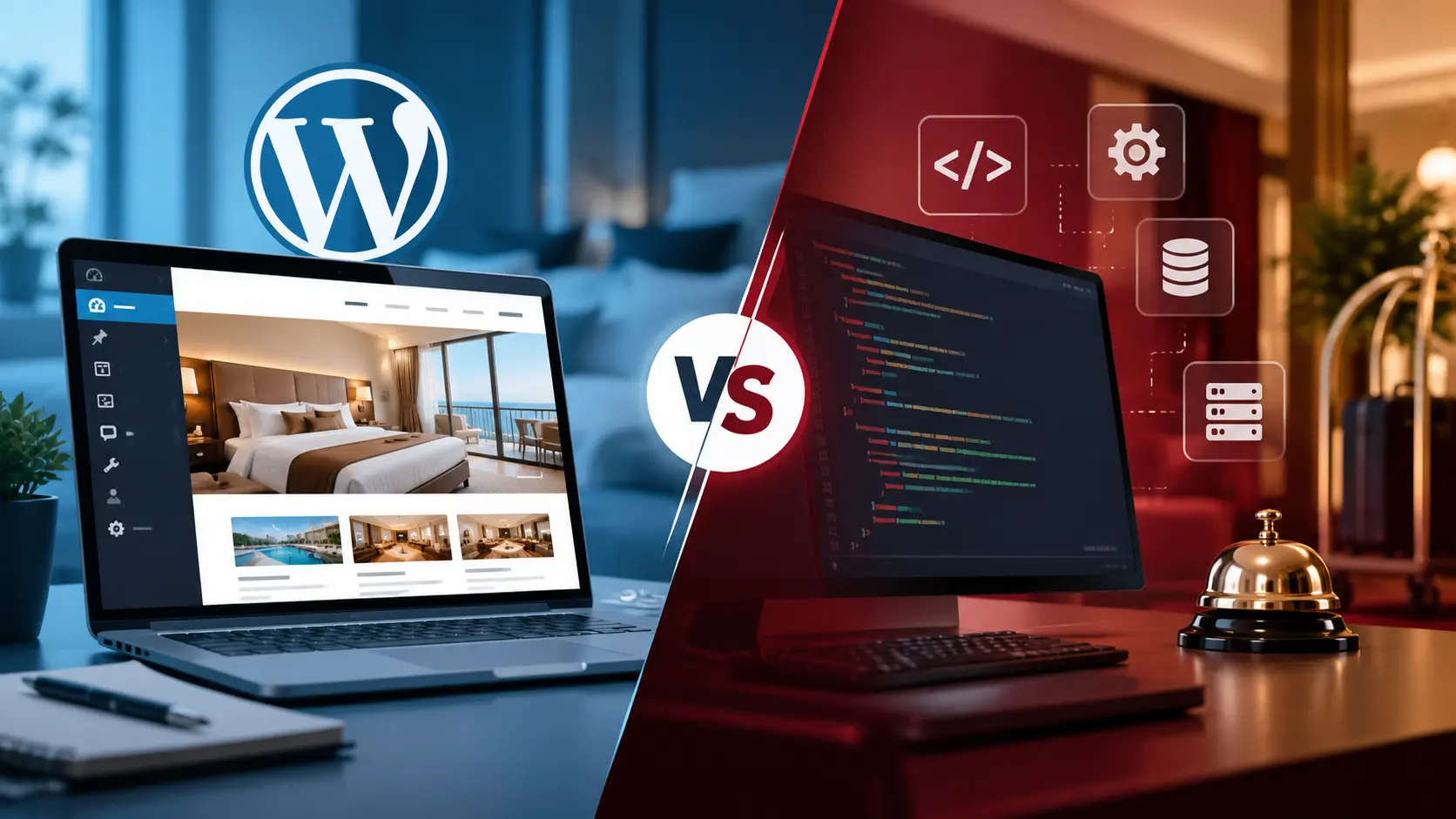
The very first dilemma facing all hotel, resort, and restaurant groups in Qatar during the website building process, even before any photograph is approved, is to choose either WordPress or custom web development. That choice will determine your booking process, how much you will pay for OTA commissions, and how easy it will be for someone who arrives at Hamad International Airport to book a room.
This debate never results in a clear-cut victory for either side as each speaks from its own workbench. WordPress people sell speed and low cost. Custom developers sell performance and control. For a hospitality business the useful version of the question is narrower: which platform protects your direct bookings, handles your property management system, and loads fast enough to stop a traveler bouncing back to Booking.com?
This guide compares the two honestly for Qatar’s hotels, restaurants, and hospitality groups. It covers what each approach delivers, how they handle the integrations hospitality actually runs on, and how each performs on the SEO that decides whether guests find you: schema, featured snippets, and mobile voice search.
The two paths, explained simply
WordPress powers almost four in every ten websites globally and hence is the most popular CMS in the world. You build your website using already built modules, where themes take care of your aesthetics, while plug-ins provide other functionalities such as booking calendar or multi-lingual capabilities, and all these are managed by you and your team using a dashboard. It’s like constructing a villa using premium quality prefabs.
Custom web development entails building a website from scratch as per your requirements without any unnecessary installations. That is the architect-designed build: slower and pricier, but shaped precisely to how your property takes reservations, sells packages, and talks to the rest of your systems.
Either is capable of creating a fast, good-looking, conversion-driving hospitality website. The distinctions lie in price, time to launch, level of integration possible, and level of control.
The factors that matter for Qatar hospitality
Budget and time to launch. WordPress wins clearly here. A professionally built hotel website using WordPress can be ready in three to six weeks at a tiny fraction of a custom cost, which is great for boutique hotels, restaurants, cafes, and serviced apartments who require booking capacity now.. Custom development typically runs two to six months and demands a substantially larger budget before a single guest lands on it.
Booking engine and PMS integration. This is where hospitality gets specific. WordPress hotel websites usually integrate with external booking engines like SiteMinder or Cloudbeds. Such channel management tools help keep rates and availability updated between your property management system and various online travel agencies. It is an effective solution that remains affordable. Custom development wins when you want the booking flow built into the site itself: your own reservation logic, loyalty pricing, package bundling, or a direct tie into Opera or another enterprise PMS with no middleman thinning the experience. If direct bookings are your plan for cutting OTA commission, this integration is worth arguing over.
Performance and security. The minimalistic custom website will include only what is needed for it, therefore, such websites are loading quickly and have fewer vulnerabilities in terms of attacks on them. The WordPress website is the most often attacked CMS due to its popularity; however, a maintained WordPress website is safe and fast enough for most sites. The problems with WordPress occur due to neglect of it.
Content management. WordPress wins for daily marketing work. Your team can publish a Ramadan brunch offer, swap the hero gallery after a renovation, or add a spa promotion without booking developer time. Custom sites can include an admin panel, but every editable section has to be built and paid for on purpose.
Bilingual capability. Qatar’s guests search and book in both Arabic and English, and right-to-left layout is not optional. WordPress has mature multilingual plugins; custom builds bake bilingual logic into the foundation. Either route works when the team knows the market, so press any website design company in Qatar to show you a live bilingual hotel or restaurant site they have actually shipped.
Ownership and scaling. WordPress brings ongoing plugin licensing, updates, and maintenance, and a very high-traffic site or a complex multi-property group can eventually outgrow it. Custom costs more upfront and scales on your terms, but ties you to a partner who knows the codebase. Neither is maintenance-free, so budget for care either way.
The SEO layer that decides who gets found
A traveler planning a Doha trip does most of the research on a phone, wants an answer in seconds, and increasingly asks out loud. Three SEO capabilities separate the properties that show up from the ones that don’t.
Schema optimization
Schema mark-up is structured data normally in JSON-LD format, which gives information to search engines about exactly what is in each webpage; such as this is a hotel, this is its room rates, this is a restaurant, this is its operating hours, this has a 4.6 rating out of 900 reviews. It gives the rich results for the hospitality industry with price and availability details shown in the search engine result page.
On WordPress, plugin support makes the basics quick. You can roll out Hotel, Restaurant, LocalBusiness, and review schema across the site in a day, though plugin output is sometimes shallow and needs tuning to reflect your real rooms and rates.
On custom builds, schema is whatever your developers write, which means it can pull straight from your live rates and reviews and be exactly right. Nothing exists by default, so if structured data isn’t in the project scope, you launch without it. Put schema in the scope explicitly on either platform and never assume it is handled.
Featured snippets
A featured snippet is an answer box at the top of Google, position zero result, which the guest sees before seeing anything else. To get featured snippets, one must focus on creating content; the guest should ask questions and provide relevant answers, which are 40 to 60 words long, use list and table formatting, and provide useful information.
WordPress editor encourages creating structured content with lots of headings, and this is why hotels that actively create content get featured snippets. A custom website can provide for the creation of the same kind of structured content; however, the website has to be built with such flexibility in mind from the beginning. The hotels of Qatar, answering their guests’ questions like “How far is Hamad International from West Bay?”, “What time is Friday brunch in Doha?” or “Do Doha hotels offer airport pickup?” gain some of the most cost-effective visibility.
Mobile voice search
Voice readiness comes down to three things: speed, because assistants favor fast pages; local schema, meaning accurate LocalBusiness and Hotel markup, opening hours, location, and a maintained Google Business Profile; and conversational content, the FAQ-style answers guests actually speak in Arabic and English. A lean custom build wins on raw speed, while WordPress makes it faster to produce large volumes of FAQ and local content. The property that wins voice treats it as a plan, not a checkbox.
So which should your Qatar hospitality business choose?
WordPress is a good choice if you own a boutique hotel, restaurant, cafe, serviced apartment, or hospitality group where the website acts as a marketing tool integrated with a booking engine; your needs are addressed through pages, galleries, offers, events, menus, and a regular reservation plugin; time and cost considerations are crucial; and your marketing department wants to control the content management.
Custom development should be considered if your core is related to direct booking logic, loyalty pricing, deep PMS or ERP integration, or multi-property portal; you have enough budget and time for building; and the website serves as operational infrastructure, not merely as a brochure.
Think about a hybrid solution that a lot of successful hospitality websites in Qatar use: WordPress as a marketing website with content and SEO plus custom booking application or enterprise PMS for precise aspects. You receive both editorial control and controlled reservation experience.
The best thing you could do is to receive an honest recommendation and not a pitch. A reputable web design company in Qatar will inquire about your booking strategy, future growth, and capabilities within the company first and then name the platform that you should consider.
Frequently asked questions
What is hotel voice search optimization?
It helps optimize your website for Google Assistant, Siri, or Alexa, who may read your hotel information out loud as an answer to a guest’s voice search for hotels, local restaurants, or activities. The longer, more conversational voice search queries require creating Q&A type content, implementing Hotel, LocalBusiness, and FAQ schema markup, optimizing page load time, and keeping Google My Business up to date.
What influence can voice search have on hospitality SEO?
The new trend changes the focus of SEO by requiring to rank as a featured snippet and therefore become the answer provided out loud. It favors long-tail keywords, mobile optimization, structured data, and local SEO. In Qatar, it is mandatory to do voice search bilingual optimization because the customers search for the services using both Arabic and English languages.
How will a hotel website appear in voice searches?
Five items are key. Answer guests’ questions in 40 to 60-word answers under questions in headings, ideally on FAQ pages. Utilize schema markup to tell search engines about the hotel’s property, location, rooms, and reviews. Ensure that mobile pages load quickly as assistants favor speed. Enhance local SEO with a complete Google Business Profile. Also write conversationally, in your guests’ language. Both WordPress websites and custom websites can achieve all five but only with intent.
The bottom line
For Qatar’s hotels and hospitality businesses, WordPress versus custom web development comes down to matching the platform to your booking strategy, budget, timeline, and scale. WordPress gets most properties online quickly, affordably, and capably, especially when a connected booking engine covers reservations. Custom development earns its cost when direct-booking logic, deep integrations, or serious scale sit at the heart of the operation. On either foundation, the SEO layer of schema, snippet-ready content, and voice search readiness is what turns a good-looking site into one guests actually find and book.
If you’re weighing this call for your own property, talk to a web design Qatar hospitality brands trust for honest advice. Our team builds both WordPress and fully custom hotel and restaurant websites, and we recommend the path that fits your goals rather than our preferences. Get in touch for a free consultation and platform recommendation, and start on the right foundation.