
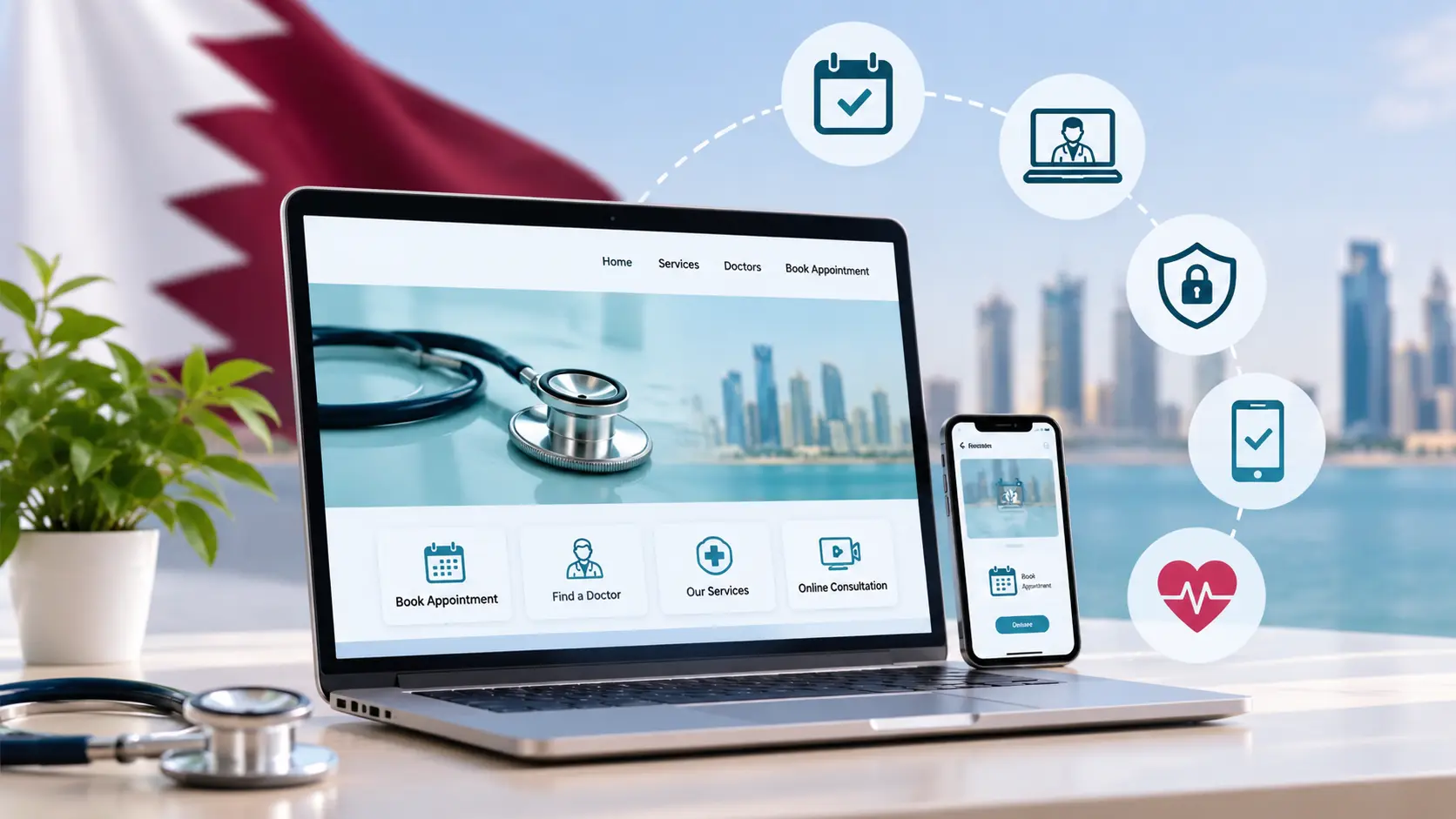
Introduction: In Qatar, Your Healthcare Website Is the First Point of Care
For many patients, the first interaction with a healthcare provider no longer happens at the reception desk. It begins online — when someone searches for a doctor, explores a treatment, checks clinic timings, looks for directions, or tries to book an appointment.
In Qatar’s highly connected and mobile-first market, a healthcare website needs to do much more than display a clinic’s services. It should help patients find information quickly, build confidence in the healthcare provider, and make the next step — whether that is booking an appointment, contacting the clinic, or finding a location — simple.
A modern healthcare website is therefore part information resource, part patient-support tool, and part digital front desk.
The question is not simply whether a healthcare provider needs a website. The more important question is: what features should a modern healthcare website in Qatar have to meet patient expectations while delivering a trustworthy and convenient digital experience?
Part One: Understanding the Qatar Patient’s Needs
Before deciding which features to include, it is important to understand the person using the website.
A healthcare website feature should exist for a reason: to answer a question, reduce uncertainty, simplify an action, or improve the patient’s experience.
The Need
The patient’s immediate need is usually practical.
They may want to:
- Find a suitable doctor or specialist
- Understand a medical service or treatment
- Check clinic opening hours
- Book an appointment
- Find the healthcare facility’s location
- Contact the clinic
- Understand insurance or payment information
- Find information in Arabic or English
The website should make these actions straightforward, particularly for users accessing it from smartphones.
The Desire
Healthcare decisions also involve a strong emotional component.
Patients want to feel that they are dealing with a professional, reliable, and patient-focused healthcare provider. They want clear information, qualified professionals, an organised environment, and an experience that respects their time and privacy.
For healthcare providers in Qatar, a polished bilingual website can also help demonstrate that the organisation understands the needs of its diverse patient population.
The Problem
Patients may arrive at a healthcare website with both visible and hidden concerns.
The visible problem might be:
“I need to book an appointment with a specialist.”
The hidden concern could be:
“Can I trust this doctor?”
Or:
“Is this clinic suitable for my needs?”
A successful healthcare website addresses both.
Part Two: Extrinsic and Intrinsic Problems on a Healthcare Website
Extrinsic Problems: Practical Friction
Extrinsic problems are the functional issues patients can immediately identify.
For example:
- “I can’t find the appointment booking option.”
- “The website is too slow on my phone.”
- “I can’t find the doctor’s qualifications.”
- “I don’t know where the clinic is located.”
- “The contact number is difficult to find.”
- “The information isn’t available in Arabic.”
- “The appointment form isn’t working.”
These problems create unnecessary friction.
When a patient cannot quickly accomplish a simple task, they may leave the website and look for another healthcare provider.
Intrinsic Problems: Trust and Confidence
Healthcare websites also need to address concerns that patients may not explicitly express.
They may wonder:
- “Are these healthcare professionals properly qualified?”
- “Can I trust this clinic?”
- “Is my information secure?”
- “Will I receive professional care?”
- “Does this healthcare provider understand my needs?”
These concerns cannot be solved through functionality alone.
Professional design, transparent information, doctor profiles, clear service descriptions, patient-friendly content, security signals, and accessible communication all contribute to a stronger sense of trust.
The central principle of healthcare website design is simple: functionality should remove practical barriers, while design and content should build confidence.
Part Three: Essential Features Every Modern Healthcare Website in Qatar Should Have
1. Mobile-First Responsive Design
A healthcare website should be designed for smartphones from the beginning rather than treating mobile as an afterthought.
Patients may search for healthcare services while travelling, at work, at home, or on the move. Important information should therefore remain easy to access on smaller screens.
The website should provide:
- Responsive layouts
- Touch-friendly buttons
- Readable typography
- Easy-to-use menus
- Simple appointment forms
- Clearly visible phone and contact options
- Fast access to doctor and service information
Mobile-first UX is particularly important for healthcare providers that depend on local search and mobile traffic.
2. Fast Website Performance
Patients should not have to wait several seconds for a healthcare website to load.
Large images, unnecessary scripts, inefficient code, and poorly configured hosting can negatively affect performance.
A modern healthcare website should focus on:
- Optimised images
- Efficient code
- Browser caching
- Fast hosting
- Lightweight page elements
- Optimised mobile performance
- Strong Core Web Vitals
Speed is not simply a technical consideration. It directly affects how easily patients can access healthcare information.
3. Arabic and English Language Support
Bilingual functionality is particularly important for healthcare providers operating in Qatar.
A modern healthcare website should provide a consistent experience in both Arabic and English, rather than simply translating a few pages.
The Arabic version should be properly designed for right-to-left reading, including:
- RTL layouts
- Correct Arabic typography
- Proper navigation
- Translated forms
- Translated service information
- Consistent calls to action
- Mobile-friendly Arabic pages
A well-executed bilingual experience makes information more accessible and demonstrates consideration for Qatar’s diverse patient population.
4. Clear Doctor and Specialist Profiles
Patients often want to know who will be providing their care before booking an appointment.
Doctor profiles should therefore provide useful, factual information such as:
- Doctor’s name
- Specialty
- Qualifications
- Professional experience
- Areas of expertise
- Languages spoken
- Consultation availability
- Location or department
- Appointment option
High-quality professional photographs and consistent profile layouts can also make the experience more personal and easier to navigate.
The objective is not to overwhelm patients with information but to give them enough context to make an informed appointment decision.
5. Easy Online Appointment Booking
Appointment booking should be one of the most visible functions on a healthcare website.
Patients should be able to move from discovering a doctor or service to booking an appointment without unnecessary steps.
Depending on the healthcare provider’s systems, the website may include:
- Doctor selection
- Specialty selection
- Location selection
- Available dates and times
- Patient details
- Appointment confirmation
- Booking reminders
- Rescheduling or cancellation options
Integration with the clinic’s appointment or hospital management system can make the website more useful as a patient-facing platform.
6. Clear Healthcare Services and Treatment Information
Patients need to understand what services a healthcare provider offers.
Service pages should explain:
- What the service is
- Which department provides it
- Who may need it
- What the process involves
- Which specialists provide the service
- Frequently asked questions
- How to book an appointment
Healthcare content should be written clearly and responsibly. Avoid unnecessarily complicated medical terminology when a simpler explanation can communicate the same information.
7. Prominent Contact and Communication Options
Patients should never have to search through several pages to find contact information.
A healthcare website should make important contact options highly visible, including:
- Phone number
- Clinic address
- Opening hours
- Emergency information where appropriate
- Appointment booking
- WhatsApp or other appropriate communication channels
- Location and directions
On mobile devices, phone numbers should be easy to tap and call.
The contact experience should be designed around the patient’s immediate need rather than the organisation’s internal structure.
8. Location, Maps, and Clinic Information
Healthcare facilities may have multiple branches or departments, making location information particularly important.
Each location page can include:
- Full address
- Interactive map
- Opening hours
- Parking information
- Nearby landmarks
- Contact details
- Available departments or services
- Appointment information
Clear location information can reduce confusion, especially for patients visiting a healthcare facility for the first time.
9. Secure Forms, Privacy, and Reliable Backend Infrastructure
Healthcare websites handle information that can be sensitive.
Security should therefore be considered during both design and website development.
A modern healthcare website should use appropriate security measures such as:
- HTTPS
- Secure forms
- Strong access controls
- Secure integrations
- Regular software updates
- Reliable hosting
- Appropriate data-handling practices
The website should also clearly communicate relevant privacy information to users.
Security is not something that should be added at the end of development. It should be considered from the beginning of the website architecture.
10. Search-Friendly Healthcare Content
A healthcare website needs to be discoverable when patients search online for relevant services and specialists.
The website should establish strong SEO foundations, including:
- Search-friendly service pages
- Doctor and specialist pages
- Location pages
- Proper page titles and descriptions
- Structured internal linking
- Clean URLs
- Structured data where appropriate
- Mobile optimisation
- Fast loading times
- Useful healthcare content
Content can also address common patient questions through FAQs, educational articles, treatment guides, and condition-related information.
The objective is to help users discover relevant information while establishing the healthcare provider as a useful and trustworthy source.
11. Accessibility and Inclusive Healthcare UX
A healthcare website should be usable by as many people as possible, including people with disabilities and users with different levels of digital experience.
Important accessibility considerations include:
- Readable font sizes
- Sufficient colour contrast
- Keyboard accessibility
- Descriptive form labels
- Meaningful alternative text
- Clear error messages
- Accessible navigation
- Mobile-friendly interfaces
Accessibility improves the experience for patients and helps healthcare organisations create a more inclusive digital presence.
12. Patient-Friendly FAQs
Healthcare websites often receive repetitive questions about services, appointments, insurance, doctors, locations, and procedures.
A dedicated FAQ section can help patients find answers without contacting the clinic for every basic question.
FAQs can address topics such as:
- How do I book an appointment?
- What documents should I bring?
- Which insurance providers are accepted?
- Where is the clinic located?
- What are the clinic’s working hours?
- Can I reschedule an appointment?
- Which languages are supported?
- How can I contact the department?
Well-structured FAQ content can also support search visibility when implemented appropriately.
13. Healthcare Content and Educational Resources
A modern healthcare website should not only promote services. It should also help patients understand their healthcare needs.
Useful content may include:
- Health education articles
- Treatment explanations
- Preventive healthcare information
- Doctor insights
- Frequently asked questions
- Procedure preparation guides
- Aftercare information
- Seasonal health advice
This type of content can improve the usefulness of the website while giving patients information before they contact the healthcare provider.
Medical content should be reviewed appropriately and presented responsibly, particularly where information could affect healthcare decisions.
14. Integration With Healthcare and Marketing Systems
A modern healthcare website should connect with the systems that the organisation already uses.
Depending on the provider, integrations may include:
- Appointment management systems
- CRM platforms
- Patient communication systems
- Analytics platforms
- Call tracking
- Marketing automation
- Payment systems
- Maps
- Email and SMS platforms
The goal is to transform the website from a static information resource into a useful part of the healthcare organisation’s digital infrastructure.
Part Four: Why Healthcare Website Design and Development Must Work Together
A successful healthcare website cannot rely on attractive visuals alone.
The design needs to communicate professionalism and trust, while the underlying development needs to make every interaction reliable.
Think of the website as a digital healthcare reception.
The frontend and UX design represent what patients see and interact with. The backend supports the systems operating behind the scenes — forms, appointments, integrations, security, content management, and other functions.
If the website looks professional but appointment booking does not work, the patient experience fails.
If the backend is technically strong but the website is confusing, patients may struggle to find the information they need.
This is why organisations looking for a web design company in Doha should evaluate both design and development capabilities rather than treating them as separate activities.
The development process should consider the healthcare audience, information architecture, mobile experience, accessibility, security, performance, integrations, and content before the website goes live.
Frequently Asked Questions
What features should a healthcare website in Qatar have?
A modern healthcare website should generally include responsive design, Arabic and English support, doctor profiles, online appointment booking, service pages, contact options, location information, security features, SEO foundations, accessibility, FAQs, and patient education content.
The exact features should depend on the healthcare provider’s services, patient requirements, and internal systems.
Why is bilingual website design important for healthcare providers in Qatar?
Arabic and English support can make healthcare information accessible to a broader audience in Qatar. Arabic pages should be properly designed for right-to-left reading rather than treated as simple translated versions of English pages.
Should healthcare websites offer online appointment booking?
For many healthcare providers, online appointment booking can reduce friction by allowing patients to select relevant services or specialists and request or schedule appointments without relying entirely on phone calls.
The booking system should be integrated appropriately with the healthcare provider’s existing processes.
How can a healthcare website build patient trust?
Trust can be supported through professional design, transparent doctor profiles, accurate service information, clear contact details, accessible content, security practices, easy navigation, and a consistent bilingual experience.
The website should make it easy for patients to understand who the healthcare provider is, what services are available, and how to take the next step.
Does healthcare website SEO matter in Qatar?
Yes. Patients often use search engines to discover healthcare providers, doctors, treatments, and clinics.
Strong technical SEO, useful healthcare content, location-focused pages, structured data where appropriate, mobile performance, and clear information architecture can help a healthcare website become easier to discover.
What is more important for a healthcare website: design or functionality?
Both serve different purposes.
Functionality allows patients to complete important tasks such as finding information, contacting the clinic, or booking an appointment. Design helps make the experience clear, professional, accessible, and trustworthy.
A modern healthcare website should therefore treat design and functionality as parts of the same patient experience.
Conclusion: Build a Healthcare Website Around the Patient
A modern healthcare website in Qatar should be more than an online brochure.
It should function as a digital gateway between patients and healthcare providers.
The essential elements include mobile-first design, fast performance, Arabic-English functionality, professional doctor profiles, online appointment booking, clear service information, accessible contact options, location information, secure infrastructure, SEO foundations, accessibility, FAQs, and useful healthcare content.
But the most important principle goes beyond individual features.