
Introduction
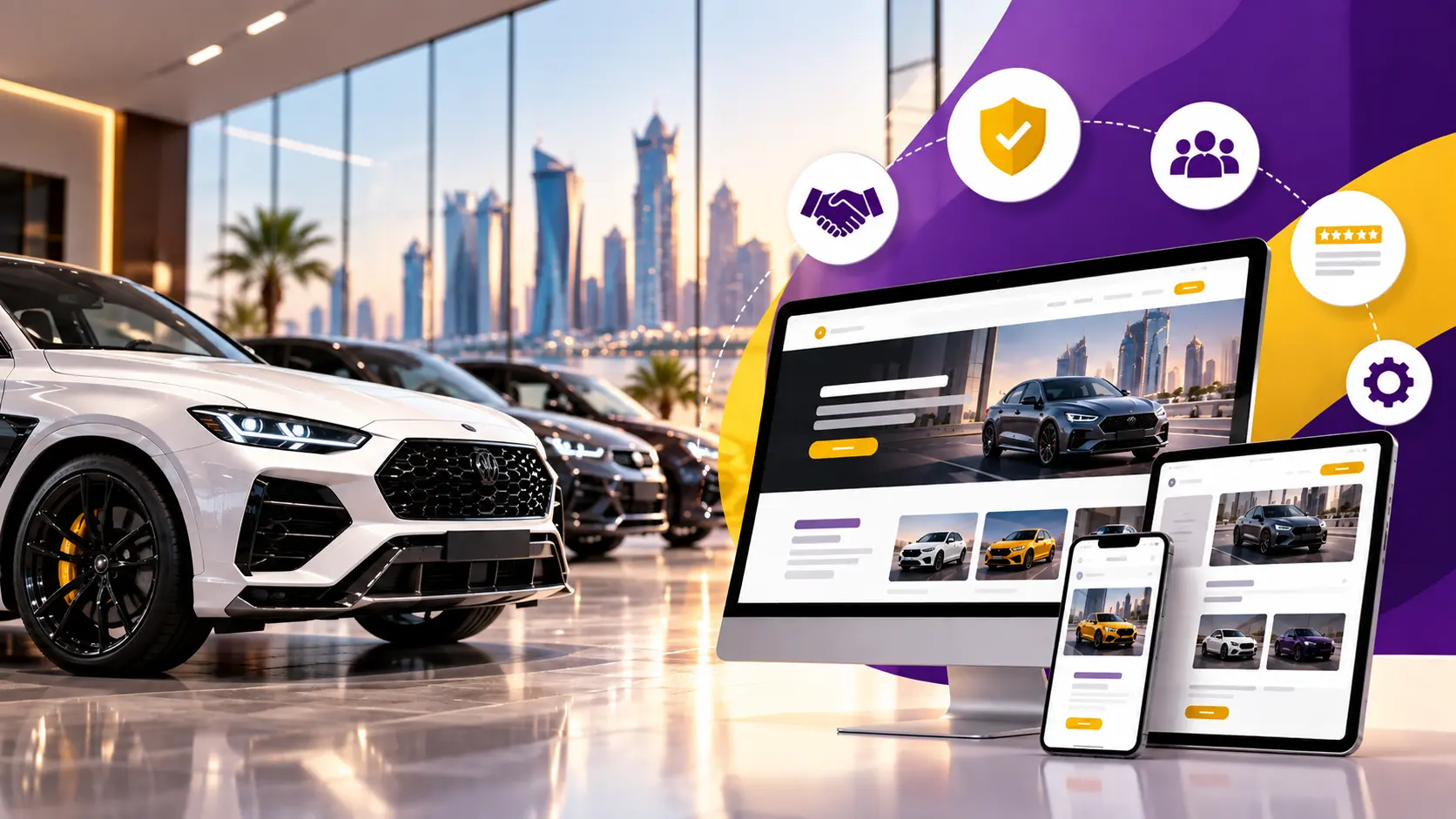
Buying a car in Qatar is one of the largest decisions a household or business makes, and it almost always starts online. Before a customer walks into your showroom or calls your service center, they have already searched your name, opened your site, and decided in seconds whether your brand looks established or amateur. That is why website design for automotive brands in Qatar is now a credibility decision, not a cosmetic one.
Trust in Qatar has always traveled through reputation, referral, and the majlis. The difference today is that the first verdict happens on a screen, often on a phone, before anyone shakes a hand.
For a dealership, service center, or parts supplier competing in a market where buyers compare several providers and smartphone use is near-universal, the website is either your strongest trust asset or your quietest liability. Below is how professional website design in Doha earns that trust element by element, and how trust turns into test drives, service bookings, and measurable leads.
The 3-second verdict: how buyers judge before they read
Visitors decide whether your site, and by extension your brand, feels credible within a few seconds of landing, long before they read your vehicle descriptions or service offers. For a high-value purchase like a car, that snap judgment carries real weight.
The verdict forms from visual and experiential cues.
Does the design look current or dated? An outdated site suggests a business that has stopped paying attention, and buyers quietly extend that judgment to your vehicles and your workshop.
Does the page load instantly? On Qatar’s fast networks, a slow site reads as unprofessional, and a shopper comparing three dealers will simply move to the next tab.
Does it work flawlessly on a phone? Most local browsing happens on smartphones, so a clumsy mobile experience is a failed first impression for the majority of your audience, not a minor flaw.
Is it visually coherent? Consistent colors, disciplined typography, and sharp vehicle photography signal an organized, detail-oriented business. Clashing styles and pixelated images signal the opposite.
None of this is about beauty for its own sake. Design quality is the fastest proxy a buyer has for business quality, so professional web design in Doha wins the three-second verdict on purpose, which is what gets your inventory and pricing actually read.
Trust signals that matter specifically to Qatar’s automotive market
Beyond universal design principles, automotive brands in Qatar earn trust through signals tuned to how cars are bought and serviced here.
Authorized status made obvious. Clear display of manufacturer authorization, dealership credentials, and genuine-parts assurance answers the buyer’s first worry. A customer spending six figures on a vehicle wants to see that you are the approved source, not a gray-market reseller.
Bilingual readiness. Serving both Arabic and English audiences with proper right-to-left layout for Arabic, not a machine-translated afterthought, tells visitors you are built for this market. A polished Arabic showroom experience still sets brands apart from competitors who neglect it.
Real inventory, shown properly. Buyers expect to see actual stock: current models, real photos, specs, and pricing or a clear route to it. Vague “contact us for details” listings read as evasive, while an up-to-date, well-photographed inventory reads as confident and honest.
Local presence made visible. A named showroom address, service center location, map, landline, and trade license details answer the question every visitor is silently asking: is this a genuine, established automotive brand in Qatar? Hiding those details makes a brand look like it does not belong.
The channels Qataris actually use. Prominent WhatsApp contact and click-to-call buttons match how vehicle enquiries and service bookings genuinely happen here. A dealer reachable the way customers prefer feels closer and more accountable than one hiding behind a single email address.
Social proof with local weight. Reviews from Qatari owners, recognizable corporate fleet clients, Google ratings, and service testimonials from work done in Doha carry far more weight than anonymous foreign praise. In a market where reputation is currency, borrowed trust from familiar names is design gold.
Security and polish on every page. The HTTPS padlock, a professional email on your own domain, working links, and a current model year each add a small deposit to the trust account. Their absence makes withdrawals.
From trust to leads: conversion-focused design
Trust is the foundation, but a trusted site that sits passive still loses business. Conversion-focused design connects “they believe us” to “they contacted us,” making the next move obvious on every page. For automotive, that next move is usually a test drive, a service booking, a parts enquiry, or a finance quote.
In practice, a lead generation website for an automotive brand follows a few disciplined principles.
One clear primary action per page. A vehicle page should push “Book a Test Drive” or “Request a Quote”; a service page should push “Book a Service.” Place that action above the fold, repeat it at natural decision points, and word it around the buyer’s benefit.
Tools that fit the purchase. A finance or EMI calculator, a trade-in valuation request, and a service-cost estimate turn browsing into commitment. These ease the anxiety of a big-ticket decision and give the visitor a reason to hand over their details.
Friction removed at every step. Every extra click, confusing menu, or “where do I go now” moment sheds a share of potential leads. Clear navigation, fast pages, and a logical flow from model to enquiry are revenue mechanics, not decoration.
Multiple contact paths, one on every page. Some buyers call, some use WhatsApp, some fill a form, some want a map to the showroom. A well-built automotive site offers all of them persistently, usually a sticky header CTA, a floating WhatsApp button, and a footer with full contact details.
Proof placed next to asks. Owner reviews, manufacturer badges, and warranty guarantees positioned beside the call-to-action answer the last-second hesitation, “can I trust them,” at the moment it arises.
Measured and refined. Conversion design is tracked, not guessed. Analytics on where visitors drop off, which vehicles draw enquiries, and which CTAs get clicked turn the site into a system that improves month after month.
This is the real gap between a brochure site and a growth asset, and it is why experienced providers of website development in Qatar design pages around the buyer’s journey rather than brand aesthetics alone.
The most underrated trust-and-lead tool: your enquiry form
If one element deserves special attention, it is the enquiry form, because it sits exactly where interest becomes a lead, and where most automotive sites quietly lose opportunities. Whether it is a test-drive request, a service booking, or a parts enquiry, the form is the handoff.
Effective contact form optimization follows a few proven rules.
Ask less, get more. Every extra field measurably lowers completions. Name, phone, and the model or service of interest is often enough to start the conversation; qualification can come later.
Make it effortless on mobile. Large tap targets, the numeric keyboard for phone fields, and no fiddly dropdowns, because most Qatari buyers will complete the form on a phone while comparing options.
Reassure at the point of submission. A short line such as “We reply within one business hour” or “Your details are never shared,” placed beside the submit button, answers hesitation where it occurs.
Confirm and follow through. A clear thank-you message with a stated response time sets expectations, and answering fast keeps the trust the design earned. In Qatar’s service-conscious market, reply speed is itself a trust signal, and for car buyers the first dealer to respond often wins the sale.
Test it relentlessly. A form that silently breaks after a site update loses every lead it should have captured. Regular submission testing is non-negotiable.
Paired with a WhatsApp option for buyers who prefer to chat, a well-built enquiry form usually becomes the highest-converting element on the entire site.
Design trust compounds over time
Website trust is not earned once. Buyers return, compare across dealers, and re-judge, especially during a purchase cycle that can run for weeks.
A site that stays fast, current, and accurate every visit compounds credibility, while one that decays with broken elements, sold-out models still listed, or last year’s copyright date spends that trust down visit by visit. That is why successful automotive brands in Qatar treat the website as an asset, designed professionally from the start and maintained for speed, security, and accurate inventory. Building trust costs far less than rebuilding it.
FAQs
1. Which website elements increase lead generation the most for car dealers?
The highest-impact components are benefit-led calls-to-action on every page such as “Book a Test Drive” and “Book a Service”; short mobile-friendly enquiry forms with three to four fields; a floating WhatsApp button and click-to-call links that match how Qatari buyers communicate; finance calculators and trade-in valuation requests that suit a high-value purchase; social proof like owner reviews, Google ratings, and manufacturer badges placed near the CTAs; fast-loading pages, since every second affects conversion; and dedicated landing pages for each model and service.
2. How many conversion points should an automotive website have?
As a working rule, at least one primary conversion point on every page, with the homepage and key model or service pages offering two or three complementary options such as a form, a WhatsApp button, and a phone number. Persistent elements like a sticky header CTA and a floating chat button keep a conversion path on screen without scrolling. The goal is not to crowd pages with buttons but to make sure that when a visitor is ready to act, they can in one click, while each page still centers on a single main action.
3. What makes visitors trust an automotive website within seconds?
Fast trust rests on quick-to-process visual cues: clean design with sensible color and typography, fast loading, flawless mobile behavior, the HTTPS padlock, and authentic, high-quality vehicle photography. Within a few more seconds, visitors look for authenticity signals such as a real showroom address and phone number, manufacturer authorization, recognizable reviews, error-free language, and current inventory. In Qatar, a correct Arabic version, visible local presence, and WhatsApp contact make the difference. Weakness in any of these does not just look bad; it makes buyers question everything else the brand claims.