
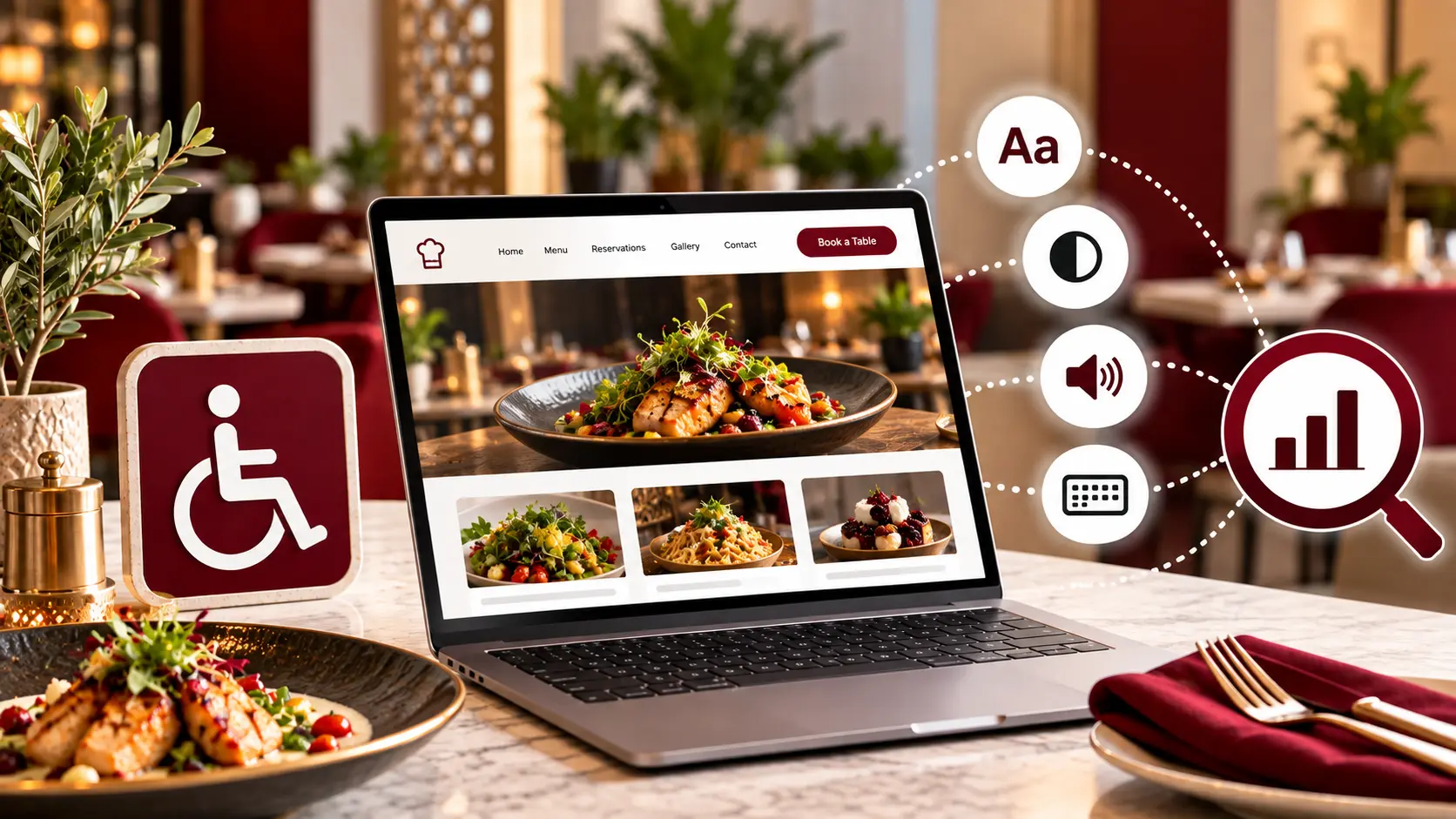
There’s a hungry, high-spending market that most restaurant websites in Qatar quietly turn away at the door.
Around one in six people worldwide lives with a disability. Add their families and friends, and you’re looking at a group that controls something like thirteen trillion dollars in global spending power, and a growing share of them are tourists, residents, and expats right here in Doha, deciding where to eat tonight. A menu page that won’t load properly with a screen reader, a reservation form a keyboard can’t tab through, a beautiful food photo with zero description: every one of these is a diner quietly bouncing to a competitor’s site instead.
We tend to file accessibility under “compliance.” A box to tick before a launch. A legal risk to manage. Something to circle back to once the branding and the food photography are done.
That’s a failure of imagination. And for a restaurant competing for table bookings and delivery orders in a crowded Doha food scene, it’s leaving covers, orders, and rankings on the table.
Here’s the part nobody tells you
Google is blind.
Googlebot can’t see your hero shot of grilled hammour or your machboos platter. It can’t watch your Instagram-style reel of the kitchen. It can’t hear the oud music on your homepage, admire your interior design, or tap “Reserve a Table” with a finger. It experiences your restaurant’s website through text, structure, and code, exactly the way a guest using a screen reader does.
Sit with that for a second.
Your single most important visitor (the crawler that decides whether your restaurant shows up when someone searches “best seafood restaurant West Bay” or “family restaurant Doha delivery”) navigates your site with the same constraints as your blind and low-vision guests. Same dependence on clear labels, logical structure, and well-written text.
Which means accessibility SEO isn’t two separate jobs for a restaurant website. It’s one. Build a site a screen reader can understand, and you’ve built a site Google can understand too. The accessibility work is the SEO work.
The same work, rewarded twice
This is why accessibility and rankings move together for restaurant sites specifically. Almost every fix that helps a disabled diner also hands Google exactly the signal it needs.
Alt text on food and venue photos. “You can order ‘Grilled Qatari hammour with saffron rice and lemon butter sauce’ to have an idea about the dish when you are ordering.” The search engine Google reads this line to make sense of the picture and of the entire web page. Here, again, we get another use of a sentence for both people and search engines.
Headings and menu structure. When a screen reader visits your website, they move through the headings such as Starters, Main Courses, Grills, and Desserts. So does the Googlebot, when making a map of the kinds of things that your restaurant offers. It’s one way of making your content accessible to all users, as well as being good for search rankings.
Descriptive link text. The phrase “click here” for a reservation button gives no information to the screen reader and does not help Google either. However, “book a table at [restaurant name] in Doha” gives both clear information on what is behind the link.
Captions on video content. Video takes precedence in many Qatari restaurants today: chef specialties, kitchen scenes, ambiance video. A deaf or hearing-impaired person needs the text version of that video. A search engine can access only the text version of that video. Add captions, and you have achieved both accessibility and searchability in one step.
Keyboard navigation for booking and ordering. Many users, including guests with motor impairments, can’t use a mouse and move through a site entirely by keyboard. A reservation widget or delivery checkout that only works with a mouse click locks out real customers, and the tangled, non-semantic code behind it is usually exactly what confuses crawlers too. A booking flow that’s a maze for the keyboard is usually a maze for the bot.
Bilingual, well-structured Arabic and English content. For a Qatar audience, accessibility and clarity extend to language too. Properly tagged Arabic (lang=”ar”) and English content, read cleanly by assistive technology in either language, is also read cleanly by Google, helping the same page rank in both English and Arabic search results.
Notice the pattern. None of this is charity bolted onto your restaurant’s SEO. It’s the same clarity, paying you twice: more guests seated, more orders placed, more visibility in search.
Inclusive design isn’t a tax on your restaurant’s website. It’s clarity.
Here’s the reframe that changes everything.
We treat inclusive design like a cost: extra work, extra expense, a constraint on the “real” design of a beautiful restaurant site. It’s the opposite.
When you create the menu, reservation process, and food order process for your guest that cannot see what is on the screen, hear the audio, or operate a mouse, then you have to answer the fundamental question: does it even make any sense? Is it possible to locate the vegetarian food choices in a document in PDF format, which is simply an image of the menu?
A restaurant website that works for a guest navigating by screen reader is virtually always faster, clearer, and easier for every guest: the tourist on a slow hotel Wi-Fi connection, the parent one-handed with a child, the diner in a hurry deciding where to eat before their flight. The constraint doesn’t shrink your design. It sharpens it.
Why this stopped being optional in Qatar
Three things have turned this from “someday” into “right now” for restaurants operating here.
First, legality. Accessibility standards and litigation are rising globally, and Qatar’s own digital accessibility expectations, aligned with international WCAG benchmarks, are tightening across government and private-sector websites. What used to be a hypothetical risk is becoming a real one.
Second, the market. Qatar’s food scene serves a genuinely global audience: residents from across the world, business travelers, and a steady flow of tourists and event visitors. A meaningful share of them, or someone in their travel party, relies on assistive technology. They’re choosing where to eat tonight, and an eager competitor’s site is one search away.
Thirdly, this is the one that transforms everything from this point onward, AI answer engines and voice assistants have become the go-to means to search for a restaurant. “Find me a halal friendly seafood restaurant near The Pearl” has become a phrase uttered aloud or inputted into an AI engine rather than a search box. These engines scan for text-based, structured and semantically clear content – precisely what accessibility requires. Restaurant SEO and disability accessibility have come together into one area.
Do right by the guest who can’t see your menu photos, and you do right by every algorithm now reading your site on their behalf.
Where the regional bar is rising
Watch accessibility standards across the Gulf for where this is heading. Government digital services and a growing list of private-sector businesses across the region, including in Qatar and the wider GCC, are being held to formal accessibility requirements aligned with global WCAG benchmarks. Inclusion is moving from optional courtesy to baseline expectation: the floor, not the ceiling.
For a restaurant investing in a new website ahead of Qatar’s next tourism season or a busy events calendar, this is a preview of where every diner-facing site is headed. The restaurants building it now won’t be scrambling to retrofit it later.
So here’s the move
Open your restaurant’s website and try to use it without your eyes, your ears, or your mouse. Tab through the reservation form with a keyboard. Try to order delivery with a screen reader running for five honest minutes. Try to find “vegetarian” or “no pork” or “gluten-free” without a menu that’s just a photo of a menu.
Whatever’s broken for that guest is almost certainly broken for Google too. Fix it once, and you’ve widened your seating and your search rankings in the same motion.
The restaurants that win in Doha’s competitive dining scene aren’t choosing between doing right by every guest and doing well in search.
They’ve figured out those were never two different things.
The most welcoming table turns out to be the most discoverable one.
That was always true. We just called it compliance and looked away.
FAQ
Does website accessibility influence SEO for a restaurant site?
Indeed, search engines parse your website in a similar manner as screen readers do – using text, HTML code and structuring rather than visuals. Everything that makes your menu, images and reservation form accessible to a disabled person is the same thing that makes Google comprehend your website and give it better rankings.
Why is accessibility becoming more important for restaurant marketing in Qatar?
This is the result of the convergence of three tendencies. Firstly, accessibility regulations that correspond to WCAG are becoming more widespread throughout the region and the number of accessibility lawsuits is increasing worldwide. Secondly, there is an extensive customer base of diners with disabilities in Qatar and other regions that just won’t book a table at your restaurant if they can’t access your website. Thirdly, artificial intelligence that parses the web and provides results through speech assistants works the same way as search engines do.
Which accessibility improvements have the biggest SEO impact for a restaurant website?
The overlaps between the two lists include: using descriptive alt text for pictures of the food and establishment; organizing the menu on the site into categories that function as headings and subheadings for dishes; providing meaningful link texts for booking and ordering forms (no “click here” buttons); including captions/transcripts for video clips that feature chefs or ambiance videos; creating a reservation and delivery process using semantically correct HTML code that can be accessed via the keyboard; and bilingual (Arabic & English) tagging.