
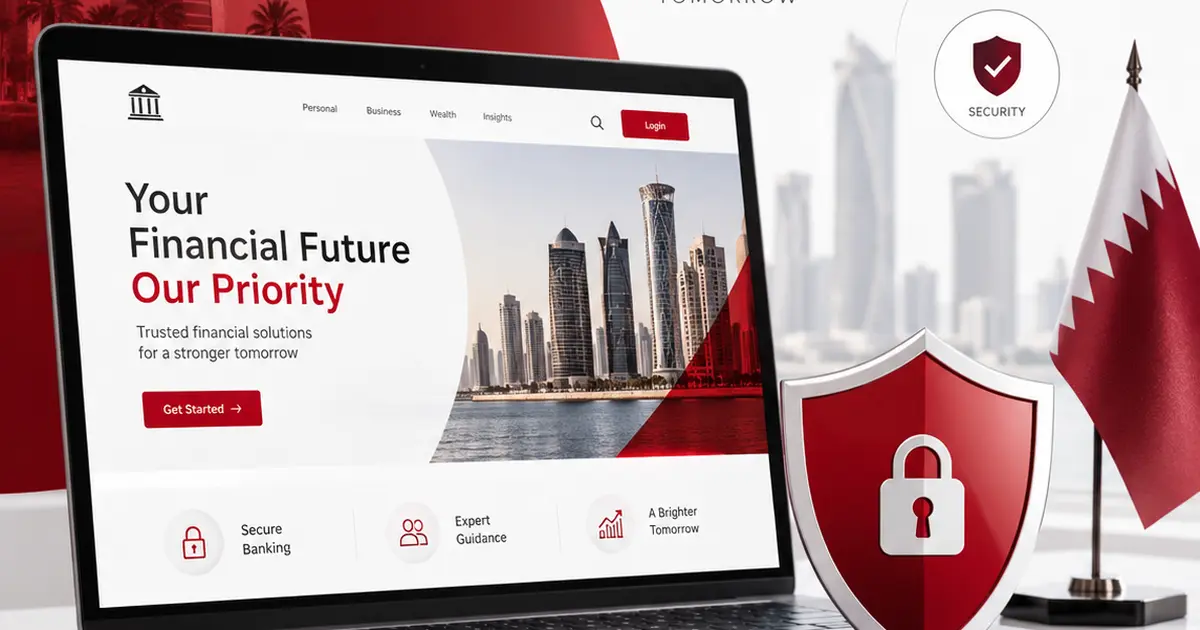
In financial services, trust is the entire product. A customer in Qatar rarely opens an account, moves savings, or signs a financing agreement without first studying you online. Even before they enter your branch in West Bay and engage a relationship manager, they will have already accessed your website and come to a conclusion.
In just a few seconds after arriving on your website, a prospective client assesses whether or not you appear credible and worthy of having their money. This quick assessment is not about appearances for banks, insurers, investment firms, and financial technology companies. It is about whether they believe you can be trusted with their financial life.
In this article we’ll look at how financial services web design in Qatar directly shapes customer trust, and how modern capabilities like dynamic content, respectful behavioral targeting, and smart interfaces are redefining what a trustworthy financial website looks like.
Why Trust Is the Currency of Qatar’s Financial Sector
Qatar’s financial market has a distinctive profile. This includes banks regulated by Qatar Central Bank, a well-developed Islamic financial sector, companies from abroad that have operations in the Qatar Financial Centre, and an increasingly vibrant fintech industry, catering to both Qatari citizens and long-time expatriates and foreign investors visiting the country.
The level of digitalization has been heightened by the government’s digitalization efforts under Qatar National Vision 2030. Customers expect this level of service from all the local institutions through which they perform banking and investment operations via globally acclaimed platforms.
In this environment, trust does double duty:
It drives the numbers. A well-designed financial site converts more visitors into applications, lowers abandonment on account-opening forms, ranks better on Google, and reduces cost per acquisition. Every design decision, from load speed to how you display your licence, has a measurable commercial consequence.
It signals safety. Beyond metrics, design tells people whether their money is in careful hands. A fast, secure, transparent, bilingual site reassures. A dated or clumsy one plants doubt, and in a reputation-driven market like Qatar, where finance runs on referrals and long relationships, that doubt is expensive.
The financial brands winning online in Doha understand both dimensions and design for them deliberately.
The Design Fundamentals That Build or Break Trust
Before any advanced capability, the fundamentals decide whether a Qatari customer feels safe enough to continue.
Speed and reliability. A finance website that fails or crashes comes across as a bank that cannot be trusted. The pages have to load quickly using 5G in Doha, and the website should remain stable even during the peak period, as a problem on a banking website is a matter of trust.
Mobile-first layouts. As most local browsing and a lot of transactions take place on smartphones, the thumb-friendly navigation, buttons, and forms are just a basic requirement rather than an addition.
Bilingual, bidirectional design. Real Arabic and English capability means more than translation. It means layouts that mirror gracefully for right-to-left reading, typography chosen for Arabic legibility, and financial terms written accurately for each audience rather than machine-converted.
Visible proof of legitimacy. This is where financial sites earn or lose trust fastest. Be sure to show your regulation by either QCB or QFC as well as your licensing information, encryption and security measures, Sharia compliance certification if applicable, presence in West Bay, and other partnership or audit credentials.
Transparency. Explicit costs, straightforward terms, and clear descriptions of product offerings help calm a market fearful of being deceived by hidden charges. Financial jargon seems an attempt at disguise to readers.
Effortless, secure pathways. Every key action, from applying to booking an advisor to logging in, should be reachable in one or two taps and visibly protected at each step.
Get these wrong and no advanced technology can rebuild the confidence you lost. Get them right and you have the platform for everything that follows.
Dynamic Content: Accuracy That Keeps Trust Intact
The static nature of financial Web sites causes all visitors to see the same numbers every time they visit; and, in finance, outdated numbers can be deadly. The dynamic nature of content involves compiling content that is seen by each individual visitor.
For a Qatari financial brand, that looks like:
- A bank that displays current profit rates, FX rates, and product terms live, so a customer never acts on an outdated figure.
- Customized dashboard that welcomes back a returning client with their relevant products and steps ahead, as opposed to a standard home page.
- Legal disclaimers, terms and conditions, as well as risks, that are updated centrally, hence ensuring all pages remain legal at the same time.
- Seasonal campaigns, such as National Day Financing offers during Ramadan and so forth, are implemented throughout the entire website instantaneously.
The trust payoff is subtle but powerful. When the numbers are always right and the site clearly reflects today rather than last quarter, customers read the institution as alive, accurate, and in control. Dynamic content turns a financial site from a brochure into a dependable, living channel.
Behavioral Targeting: Relevance Without Overstepping
Most financial web sites are designed based on what the business thinks the customer wants. Behavioral targeting looks at what the visitor is doing and the pages the visitor is visiting.
Done well in a Qatar financial context, it looks like this:
- Relevant guidance. A visitor who reads home-finance pages twice sees mortgage tools and a specialist contact, not a generic form.
- Smarter timing. Prompts and offers appear when engagement signals genuine interest, not the instant someone lands.
- Reduced friction for returning clients. The site remembers language preference and progress through an application, so nobody starts over.
- Predictive pathways. Analytics reveal where applicants hesitate or drop off, and design is refined to answer the next question before it is asked.
Two things matter enormously in finance. First, subtlety: good targeting feels like service, never surveillance. The customer should think “this provider understands my needs,” never “this site is tracking me.” Second, privacy and consent: in financial services the bar is higher, and personalisation must rest on transparent data practices aligned with Qatar’s personal data protection law. A professional web design agency, one that Qatar’s financial institutions trust to do the job right, will ensure that this happens right from the start. The result: a website that doesn’t behave like a brochure but like a very helpful personal advisor who can provide relevant advice without being intrusive.
Smart Interfaces: Removing Friction Without Sacrificing Security
The third frontier is the interface itself. Smart interfaces use AI and automation to make interacting with a financial site feel effortless, while keeping every interaction secure.
For Qatar’s market, the most valuable capabilities include:
Intelligent chat and voice assistance. AI chat resolves routine questions instantly in Arabic and English around the clock, including the enquiry that arrives at 11 p.m. and would otherwise be lost, while sensitive actions are handed to secure, authenticated channels.
Secure, seamless authentication. Login using biometric and multifactor authentication which is convenient but visible in protecting the account helps reassure clients that convenience does not mean compromising on security.
Predictive search. Search that understands intent and surfaces the right product, rate, or document before the query is finished.
Intelligent forms and applications. Forms that pre-fill known information, adapt their questions, and connect directly to your core systems, turning a daunting application into a short, guided task.
Accessibility by design. Financial services can be made accessible to all via AI-supported alt text, structures compatible with screen readers, and adjustable contrast levels.
Continuous optimization. A financial site should not freeze at launch. Ongoing performance tracking and testing refine security, clarity, and conversion over time.
Each capability removes a moment of friction, and in financial services every friction point resolved is also a moment of doubt removed.
Bringing It Together: Trust as Strategy, Not Decoration
This is the difference between the companies that lead the market and those that follow: website design is not superficial – it is a trust mechanism. The surface may be important, but the real questions are structural. Who are our distinct audiences, and what reassurance does each need first? Where do applicants currently abandon the process, and why? What should the site learn from behavior, and how should it adapt within the limits of consent? Which interactions can be made instant and secure instead of slow and manual?
Answering those questions takes a partner who combines design craft with data, security, and local market knowledge, someone who understands Qatar’s audience mix, its bilingual expectations, and the compliance realities of a regulated sector. When assessing web designing companies in Doha, do not judge on portfolio looks alone. Ask how they handle security, privacy, performance, personalisation, and post-launch improvement. The ones who can answer in detail are the ones who will still be earning your customers’ trust three years from now.
Ready to Turn Your Website Into Your Strongest Trust Signal?
Qatar’s financial customers reward the institutions that make things feel effortless and safe at the same time. A website built on strong fundamentals, and elevated with accurate dynamic content, respectful behavioral targeting, and secure smart interfaces, does more than look impressive. It signals that you are dependable, transparent, and worth trusting, and it quietly guides prospects toward becoming clients.