
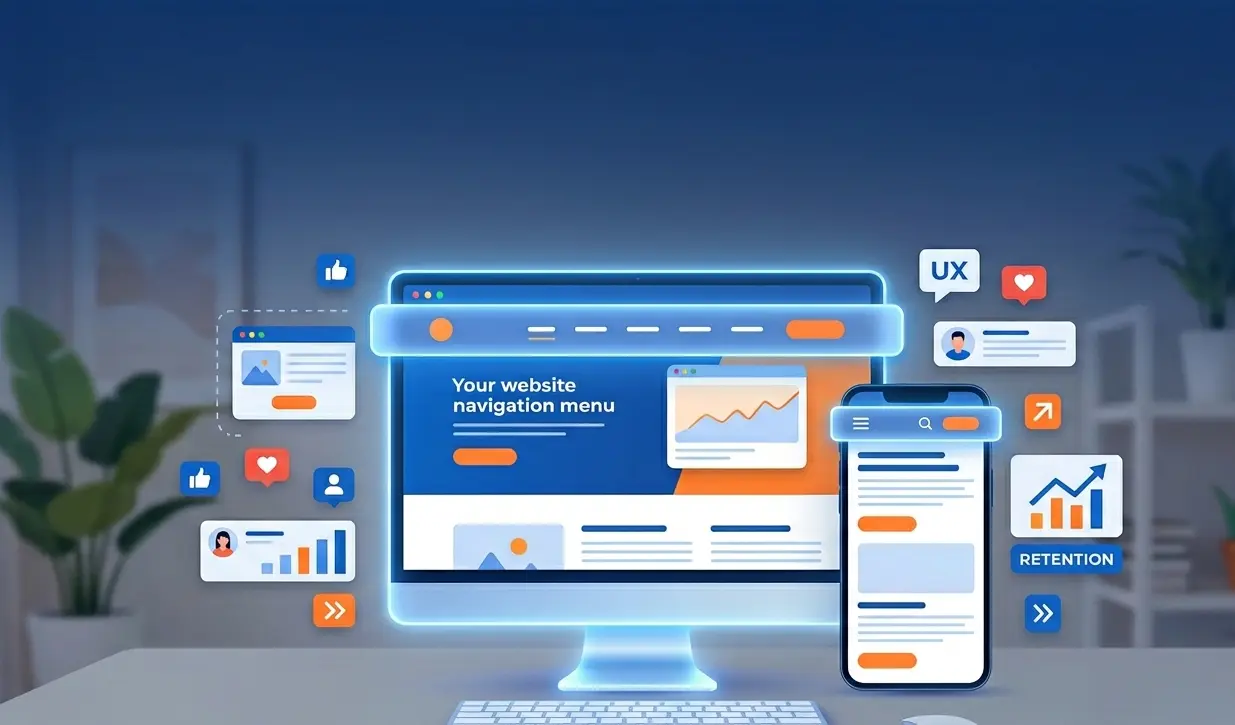
When it comes to such a fiercely competitive digital space, especially in the context of the UAE and the GCC region, it is not unlikely that what keeps businesses around while others leave will simply come down to something as basic as site navigation. Sticky navigation bars have quietly become one of the best UX improvements any business could make, yet when it comes to sites serving customers in Dubai and Abu Dhabi, they have become mandatory.
What Is a Sticky Navigation Menu?
A sticky navigation menu (also referred to as a sticky header or fixed navigation bar) is an interface feature that stays on top or occasionally on the side of the web page while scrolling through a site. The major difference between a regular navigation bar and a sticky header is that the latter is not hidden from the user’s sightline once it has been scrolled away.
Thus, the end result is obvious and easy to achieve – all the critical links, logo, call-to-actions buttons, and branding are literally a mouse click away from the visitor of your site.
Why Sticky Navigation Menus Matter for UAE Websites
The UAE is included among the countries that have high smartphone penetration rates, as over 98% of the UAE’s residents use mobile phones. Mobile browsing involves a lot of scrolling activities, whereby the navigation toolbar is lost after a few seconds once the user starts interacting with the content.
For businesses investing in web design in UAE, this creates a direct UX problem: users who want to navigate to another page or click a “Contact Us” button must scroll all the way back to the top. That friction costs you conversions.
22% Average increase in page views with sticky navigation enabled
48% Faster task completion for users with fixed headers vs. static ones
36% Reduction in bounce rate reported after implementing sticky menus
3.1× More CTA clicks recorded with always-visible navigation buttons
This indicates a worldwide trend; however, its effect is more pronounced in regions such as Dubai, where website visitors have extremely high expectations regarding digital user experience due to their familiarity with superior applications and websites. Website navigation UX has become a crucial part of a company’s branding strategy in the UAE.
The Psychology Behind Sticky Menus
Good UX design is rooted in how the human brain works. Cognitive load, the mental effort required to interact with a system is the enemy of conversion. When users must remember where the navigation is, scroll back up to access it, or hunt for a button they’ve already seen, their cognitive load spikes. And with it, their frustration.
A sticky navigation menu eliminates this entirely. Navigation is always in the right place. It is because of this that websites with fixed headers always perform better than websites without them.
“Navigation is the heart of any website. It’s like being lost in the middle of an amazing experience.”
In addition to reduced cognitive load, sticky headers help establish brand identity as well. Your brand logo, brand color scheme, and main CTA button always stay prominent and help build familiarity with your brand.
Key UX Benefits of Sticky Navigation for UAE Businesses
1. Reduced Bounce Rate
If people enter a page and cannot figure out how to navigate right away, they will exit the site. Having a sticky header that guides them through the structure of your website helps them feel comfortable exploring it further. In the case of ecommerce platforms, property listing websites, or other services provided by Dubai-based companies, this is directly translated into better dwell time and fewer abandoned visits.
2. Improved Accessibility
Having a sticky header helps people with disabilities, especially those who navigate the web using the keyboard. It is essential due to the growing trend of adopting accessibility standards on UAE website UX design (WCAG 2.1).
3. Higher Conversion Rates
When your “Get a Quote,” “Book Now,” or “Shop” button is permanently visible in the sticky header, click-through rates climb. Users don’t need to think about where to go next; the path is always right there. This is one of the most reliable ways to increase conversions on any Dubai web design sticky menu implementation.
4. Better Mobile Experience
On mobile devices which account for the majority of web traffic across the UAE users rely almost exclusively on the navigation bar for orientation. It is important for sticky headers to be present on mobile devices since this is the norm and expectation. Properly designed sticky navigation headers give your website a professional touch irrespective of screen size.
5. SEO Indirect Benefits
Given Google’s Core Web Vitals and their emphasis on user experience, engagement parameters such as dwell time, page sessions, and bounce rate have become important determinants of how search engines index your site. Sticky headers contribute towards increasing these values and therefore become an important consideration in the UAE SEO for sticky headers process.
Sticky Navigation Best Practices for UAE Web Design
Not all sticky menus are alike. A poorly designed one could even make your user experience suffer by using up too much vertical space or intruding visually in some way. These are elements you need to pay attention to:
- The header should be small, not exceeding 60–70px at the most on desktop, 56px on mobile
- It should have a solid background when users scroll down, rather than a transparent one
- There should be a drop shadow or border to help distinguish the header from the main content
- Implement a smart sticky header that becomes visible when users scroll down and hidden when they scroll up
- Always include your primary CTA button in the sticky header not just logo and links
- Test on both iOS Safari and Android Chrome, as rendering differences are common
- Make sure that the sticky navigation bar doesn’t cover any anchor points by adding scroll-margin-top in the CSS.
- Provide RTL support for Arabic language websites of the UAE.
Smart Sticky vs. Always-On Sticky: Which Is Right for You?
There are two main variants of sticky navigation worth understanding:
Always-on sticky headers remain fixed at all times. Most suited for content-rich web portals and software-as-a-service websites, including multi-sectional health directories, government portals, or even business web portal designs typical of UAE enterprise web portal designs.
The smart sticky header feature hides while scrolling downwards (to enable maximum viewing of content) and reappears once the user scrolls upwards, showing that they want to navigate the website. The technique has been the recommended trend for e-commerce and media websites designed for UAE audiences seeking seamless mobile app-like experience.
Real-World Impact: Before and After Sticky Navigation
Take, for instance, an average UAE real estate web site. The user lands on a page that offers everything, from pictures to floor plans and prices, in perfect presentation. But for the purpose of making inquiries, the user has to scroll through an additional 1,200 pixels of content. However, with the help of sticky navigation, more visitors will make enquiries due to a constantly visible “Book Viewing” button.
This scenario applies everywhere else too. Whether it is hospitality companies based in Dubai, retail companies that use their websites to conduct regional e-commerce, or service-oriented governmental sites in Abu Dhabi and Sharjah, they are all likely to benefit from sticky navigation.
Sticky Navigation and Core Web Vitals
A legitimate worry for developers about sticky headers has been whether they negatively affect page performance, particularly in terms of CLS score, which measures visual instability. The answer: When done right using CSS position: sticky or position: fixed (while reserving layout space for the sticky element), sticky headers have no detrimental effects on CLS whatsoever. They even serve as positives when it comes to INP (the latest Core Web Vital).
Frequently Asked Questions
What is a sticky menu in website design?
A sticky navigation menu refers to a website header which does not change its position on the page while scrolling down. It keeps the user’s navigation options and CTAs always visible and does not require him/her to scroll back.
Does a sticky menu contribute to SEO in the UAE?
Indirectly. The presence of a sticky navigation bar results in an increase in session duration and decrease in the bounce rate and pages per session. It has a positive effect on Google search rankings and proves to be beneficial to UAE-based businesses using competitive keywords.
Is it useful to have a sticky header on mobile websites?
Certainly. Users scroll even more often on mobile devices and there are no other ways to navigate the page without a sticky header.
How does sticky navigation lower bounce rate?
Since navigation stays on top all the time, sticky menus ensure that there is little effort required by users to navigate other webpages. When a user would have left after hitting the scroll bar, he or she can visit different pages in one single click, reducing the bounce rate.
What is the difference between sticky headers and fixed headers?
Despite appearing to be the same things in a number of cases, fixed headers refer to CSS position:fixed, implying that it sticks to the window regardless of how far the user scrolls on the site, while sticky headers imply CSS position:sticky. Both of them stick to the top of the page.
Conclusion: Make Your Navigation Work as Hard as Your Content
Sticky menu navigations are one of the most obvious examples of ROI in web designs. These are easy to create, have an instant impact on browsing experiences, and are based on the way actual users interact with websites in 2026, especially when using their smartphones in the UAE’s advanced digital economy.
Whether it’s an online shopping site, real estate listings, a corporate website, or even a website related to the government, a sticky header menu will help increase engagement rates, improve conversion rates, and drive user interaction through ease of navigation.
It all comes down to this – the best websites offer not just good content but also provide an easy way of navigating through said content. And this can only be accomplished through the use of sticky menus.