
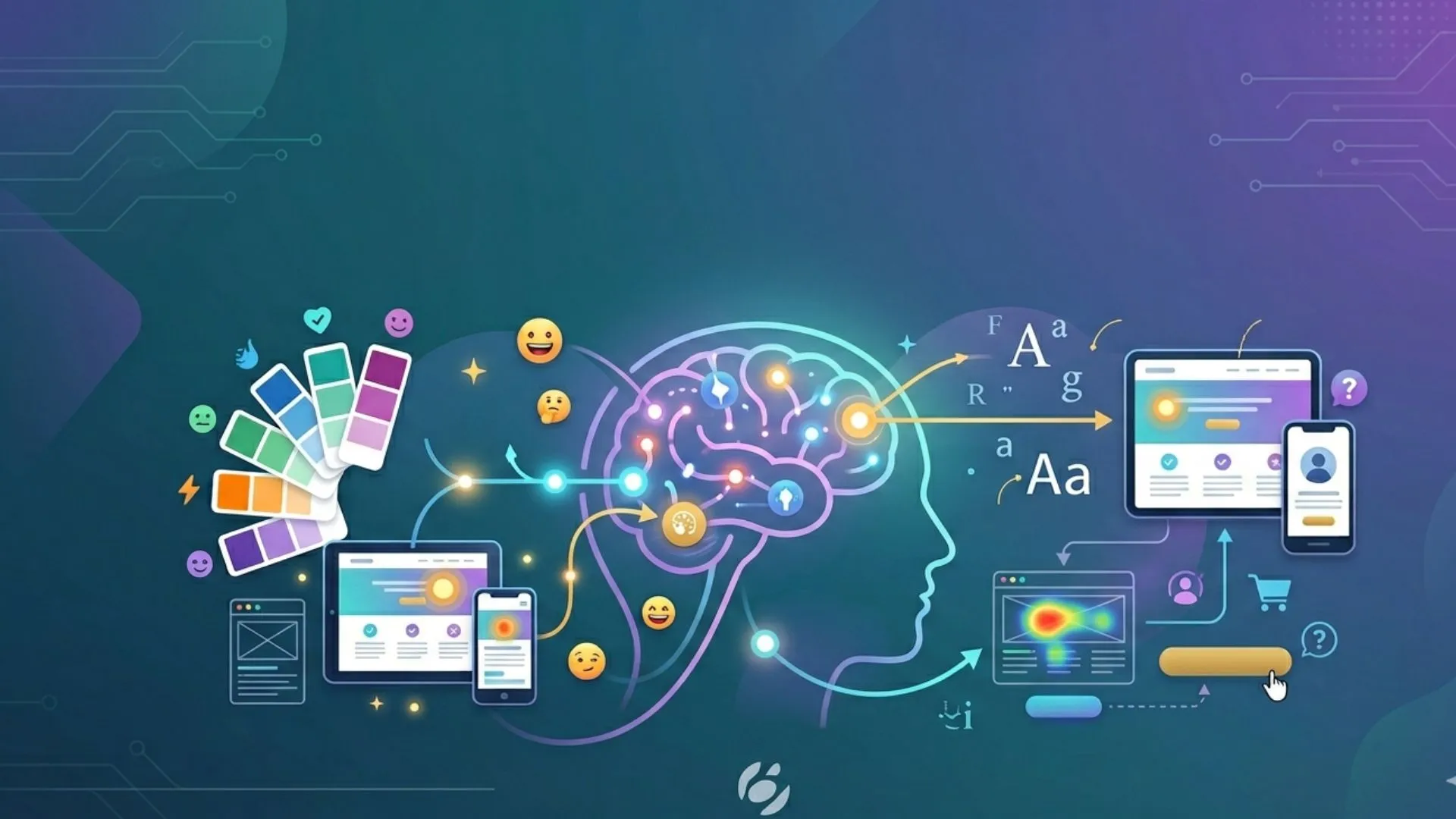
Have you ever come across a website and immediately felt like you could trust it, or immediately moved away? This has not occurred accidentally. It is the result of carefully applied web design psychology principles that quietly played on your emotions and decisions without you even realizing it.
Whether you are a startup in Dubai or an established e-commerce brand in Abu Dhabi, understanding how web design and user behavior interact is the single most underrated competitive advantage in digital business today.
1. First Impressions in Milliseconds
Studies in User experience psychology in web design show that users form a first impression of your website in the first view itself. That is about less than 59 milliseconds, just faster than the blink of an eye. In that fraction of a time, your visitor already decided to continue or drop and look for other professionals.
That is, your web design on conversions starts the moment your page appears to the users eyes. Poor visual hierarchy, clumsy layouts, or outdated designs immediately pass the low values of trust and quality – even if your product or service is excellent.
This is a very important factor for the businesses investing in website designing in UAE. The UAE market is digitally advanced – consumers already experienced polished, intuitive, and visually compelling websites from the very first glance.
2. Color Psychology: Beyond Aesthetics
Color is one of the most prime factors in the psychology of web design. It is not only to make your website look good but also actively triggers emotional responses that affect decisions. Here is what the science tells us:
- Blue builds trust and reliability – Most of the banks, tech companies, and healthcare brands go for it.
- Red creates urgency and excitement – perfect for upscaling the sales, CTAs, and exciting offers.
- Green conveys safe, healthy, and positivity- commonly used for buyer intents.
- Black promotes luxury and exclusivity – ideal for premium product websites.
Choose your web color and brand color palette with strong intention – not just personal color preference. Every color on your page is a silent factor to the visitor to lead.
3. Visual Hierarchy Gives the Direction to the Eye and the Brain
Visual hierarchy is the careful placements of design elements in a way to bring the user’s attention from the most important area to least important part. It is one of the basic web design psychology principles that can go wrong with small flaws but succeed when done right.
When visitors come on your website, their eyes follow a skimming method in a way of F or Z. The right conversion oriented web design anticipates this behavior and places key messages, CTAs, and trust signals exactly where the user’s eye falls naturally.
That is, your headline should be the largest element on the page to get the first attraction, your CTA button should be picky sharply with its surroundings, and enough white spaces to give a breathing space for the user to process information without feeling full.
4. The Principle of Social Proof and Trust Signals
Humans are wired to follow the crowd. When users see that others have already bought the product, reviewed the services, or endorsed your thing, their psychological risk assessment lowers drastically.
Effective trust signals endorsed in web design include: customer testimonials displayed clearly above the fold, star ratings and reviews on product pages, client logos for B2B brands, and security badges until checkout.
For companies focused on website designing in UAE, localizing these trust signals is very important. Showcasing UAE-based clients, Arabic-language testimonials, and region-specific certifications influence directly to local buyers’ brain – making them feel considered and valued.
5. The Choice: Less Is More
One of the most flabbergasted web design psychology principles is that giving users fewer hand picked choices often leads to more conversions or sales. Psychologist Barry Schwartz’s “paradox of choice” theory explains it perfectly: when people are presented with too many options, they feel full, leading to no decisions and often opt out entirely.
You can see this in Amazon’s product pages that they simplify checkout to a single ‘Buy Now’ button. That is why top SaaS companies use minimalist pricing pages that end in a maximum of two folds or pages. So most of the sales oriented web pages avoid clumsiness and follow minimalism.
The thumb role: every page on your website must be a goal focused. Navigation, layout, and content should all support that single goal – nothing else.
6. Speed, Loading Time, and the Psychology of Patience
Website speed is not just a technical issue but at the same time a psychological issue. Research shows that 53% of users will leave a site that takes a long time to load: precisely more than 3 seconds. That is not due to impatience and just because of the value of time.
Slow loading times don’t just frustrate users – they directly undermine trust. When your site lags, the subconscious message it sends is: this brand doesn’t care about my experience. For brands investing in website designing in UAE, where users are accustomed to world-class digital experiences, a slow website is simply not an option.
7. Typography: The Voice Behind Your Brand
Typography is one of the most overlooked aspects of web design psychology. Your website’s fonts communicate personality, credibility, and emotion before the service or products’ information convey. For example Serif fonts feel authoritative and traditional that is ideal for legal, financial, or heritage brands. At the same time Sans-serif fonts are modern, clean, and smooth, normally better suited to tech or lifestyle brands.
Beyond style, readability drives conversions. The text color, brightness, line spacing, and letter spacing are highly mattered because the user’s brain registers it as too effortful or too easy at first glance.
8. Design For Emotions: Making Special Feel
People don’t make decisions not just purely on logic . They make them primarily based on emotion and then justify it with logic later on. This is a deepest insight in user experience and customer behavior in terms of web designs.
Emotional design means crafting every visual and written element to share a special feeling: excitement, trust, aspiration, belonging, or need. The real heroic images create empathy. Micro-animations such as hover effects and smooth scroll add delight. Error messages written with warmth and fun reduce frustration and change the emotion.
When users feel delighted on your website, they stay longer, trust, buy and visit again. The emotional experience of your site slowly transforms to your brand experience.
Conclusion: Design Is Strategy
The psychology of web design is not a good one. It is the real backbone of every high converting website. From the color palette you choose to the fonts you prefer, from the placement of your CTA button to the page load speed, every element in the web design is either attracting your users or pushing them away to other websites.
For businesses in the region, especially those looking at professional web designing agencies in UAE, working with a team that understands both design needs and behavioral psychology will create the difference between a website that looks great and a website that actually grows your business.