
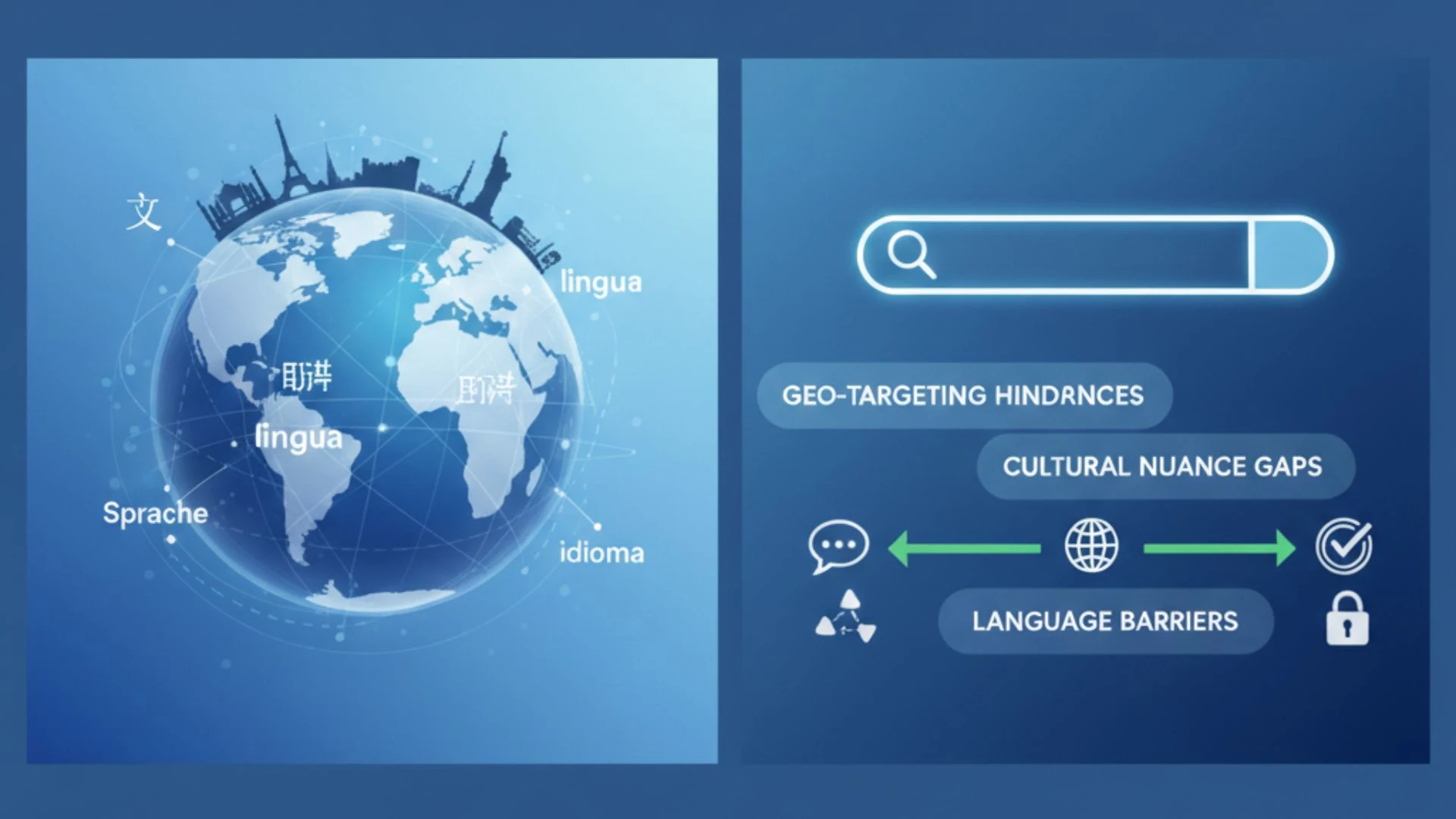
The Multifaceted Challenges in SEO with Multiple Languages
Strategies to overcome multilingual SEO challenges in 2026 focus on intent and technical signals, rather than simple errors in translation. As with any online content, having content in multiple languages does not guarantee visibility or accessibility. What search engines value today is depth of local relevance. For many developing brands, the largest obstacle is to keep distinct content for a region from competing with itself.
Issues like “index bloat,” where search engines expend crawl resources over redundant translated pages, can drain your crawl budget and reduce your site authority. With AI search engines, you must also meet cultural and emotional user needs. For a web design dubai company serving the Middle East, this means offering more than low-quality translations into Arabic. It requires understanding the cultural nuances, dialects, and Gulf country-specific search patterns and behaviors.
Strategic Framework for Multinational Website SEO
A successful multinational website SEO strategy should integrate your global brand with local customers. By 2026, the SEO for multi-region sites architecture should have a technical framework as a primary ranking criterion. Google and subsequent regional search engines have localized search results partly based on clear “locale” indicators.
- URL Structure: When it comes to the URL structure, global leaders in 2026 are predominantly using subdirectories (e.g., /fr/ or /ae/) over subdomains, providing a clear regional user journey. This way, you can also retain your backlink authority with a single domain.
- Server Proximity and CDNs: For effective SEO on multinational websites, using a Content Delivery Network (CDN) is a must. A user in Tokyo shouldn’t have to wait for a server in London to respond. Page speed, a ranking factor for Google, is something that doesn’t care about borders.
- Local Entity Signals: Search engines use local addresses, telephone numbers, and currency symbols to “identify” your area. In structured data, adding these elements helps to establish “Entity Authority” in new markets.
Step by Step Process: Hreflang Best Practices
To avoid diluting search visibility across markets, your website has to have “hreflang” tags, which tell search engines the target language and country of each individual page. This, combined with hreflang best practices, is the only way to ensure that a user in Mexico will not land on the Spanish-for-Spain landing page by mistake.
| Best Practice | Description | Why It Matters for 2026 |
| Reciprocity | If page A links to page B, page B must link back. | Prevents tags from being ignored. |
| Self-Referencing | Each page must include a tag that points to itself. | Confirms the page’s own locale identity. |
| The x-default Tag | A fallback for users whose language isn’t targeted. | Improves UX for global “edge case” visitors. |
| ISO Code Accuracy | Using correct codes (e.g., en-GB not en-UK). | Protects the technical aspect of your SEO from becoming invalidated. |
Maintaining Search Visibility Across Regions
Sustained search visibility across markets requires us to rethink ‘translation’ and move towards ‘transcreation.’ This means you will have to rewrite your primary messaging to fit the cultural context and search behavior of the region. To illustrate, global SEO insights for the UAE show that Dubai users frequently combine English and Arabic terms in the same search.
In 2026, the best SEO for multi-region sites will be those that have “living websites.” In order for your brand to truly “exist” in new markets and to compete for triumph, it is essential to have a blend of novel technical digital PR, localized links, and culture. Global expansion is a marathon, and the winners are those who build a foundation that is as culturally flexible as it is technically precise.